What Makes a Prediction Falsifiable
A prediction is only scientific if there is a specific measurement that would prove it wrong; vague claims that survive any outcome are not predictions.
The test that could kill the claim
A falsifiable prediction names, in advance, a measurement whose result would show the prediction is wrong. If no possible outcome could refute a claim, the claim carries no information -- it is compatible with everything, and therefore says nothing. Every headline number we publish is meant to be falsifiable in this sense.
Ingredients of a falsifiable prediction
- A specific quantity: not 'good performance' but a named number with units.
- A stated uncertainty: the band inside which the prediction counts as confirmed.
- A defined test: the measurement, and the conditions under which it is made.
- A date it was fixed: so it cannot be edited after the result is known.
Applying the test to ourselves
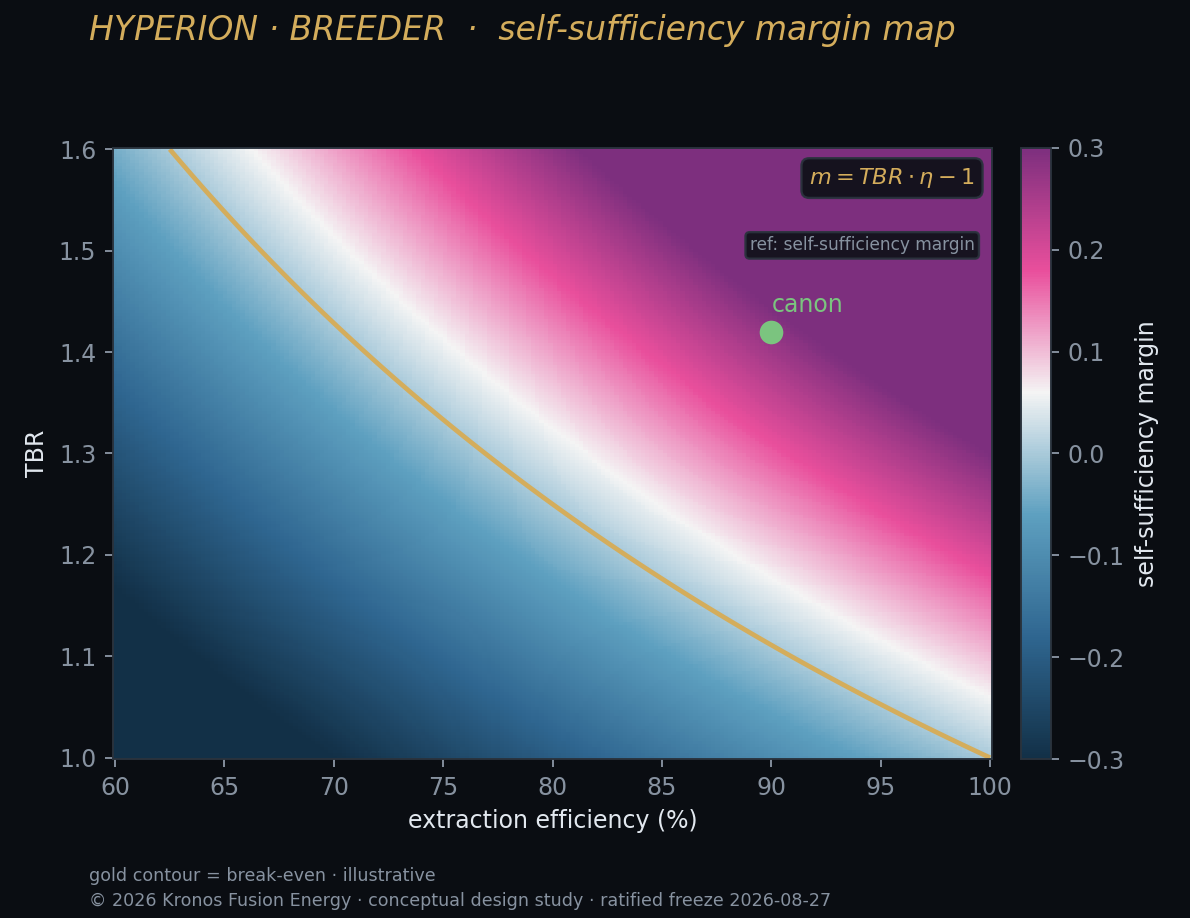
Q_sci 3.076 is falsifiable: FOAK will measure a gain, and a measurement well outside the predicted band with its uncertainty would refute the design. The tritium breeding ratio, carried as a lever across 1.1, 1.5, and 1.8, frames a falsifiable question about self-sufficiency that only integrated operation can settle. Naming the band and the test in advance is what makes these more than hopes.
Falsifiability is a discipline against comfort. It is tempting to phrase claims loosely enough that no result can embarrass them. We do the opposite on purpose, because a claim that risks being wrong is the only kind that can earn being believed. A field littered with unfalsifiable claims is a field where nothing can ever be settled; committing to specific, refutable numbers is how a design study earns the right to be argued with, and eventually, to be proven.