Tritium Breeding Ratio as a Design Lever
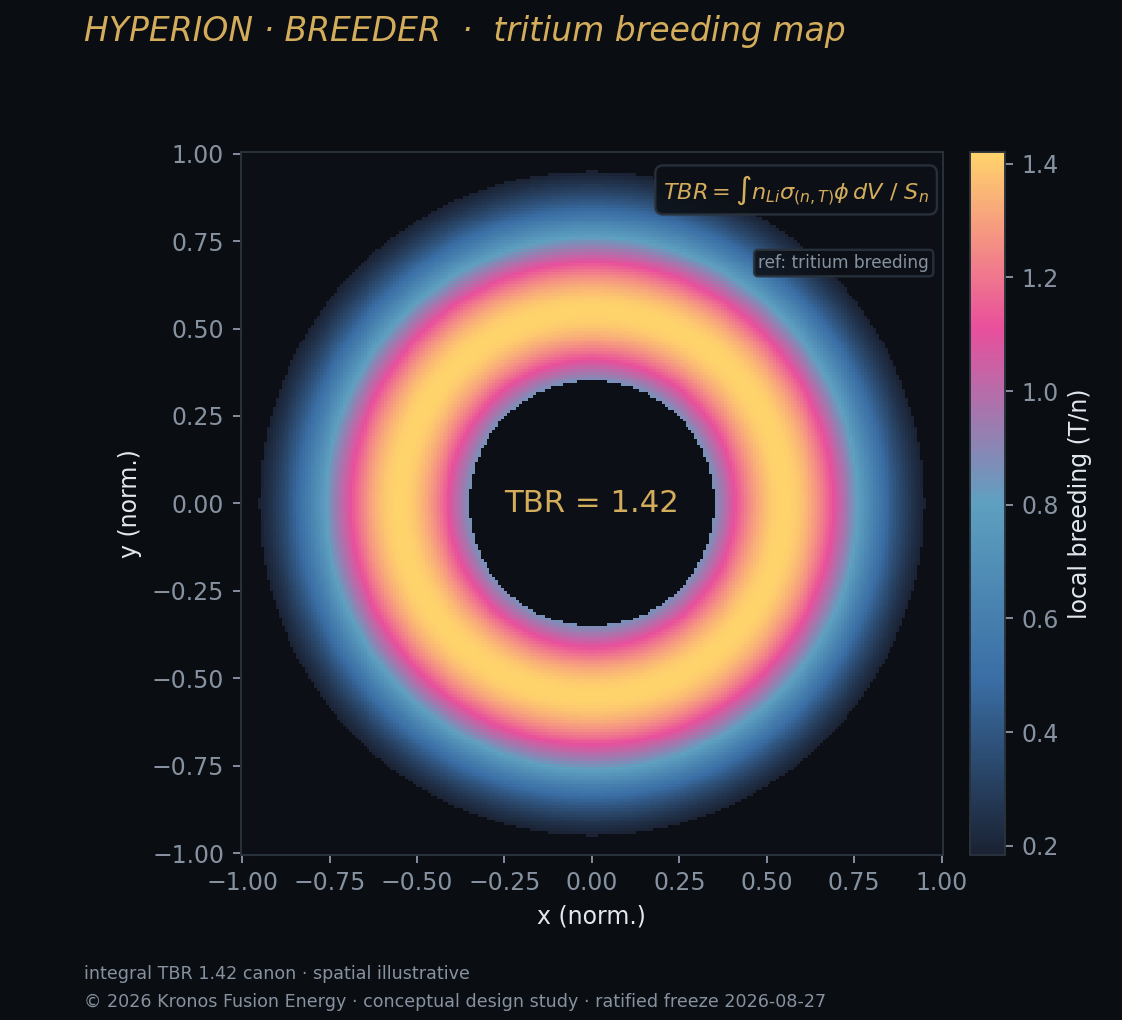
Kronos reports the breeder's tritium breeding ratio as a scanned range — 1.1, 1.5, 1.8 — not a single flattering number, because the real value must be measured.
Why TBR is a range, not a fact
The tritium breeding ratio (TBR) is how much tritium a D-T machine's blanket breeds per tritium consumed. Above 1.0 the machine can sustain its own fuel and produce a surplus. The real TBR of a physical blanket depends on geometry, materials, and neutron transport that only a built blanket settles. So Kronos treats TBR as a design lever and reports it across a range.
What the scan shows honestly
- TBR 1.1 — a conservative, near-self-sufficient case
- TBR 1.5 — a mid case with meaningful surplus for products and startup inventory
- TBR 1.8 — an optimistic case; we flag it as such, and note a local-versus-net reconciliation is open
The discipline
Reporting a single high TBR would make the tritium and helium-3 product story look settled when it is not. Reporting the range, with assumptions, lets a reader see how sensitive the product outputs — the ~4 kg/yr tritium class and ~1.97 kg/yr helium-3 — are to a number nobody has yet measured in a physical Kronos blanket.
When a blanket is built and its breeding is measured, the scan collapses to a value with error bars, and the range is retired in public.