Equilibrium Reconstruction as an Inverse Problem
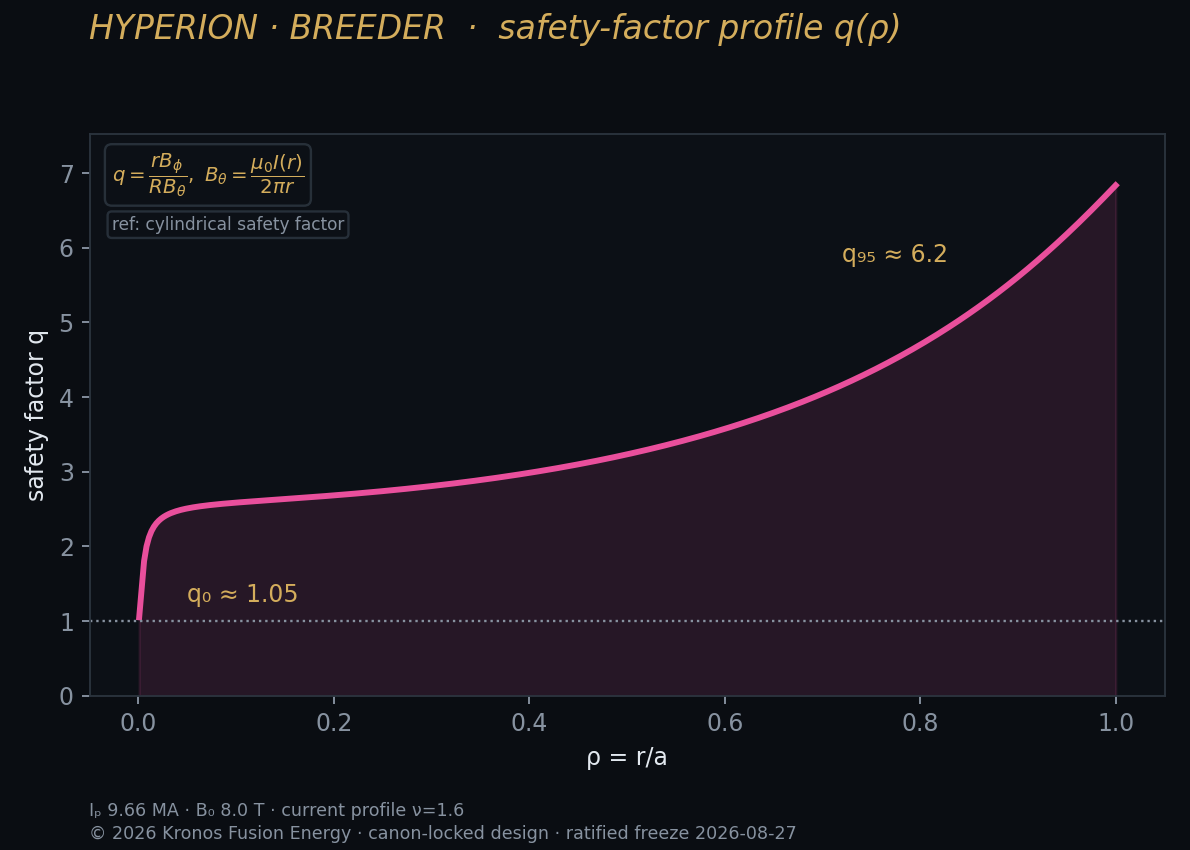
Real-time reconstruction fits a Grad-Shafranov solution to magnetic and kinetic diagnostics, an ill-posed inverse problem regularized and accelerated for the control loop.
The reconstruction problem
Equilibrium reconstruction infers the internal flux distribution psi and the free profiles p'(psi), F F'(psi) from external measurements: flux loops, Mirnov coils, and kinetic diagnostics such as Thomson scattering and interferometry. It is the breeder's most fundamental state-estimation task, feeding the KRONOS-CTRL twin and every shape and stability calculation.
Constrained least-squares (EFIT-style):

  minimize   sum_m  ( (M_m[psi] - d_m) / sigma_m )^2  +  R[psi]
  subject to Delta* psi = -mu0 R^2 p'(psi) - F F'(psi)   (GS constraint)

  M_m[psi] : predicted value of diagnostic m (linear in psi)
  d_m      : measured value ,  sigma_m : uncertainty
  R[psi]   : regularization on profile smoothness
Why it is ill-posed
External magnetic measurements constrain the plasma boundary and total current well but the internal current profile only weakly - many internal profiles fit the same external signals. This is the classic magnetics-only degeneracy. Adding kinetic constraints (pressure from Thomson, density from interferometry, current direction from motional Stark or polarimetry) and profile regularization breaks the degeneracy.
# Gauss-Newton reconstruction step (schematic)
# unknowns: basis coeffs for pprime(psi), ffprime(psi)
for it in range(max_it):
    psi   = solve_GS(pprime(c), ffprime(c))     # forward solve
    r     = (predict(psi) - d) / sigma          # weighted residual
    J     = jacobian_predict_wrt_c(psi, c)      # sensitivity
    dc    = solve( J.T@J + gamma*Reg, -J.T@r )   # regularized GN
    c    += dc
    if norm(dc) < tol: break
Real-time acceleration
A full Gauss-Newton reconstruction is too slow for the fast control loop. The stack keeps the rigorous solve as ground truth and runs a PINN-based reconstruction that maps diagnostic vectors directly to psi and profiles in one forward pass, retrained against the offline solver. The PINN carries the Grad-Shafranov residual so its output is a physically admissible equilibrium, not just a regression fit.
- Inputs: flux loops, Mirnov coils, Thomson, interferometry, coil currents.
- Outputs: psi(R,Z), p'(psi), F F'(psi), boundary shape, q profile.
- Guarantee: GS residual bounded, so reconstructions are admissible equilibria.
- Confidence: per-region uncertainty from diagnostic coverage and residual.
Reconstruction confidence is reported, not assumed: where diagnostic coverage is sparse the uncertainty widens and downstream MPC enlarges its margins accordingly.