The Grad-Shafranov Equation
The breeder's axisymmetric equilibrium reduces to a single nonlinear elliptic PDE for the poloidal flux, and every equilibrium tool in the stack solves or inverts it.
Force balance in an axisymmetric plasma
For a static, axisymmetric magnetized plasma the ideal-MHD force balance J x B = grad p, combined with Ampere's law and the divergence-free magnetic field, collapses to one scalar equation for the poloidal flux function psi(R,Z). This is the Grad-Shafranov (GS) equation. It is the single most-used equation in the breeder stack: the KRONOS-CTRL twin, PINN equilibrium solvers, and real-time reconstruction all rest on it.
Grad-Shafranov equation (poloidal flux psi(R,Z)):

  Delta* psi  =  -mu0 * R^2 * p'(psi)  -  F(psi) * F'(psi)

with the elliptic (Shafranov) operator

  Delta* psi  =  R * d/dR( (1/R) * dpsi/dR )  +  d^2psi/dZ^2
              =  d^2psi/dR^2 - (1/R) dpsi/dR + d^2psi/dZ^2

  p(psi)      : plasma pressure profile (free function)
  F(psi)=R*Bt : poloidal-current / toroidal-field function (free)
  ' = d/dpsi ,  mu0 = 4*pi*1e-7
The two free functions
The right-hand side depends on psi only through two free profile functions, p'(psi) and F F'(psi). Physically these encode the pressure gradient and the toroidal field/current. The problem is nonlinear because the source depends on the unknown solution through psi. In the breeder these profiles carry the negative-triangularity, high-field (16.84 T peak, 8 T on-axis) operating point at 9.66 MA.
Fields recovered from psi
Magnetic field from the flux function:

  B_R  = -(1/R) * dpsi/dZ
  B_Z  =  (1/R) * dpsi/dR
  B_t  =  F(psi) / R           (toroidal)

Toroidal plasma current density (from Delta* psi):

  J_phi = R * p'(psi) + F*F'(psi)/(mu0 * R)
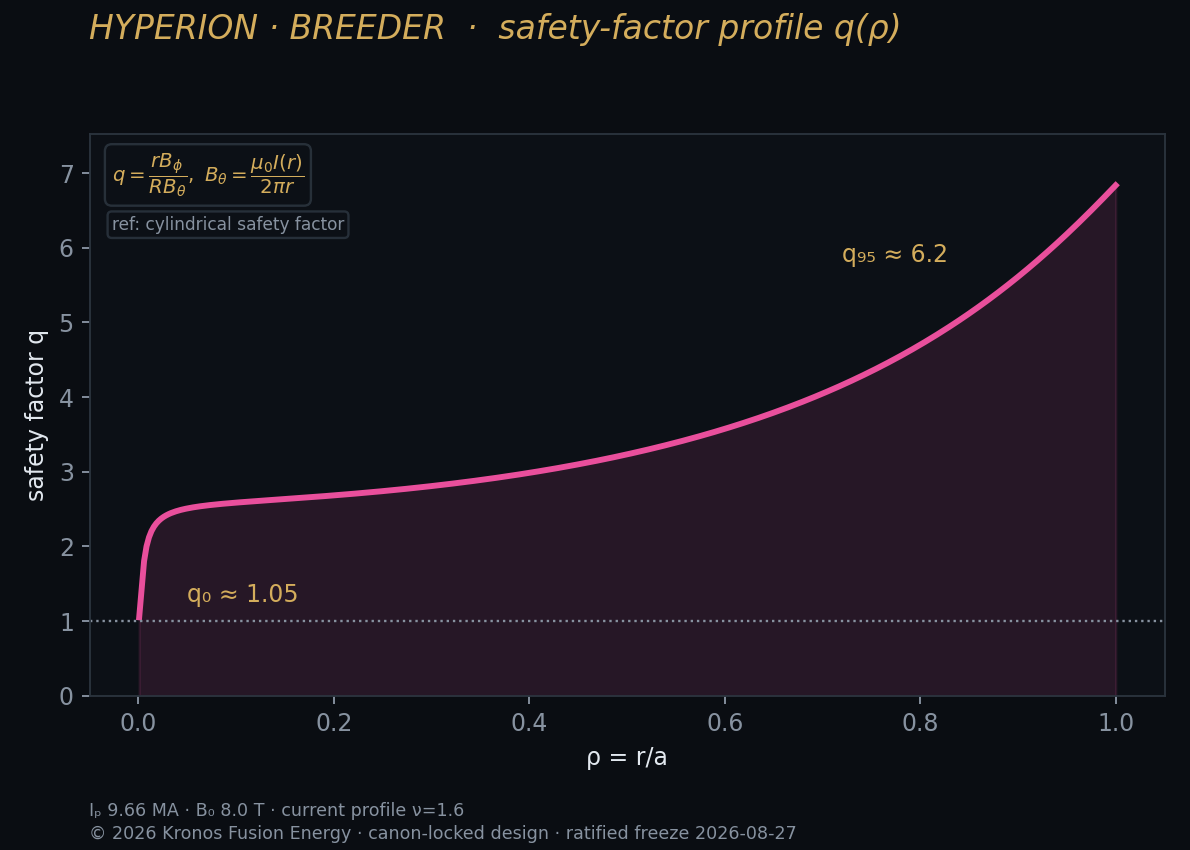
Once psi is known everywhere, the entire equilibrium follows algebraically: flux surfaces are level sets of psi, the last closed flux surface defines the plasma boundary, and the safety factor and current profile are integrals over psi. Boundary conditions come from external poloidal-field coils, which makes the practical breeder problem a free-boundary one, treated on its own page.
Because the operator is elliptic and self-adjoint under the weight 1/R, GS is well suited both to finite-element discretization and to physics-informed neural network solvers, and its structure is what lets a PINN carry the residual directly in its loss.