Tandem-Mirror Equilibrium Mathematics
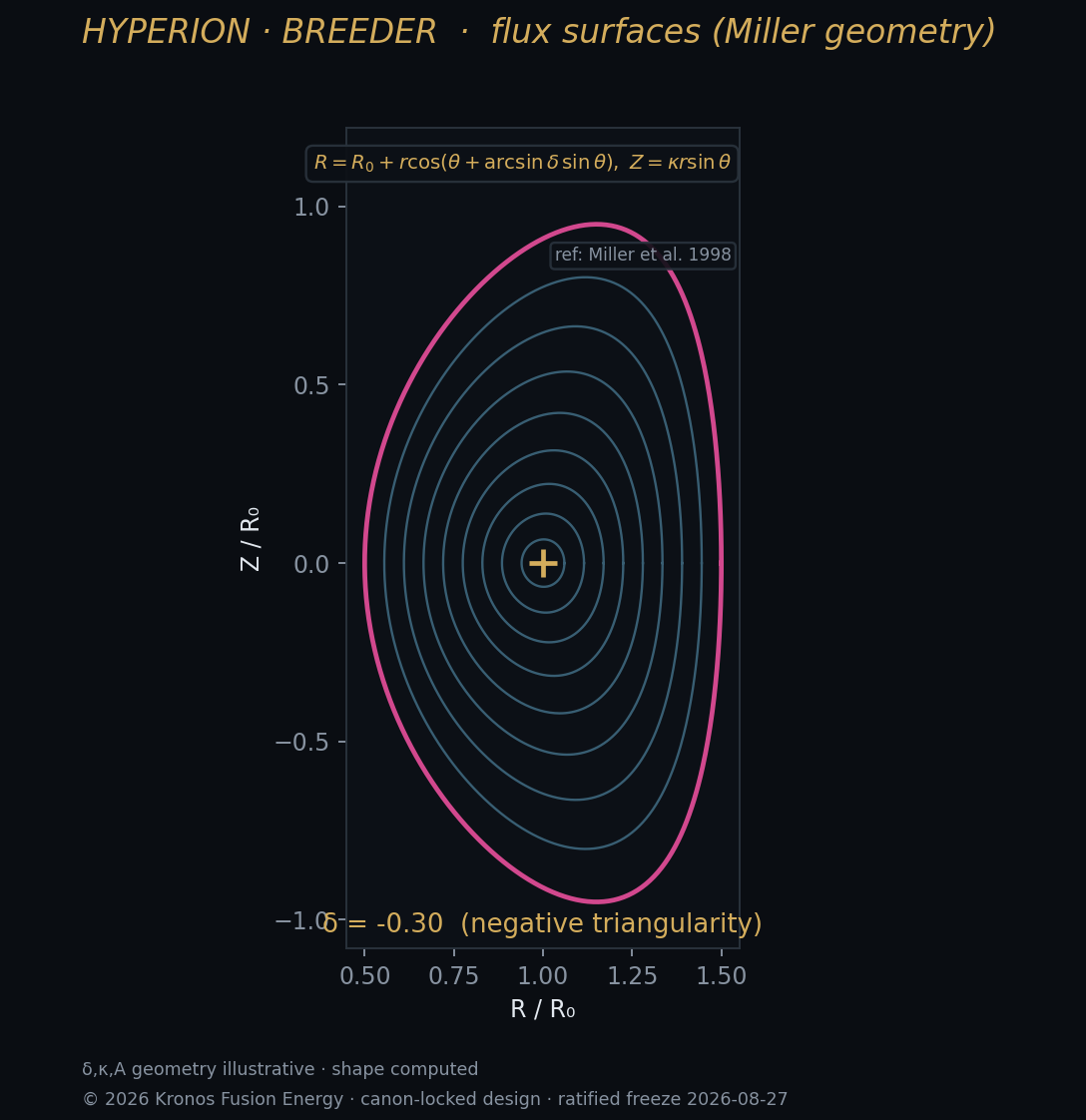
The burner is not a torus; its equilibrium is set by paraxial force balance and mirror confinement along an open field line, a different mathematics from Grad-Shafranov.
Open field lines and mirror confinement
The burner (Aegis / MetroVolt) is a D-3He tandem-mirror generator with a 26.49 T plug and 17 T throat. Its field lines are open, not nested tori, so Grad-Shafranov does not apply. Confinement comes from the magnetic mirror force plus an electrostatic ambipolar potential built by high-field end plugs. The equilibrium mathematics is one-dimensional along the axis in the paraxial approximation.
Magnetic moment invariance and the mirror force:

  mu = m v_perp^2 / (2 B) = const  (adiabatic invariant)
  Energy:  (1/2) m v^2 + q Phi = const

  Reflection condition (loss cone):
    particle reflects if  v_par^2 < v_perp0^2 (R_m - 1)
    mirror ratio R_m = B_max / B_min
    Burner: throat 17 T, plug 26.49 T set the mirror ratios
Paraxial force balance
In the paraxial (long-thin) limit, radial force balance across the narrow flux bundle relates plasma pressure, magnetic field, and field-line curvature. The axial variation of B, density, and potential is solved as a coupled 1D system. This replaces the 2D elliptic Grad-Shafranov solve with an axial two-point boundary-value problem.
Paraxial radial pressure balance (schematic):

  d/dr [ p_perp + B^2/(2 mu0) ]  =  (curvature/anisotropy terms)

Axial (parallel) force balance with anisotropy:
  d p_par/dz + (p_par - p_perp) dlnB/dz = n q dPhi/dz

  p_par, p_perp : parallel/perpendicular pressures (anisotropic)
  Phi(z)        : ambipolar electrostatic potential
Why this is an engineering program
The tandem-mirror equilibrium the burner needs sits far outside any built device. The plug operating regime is 166-830x beyond experimental experience, so the equilibrium cannot be post-dicted against data today - it is a simulation construct. The stack treats every burner equilibrium quantity as carrying that extrapolation risk, and reports it, rather than presenting the solve as validated.
- State variables: B(z), n(z), Phi(z), p_par(z), p_perp(z) along axis.
- Boundary data: plug/throat fields (26.49 T / 17 T), end-cell conditions.
- Confinement set jointly by mirror ratio and ambipolar potential.
The same PINN and estimation machinery used on the breeder is retargeted to this 1D axial operator, but the honesty requirement is stronger: with no comparable device, uncertainty bands dominate and are surfaced to every consumer.