Real-Time Equilibrium Reconstruction with PINNs
The equilibrium PINN doubles as a reconstructor, fusing sparse magnetic and kinetic diagnostics into a full flux map at twin cadence.
Reconstruction as an inverse problem
Reconstruction asks: what equilibrium is most consistent with the measurements right now? Classically this is an iterative fit (Grad-Shafranov solved repeatedly to match flux loops, Mirnov coils, motional Stark effect, pressure). Kronos folds the physics and the data into one PINN objective: minimize the Grad-Shafranov residual and the mismatch to L2-validated diagnostics simultaneously.
Because the network already encodes the equilibrium operator, reconstruction is a fast conditioning of psi_theta on the current measurement vector rather than a cold solve. The GNN-imputed diagnostic set feeds the data term, so even with dropped channels the reconstruction stays constrained; the imputation uncertainty widens the effective data-term variance rather than being ignored.
What the twin gets
- Full psi(R,Z) flux map at 50-100 ms shadow cadence
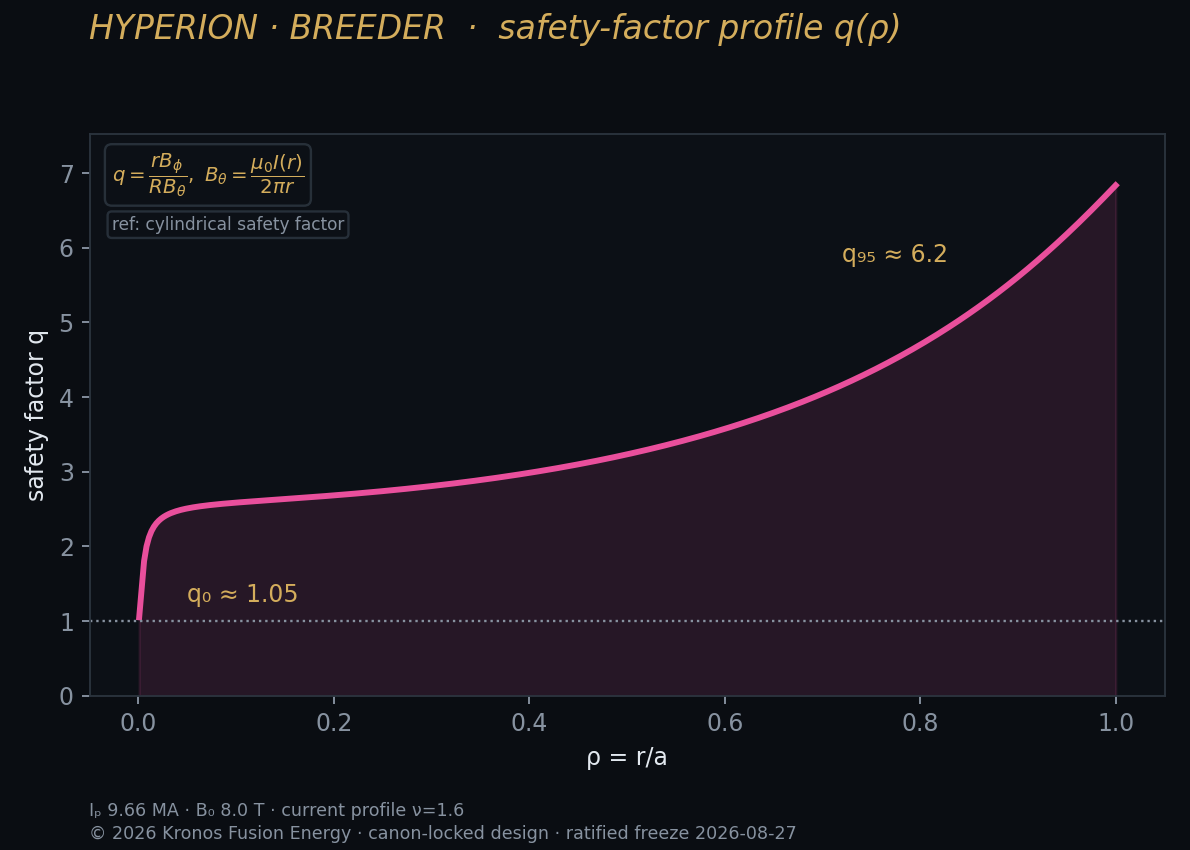
- Derived quantities: q-profile, plasma boundary, X-point, triangularity
- Consistency residual as a self-diagnostic of reconstruction quality
- Boundary and current-profile parameters handed to the stability PINN
The reconstruction reports its own Grad-Shafranov residual as a health metric. If diagnostics are inconsistent (a failing sensor L2 did not catch, or a genuinely off-normal event), the residual rises and the twin lowers its equilibrium confidence rather than presenting a clean but wrong flux map. That honest degradation is what lets MPC widen margins instead of steering on a false equilibrium.
For the breeder, accurate reconstruction of the negative-triangularity boundary and the X-point position is the prerequisite for both shape control and disruption avoidance. The reconstructed triangularity is checked against the design delta -0.30, and drift away from it is flagged.