Quantum Simulation of Neutron-Damage Defects
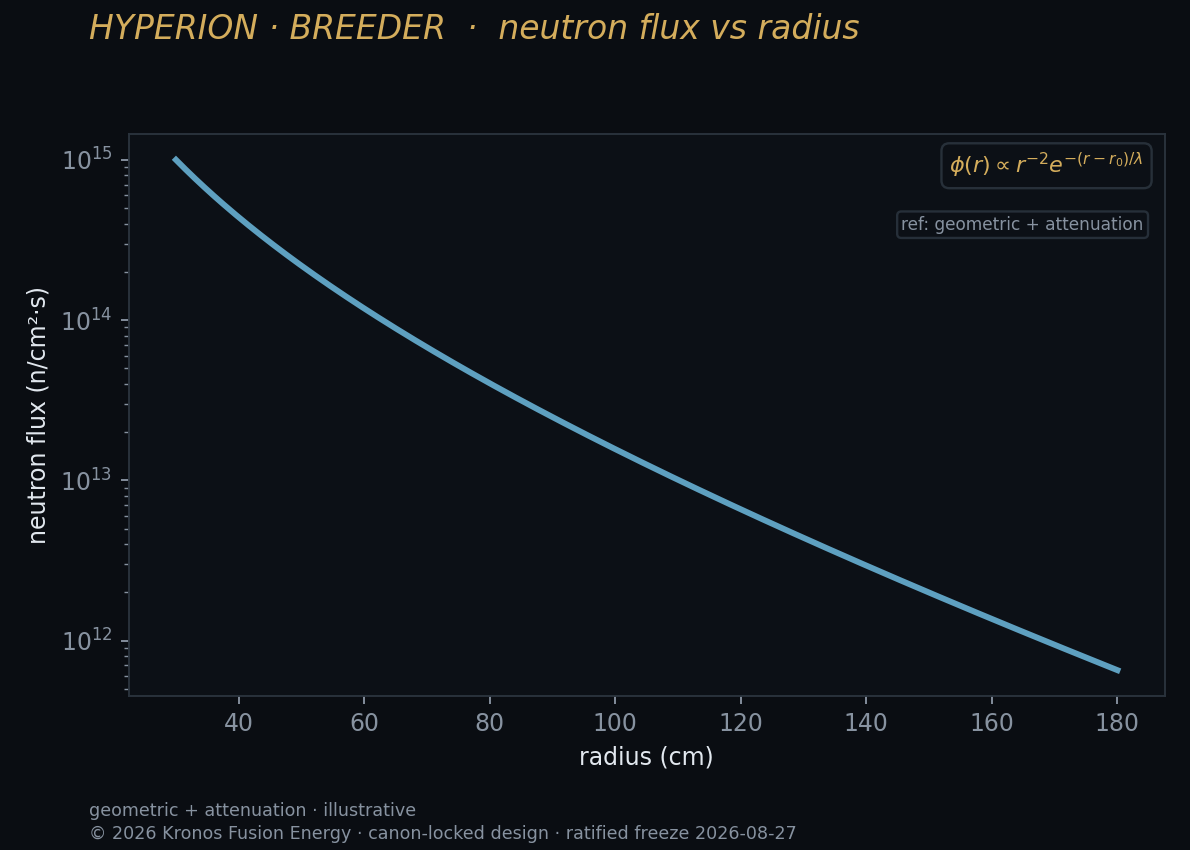
14 MeV neutrons displace atoms and grow defect clusters; their formation energies are correlated-electron quantities quantum simulation targets.
The damage cascade endpoint
Both machines produce fast neutrons: the breeder at 85.0 MW of D-T fusion power with a 14 MeV neutron spectrum, and the burner with a 5.44% neutron fraction from D-3He side reactions. A 14 MeV neutron initiates a displacement cascade that leaves vacancies, self-interstitials, and, through transmutation, helium and hydrogen. The long-term material state is governed by the energetics of the surviving defects.
# Displacements per atom from cascade (NRT-style estimate):
N_d = 0.8 * E_dam / (2 * E_d)
#   E_dam damage energy, E_d displacement threshold (~90 eV for W)

# Vacancy formation energy (electronic-structure ground states):
E_f^vac = E(N-1 atoms, relaxed) - ((N-1)/N) * E(N atoms, perfect)
# open-shell, magnetic transition metals -> correlation-sensitive
Where classical methods wobble
- Helium-vacancy cluster energetics in tungsten, which drive bubble nucleation and surface blistering.
- Magnetic and open-shell configurations at defect cores, where DFT exchange-correlation choices change answers.
- Interstitial hydrogen isotope binding, coupling to tritium retention.
The quantum role, stated honestly
Multiscale damage modeling is overwhelmingly classical: molecular dynamics for cascades, rate theory and kinetic Monte Carlo for microstructure evolution. Quantum simulation would supply only the small set of formation and binding energies where classical electronic-structure methods disagree by chemically significant amounts.
That is a narrow but high-leverage insertion point: a few accurate numbers recalibrating rate models that predict first-wall lifetime across the fleet. It requires accurate ground-state energies via VQE or phase estimation at accuracies that today demand fault-tolerant machines. We validate every quantum estimate against classical references before it informs any material decision.