🎧 Prefer to listen? Open the audiobook
The Long Road to Two Machines
For the whole of human history the nearest fusion reactor sat ninety-three million miles away, and we called it the Sun. Every calorie you have ever eaten, every gust of wind, every barrel of oil is stored starlight — the deferred output of a hydrogen furnace we could see but never touch. To build one of our own, here on the ground — to hold a fragment of a star still inside a cage of magnetism and make it work for us — is the oldest and most audacious ambition in engineering. I did not set out to do it with two machines. Almost no one does. You set out to build the fusion machine — the single reactor that makes clean power and ends our long dependence on fire — and then, if you are honest with your own data, the machine tells you what it actually wants to be. This chapter is the story of how humanity, and then my own team, followed the physics from the dream of one machine to the reality of two. It is a story of dead ends that were not failures, and I want to tell it plainly, because the shape of the answer only makes sense once you have walked the road that led to it.
The tokamak, and the promise of the doughnut
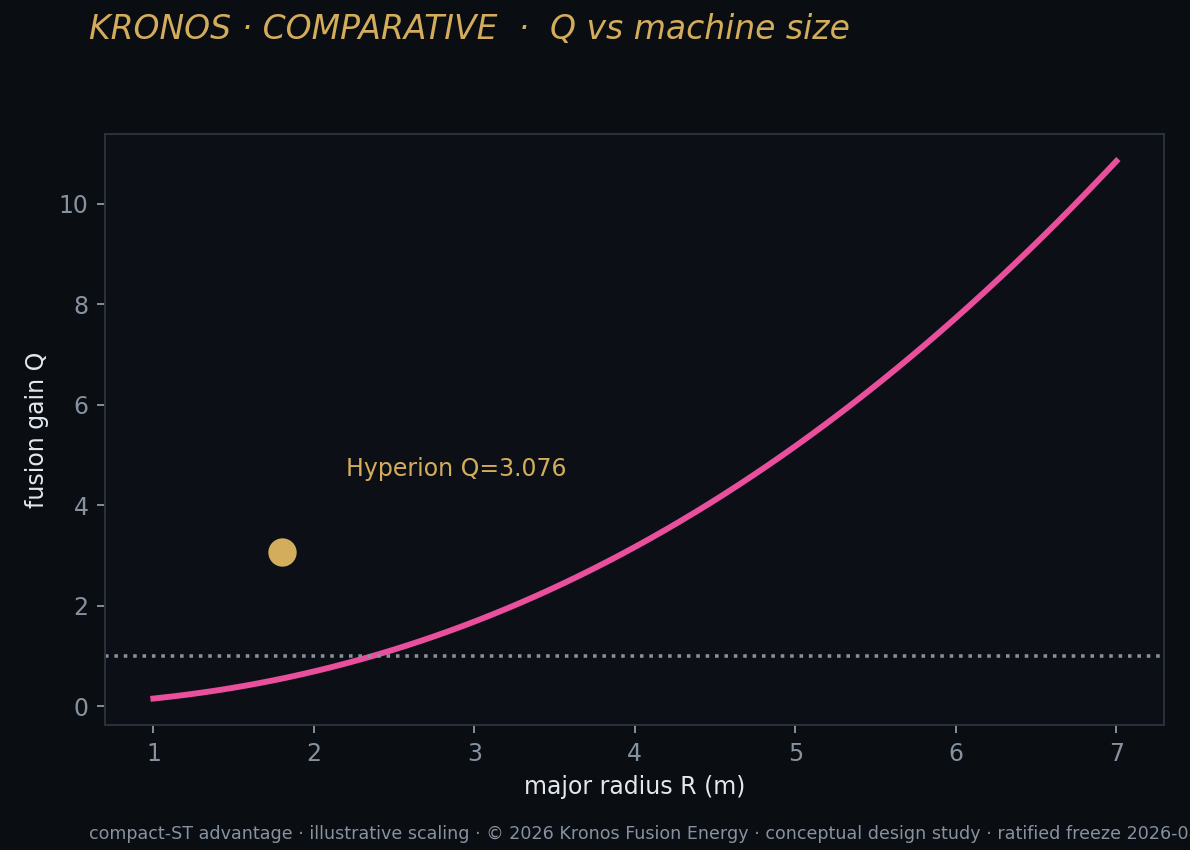
For half a century, the great hope of fusion was the tokamak: a doughnut-shaped chamber that holds a ring of superheated plasma — matter hotter than the core of the Sun — suspended inside a cage of magnetic fields, touching nothing. It is one of the most beautiful ideas the twentieth century produced, and it works — tokamaks make fusion. The world's flagship efforts, the giant international machines, are tokamaks, and they have taught us most of what we know about the delicate art of confining a star.
The conventional path ran on the easiest fuel to ignite: deuterium and tritium, two heavy forms of hydrogen. D–T fusion lights at the lowest temperature of any reaction available to us — its cross-section peaks near conditions we can actually reach, an order of magnitude gentler than any cleaner fuel. That is why every near-term machine reaches for it. If you want a fusion reaction at all, D–T is where you start. So that is where the field started, and where it has largely stayed.
I spent years believing, as almost everyone did, that the road to clean fusion power was simply a bigger, better, hotter tokamak burning D–T. Build it large enough, hold the plasma long enough, and the gain would come. The physics was sound. The trouble was not the physics. The trouble was the neutrons — and the neutron, it turns out, is the ghost that has haunted the fusion dream from the beginning.
The neutron problem nobody can wish away
When deuterium fuses with tritium, roughly eighty percent of the released energy leaves as a single fast neutron carrying 14.1 million electron-volts — an uncharged particle moving at about a sixth of the speed of light. Neutrons are wonderful if what you want is neutrons. They are a serious problem if what you want is a clean, long-lived power plant.
Because it carries no charge, a 14 MeV neutron ignores the magnetic cage entirely. The fields that hold the plasma might as well not exist; the neutron flies straight out of the burning core and buries itself in the first solid thing it meets — the wall. And it does not politely deposit its energy and leave. Consider what a single one of these neutrons does when it strikes the steel of a reactor wall. It does three destructive things at once, and each one is a slow catastrophe.
First, it moves atoms. The neutron slams into an atomic nucleus in the crystal lattice and knocks it clean out of its place, and that recoiling atom then knocks out others, and those knock out others still — a branching avalanche through the metal that ends with thousands of atoms displaced from where they belong. Materials scientists measure this in displacements per atom, DPA: the number of times, on average, every atom in the structure has been kicked out of its lattice site and forced to find a new home. Over a few years of full-power operation, the first wall of a D–T reactor accumulates tens of DPA — meaning every atom in the metal has been knocked loose dozens of times. The metal remembers this. It swells, it hardens, it grows brittle. A wall that began as tough, ductile steel slowly turns into something closer to ceramic, prone to cracking under the very stresses it was built to shrug off.
Second, it transmutes the wall into something radioactive. Some neutrons are not merely deflected; they are absorbed, and absorption changes what an atom is. A stable iron or nickel nucleus swallows a neutron and becomes a different, often radioactive, isotope. The structure that was inert when installed becomes hot with induced radioactivity — activated — so that even after the plasma is switched off, the machine must be handled remotely and its retired components stored as nuclear waste. Worse, some of these reactions spit out helium and hydrogen atoms inside the solid metal. That gas has nowhere to go. It collects into microscopic bubbles along the grain boundaries, and the bubbles pry the metal apart from within, swelling it and embrittling it further. The wall is being both irradiated and inflated at the atomic scale.
Third, it dumps heat exactly where you least want it. All that kinetic energy — 14 MeV per neutron, times an astronomical number of neutrons every second — turns into heat deep inside the wall and the surrounding structure, not on a surface you can easily cool but volumetrically, throughout the material. Managing that buried heat load is its own punishing engineering problem, layered on top of a wall that is simultaneously being displaced, activated, and gas-filled.
Put the three together and the picture is stark. A D–T power reactor is, among other things, a machine for destroying itself from the inside. You can engineer around it — with specially developed low-activation steels, with thick neutron shielding, with a "first wall" and blanket explicitly designed as consumable parts to be swapped out on a schedule as they degrade. But every one of those answers is a cost, and the costs compound in ways that are easy to underestimate from the outside.
Consider the shielding first. To protect the superconducting magnets and the outer structure from the neutron flux, you must wrap the core in enough dense material to absorb it — and neutrons are penetrating, so "enough" means thick, and thick means massive. That mass sits at the largest radius of the machine, where it drives the size, and therefore the price, of everything outboard of it: the magnets that must reach around it, the vessel that must contain it, the building that must house it. A large share of a D–T reactor's bulk exists for no other reason than to stop its own neutrons. Then consider replacement. The first wall and blanket are consumables with a finite radiation lifetime; when they reach it, they must come out. But by then they are intensely radioactive, so no person can enter the chamber. The exchange is done remotely, by machines built specifically for the task, on a plasma that has been shut down for the duration — and every day the plasma is off is a day the plant earns nothing while its capital keeps costing. Downtime, remote handling, and a fresh stream of activated waste to be stored: that is the recurring tax on burning D–T for power.
Remember the second forty: forty dollars a megawatt-hour. A machine that eats its own walls, must carry hundreds of tons of shielding to survive itself, and must be partly rebuilt every few years by robots because no human can go near it, has a very hard time getting under that line. The neutron does not just damage the reactor. It sets a floor under the price of its electricity.
D–T fusion is the easiest reaction to start and the hardest to live with. Almost the entire difficulty of "clean" fusion is the difficulty of the neutron.
So the field has long dreamed of a way out: aneutronic fusion — reactions that release their energy as charged particles instead of neutrons. Charged particles feel the magnetic field. They can be caught, steered, slowed against a voltage, and converted straight to electricity without ever boiling water. An aneutronic plant would be clean in a way a D–T plant can never be, gentle on its own structure, and far cheaper to run for decades because nothing is quietly wrecking it from within. If D–T is the reaction that starts easily, aneutronic fusion is the reaction you actually want to live with.
Why you cannot simply "go aneutronic" in a tokamak
Here is the hard lesson, and it took the field — and me — a long time to accept it.
The cleaner the fuel, the higher the price of admission. Reactions that release little or no neutron energy do not light at tokamak temperatures; they demand conditions far beyond what D–T needs. Where D–T ignites at temperatures already brutal to reach, the near-aneutronic fuels want plasmas several times hotter still, with the density and confinement held in proportion. You are not climbing the same hill a little further. You are climbing a much steeper one, and the reaction only pays out at the top.
And on the way up that hill, a second, quieter enemy is waiting — one that gets stronger exactly as you push toward the temperatures clean fuel demands. It is called bremsstrahlung, "braking radiation": the light a plasma throws off whenever its electrons swerve past ions. Every plasma radiates this way, and the radiated power climbs with temperature and climbs faster still with the charge of the ions in the mix. The energy you pour in to heat the plasma toward ignition is, at the same moment, streaming back out as X-rays.
This sets up a race, and the race is the whole game. On one side is the fusion power the plasma produces, which must stay hot enough and dense enough to keep itself lit. On the other is the radiated power leaking away as light. For a fuel to burn, fusion power has to win — it has to outrun the radiation losses with enough margin left over to sustain the reaction. The single figure that captures the whole contest is the ratio of the two:
fusion-to-radiation ratio = P_fusion ÷ P_bremsstrahlung
>
Above one, the burn can sustain itself; at one, it is on the knife-edge; below one, no confinement can save it.
D–T wins that race comfortably, which is another reason it is the easy fuel. The cleaner fuels win it only in a narrow window, high on the temperature hill — for pure deuterium, the ratio peaks at just 1.589, and only near a punishing hundred-and-eight kilo-electron-volts — and only if almost nothing else is bleeding energy away.
That is precisely where the tokamak fails the clean fuel. Push a doughnut plasma to those temperatures, in the strong twisting fields a tokamak requires, and the geometry itself adds losses on top of the radiation — turbulent transport carrying heat across the field lines, the curvature of the torus driving instabilities. The margin that clean fuel needs is thin to begin with, and the tokamak spends it before the reaction can. The plasma pours its energy away faster than the burn can replace it. The harder you push, the more it leaks. There is a ceiling, and it is not an engineering ceiling you can spend your way through — it is set by the physics of the geometry itself.
This is the dead end that stops the obvious dream. You cannot take the machine that ignites easily — the D–T tokamak — and simply feed it the fuel you wish you could burn. The tokamak is the wrong shape for a clean burn. For years I kept trying to force one machine to do both jobs. I would redesign, re-optimize, add fields, change the profile, and the machine kept refusing, always in the same voice, always pointing at the same wall. I treated every refusal as a problem to be out-engineered. It was not. It was information. Eventually I stopped arguing with the machine and started listening to what it had been telling me all along: that I was asking one shape to do two things physics had made incompatible.
Four things the physics settles before you draw a machine
When I finally stopped arguing, I went back to first principles and worked out what a deuterium plasma can and cannot be made to do — before any choice of shape, field, or size. Four results came out of that exercise, and they are the reason there are two machines in this book and not one. They depend only on the physics of the reactions and the radiation; they hold for any device that burns deuterium, ours or anyone's. I want to lay them out plainly, because they are the load-bearing timbers under everything that follows, and because each one closed a door I had spent years trying to walk through.
First: the clean fuel sits on a knife-edge. Take a pure deuterium plasma — the cleanest fuel there is — and ask whether it can heat itself. The charged particles it makes deposit their energy locally and warm the plasma; the bremsstrahlung streams away as light. Compute the ratio of the two and it peaks, at the best temperature, at about 1.589 — barely above one. We evaluated the self-heating balance four independent ways, and every route landed between 0.984 and 1.121, straddling unity. In plain terms: the clean burn barely breaks even against its own radiation, and every loss channel we then neglected — cyclotron light, transport, the faintest trace of impurity — is strictly negative. There is no comfortable margin to spend. That is the knife-edge, and it is not an engineering problem you can out-build. It is arithmetic.
Second — and this is the one that took a genuine dead end to teach me — you cannot buy your way off the knife-edge with better confinement. For decades the field's reflex, faced with a plasma that leaks, was: hold it longer. Improve the confinement and the gain will climb. For a radiating plasma, that reflex is wrong, and the reason is beautiful in its simplicity. Confinement holds particles and heat; it does nothing to light. Photons leave at the speed of light whatever you do. So as you improve confinement toward perfection, the transport losses vanish but the radiation loss does not — and the gain climbs only to a ceiling set entirely by the radiation balance:
Q∞ = P_fusion ÷ (P_radiation − P_self-heating)
In words: in the limit of perfect confinement, the gain approaches the fusion power divided by the amount the radiation out exceeds the self-heating in. If radiation wins that race even slightly, the gain is finite no matter how well you hold the plasma; it does not go to infinity, it goes to a wall. Asking "what confinement enhancement does a clean-fuel machine need to ignite" is therefore a malformed question — the honest answer is that no amount is enough, because the thing bleeding you away does not care how long you confine what is left. That single realisation is what finally stopped me redesigning the tokamak.
Third: impurity tolerance is not one number. The radiation ratio does not fall as one over the plasma's effective charge, the way the textbooks are often read; it has a stubborn, temperature-dependent floor that never goes to zero — mathematicians call that shape affine, a fixed floor plus a sliding part, and the plain consequence is that you can never clean the plasma enough to make the radiation loss disappear. Two plasmas with the same nominal charge but different contaminating species do not radiate the same. So any claim of the form "this machine tolerates impurities up to such-and-such" is not reproducible unless it names the species and the temperature. This sounds like a technicality. It is not: it is the reason our breeder's exhaust story, later, has to specify exactly which gas it seeds its edge with, rather than quoting a single comfortable figure.
Fourth — and this is the bridge to the whole second machine — being charged is not the same as being collectable. A fusion product that comes out charged can be steered by a field. But whether its energy can be converted directly to electricity depends on something subtler than its charge: it depends on how many bodies come out of the reaction. A two-body reaction sends its products out at sharp, discrete energies you can tune a collector to. A three-body reaction smears them across a continuum that no collector can lock onto. The fully aneutronic dream fuels — the ones that make three particles — are charged to the last electron-volt and yet carry a directable fraction of essentially zero. Charge earns you the magnetic steering; multiplicity earns you the electricity. Miss that distinction and you will design a converter for a fuel that can never feed it.
Put those four together and the shape of the answer is already forced before you draw a single coil. The clean fuel is real but marginal; you cannot rescue it with confinement; you must be honest about what pollutes it; and the fuel worth converting is the two-line fuel, not the "cleanest" one. The dream of a single reactor that ignites easily and burns clean and converts directly dies on these four results. What survives is a division of labour.
What the spherical tokamak is genuinely great at
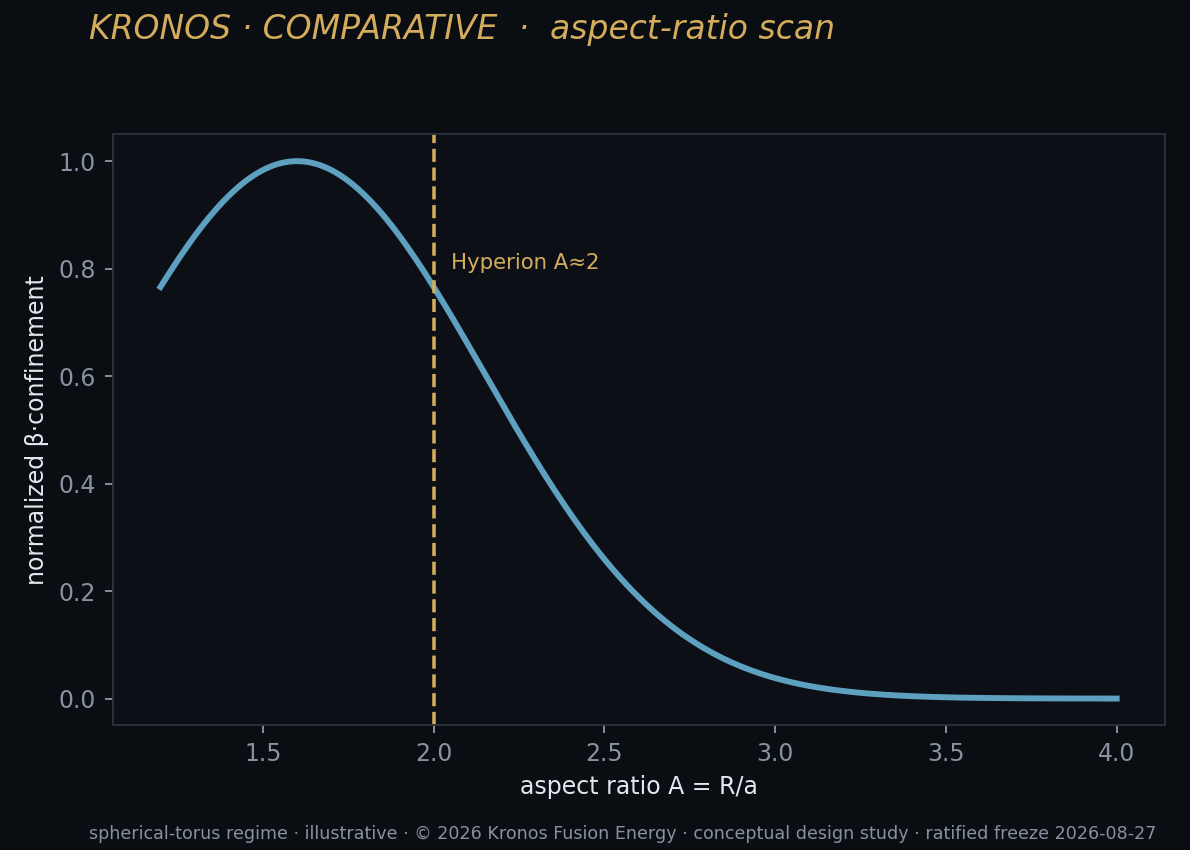
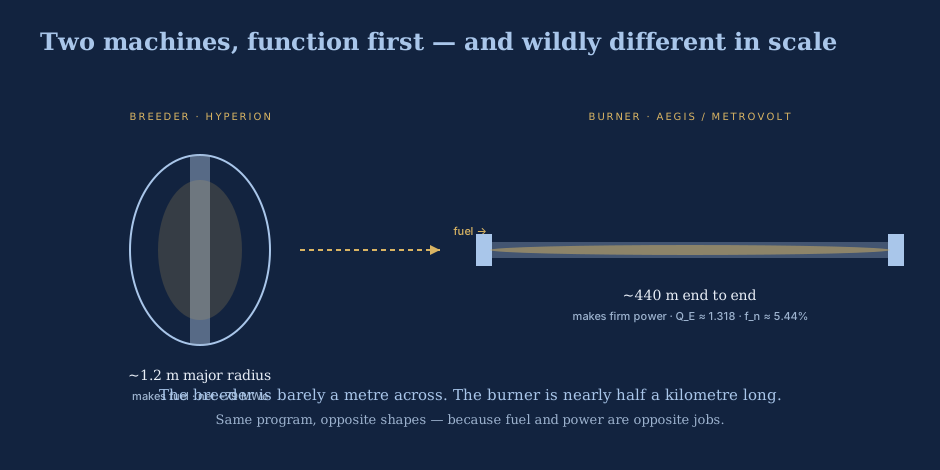
Listening changed the question. Instead of asking how to make the tokamak stop producing neutrons, I asked what the tokamak is for — and the answer was almost embarrassing in its obviousness. If the tokamak is the wrong shape to burn clean fuel, it is a magnificent shape to make it. A breeder's whole purpose is neutrons, so you reach for the most neutron-prolific geometry there is — a spherical tokamak, a doughnut squeezed until the plasma hugs a slender central column, concentrating a torrent of 14 MeV neutrons into a core barely a metre across. For decades that torrent was treated as a nuisance to be shielded against; we turned the problem around and made it the product. The fuel followed the same discipline that produced the two-machine answer — fuel follows purpose. We did not assume deuterium–tritium; we let more than twenty-five thousand machine configurations choose across both candidate breeder fuels, and the one that minimises the machine's binding constraint — its plasma current — won, because D–T's roughly nineteen-fold reactivity meets the same kilograms-a-year tritium duty at a fraction of the current a cleaner fuel would demand. Our breeder, Hyperion, is that machine: a compact spherical tokamak that burns D–T not to make electricity but to make materials — tritium to fuel the machines that follow, helium-3 for the burner, and a flood of neutrons for a whole industry of materials testing and isotope production. It runs net-negative on electricity, drawing roughly −79 MWe rather than feeding the grid — not a flaw but the job, because the near-term business of fusion is fuel and materials, not power. The foundry chapter works the numbers, current by current and neutron by neutron; here it is enough to say that the geometry which dooms a clean burn is the geometry that makes a superb fuel factory.
The other machine: a burner that likes the clean fuel
Once you accept that one machine should make the fuel, the second machine becomes obvious: something to burn it, cleanly, for power. And the burner wants a completely different shape — not because we prefer variety, but because the same loss race that defeats the clean fuel in a torus can be won in a straight line.
Our burner is not a doughnut at all. It is a long, straight magnetic bottle — a tandem mirror, roughly 440 meters end to end — that runs on deuterium and helium-3, the clean fuel Hyperion produces. The open, linear geometry is the whole point. A tandem mirror confines its plasma between two intensely strong magnetic "plugs" at the ends — our design reaches 26.49 tesla at the high-field plug, with a 17 tesla throat in the central cell — that reflect particles back toward the middle like mirrors facing each other down a hallway. There is no toroidal curvature to drive the instabilities and cross-field turbulence that bleed a tokamak dry, and a linear machine can hold plasma at very high pressure relative to its field. That combination widens the thin margin the clean fuel needs. In the straight bottle, D–³He can be run hot enough, and lose slowly enough, that fusion power finally wins the race that a tokamak makes it lose.
The fuel does the rest, and here the fourth law from earlier in this chapter pays off. D–³He fuses along a primary branch into just two bodies — a 14.66-MeV proton and a 3.67-MeV helium nucleus — and two bodies means two discrete energies, sharp lines a converter can be tuned to. That is the fuel the fourth law selects: not the "cleanest" conceivable fuel, but the convertible one. (The fully aneutronic alternative people always propose, helium-3 burning on itself, throws three bodies out into a smeared continuum that no collector can lock onto — clean to the last electron-volt and useless to convert.) So the burner sidesteps the neutron catastrophe entirely: its neutron fraction is just f_n ≈ 5.44% — a small fraction of D–T's roughly eighty percent. There is far less to displace the walls, far less to activate the structure, far less consumable machine. And because the energy comes out charged, the open ends of the mirror become a feature rather than a leak: particles stream out along the field lines into a direct energy converter, a set of charged collectors that slow the escaping ions against a voltage and harvest their motion as current — electricity taken straight from the plasma, without paying the full thermodynamic penalty of a steam cycle. The shape that lets the clean fuel burn is the same shape that lets you collect its output directly. Everything fits.
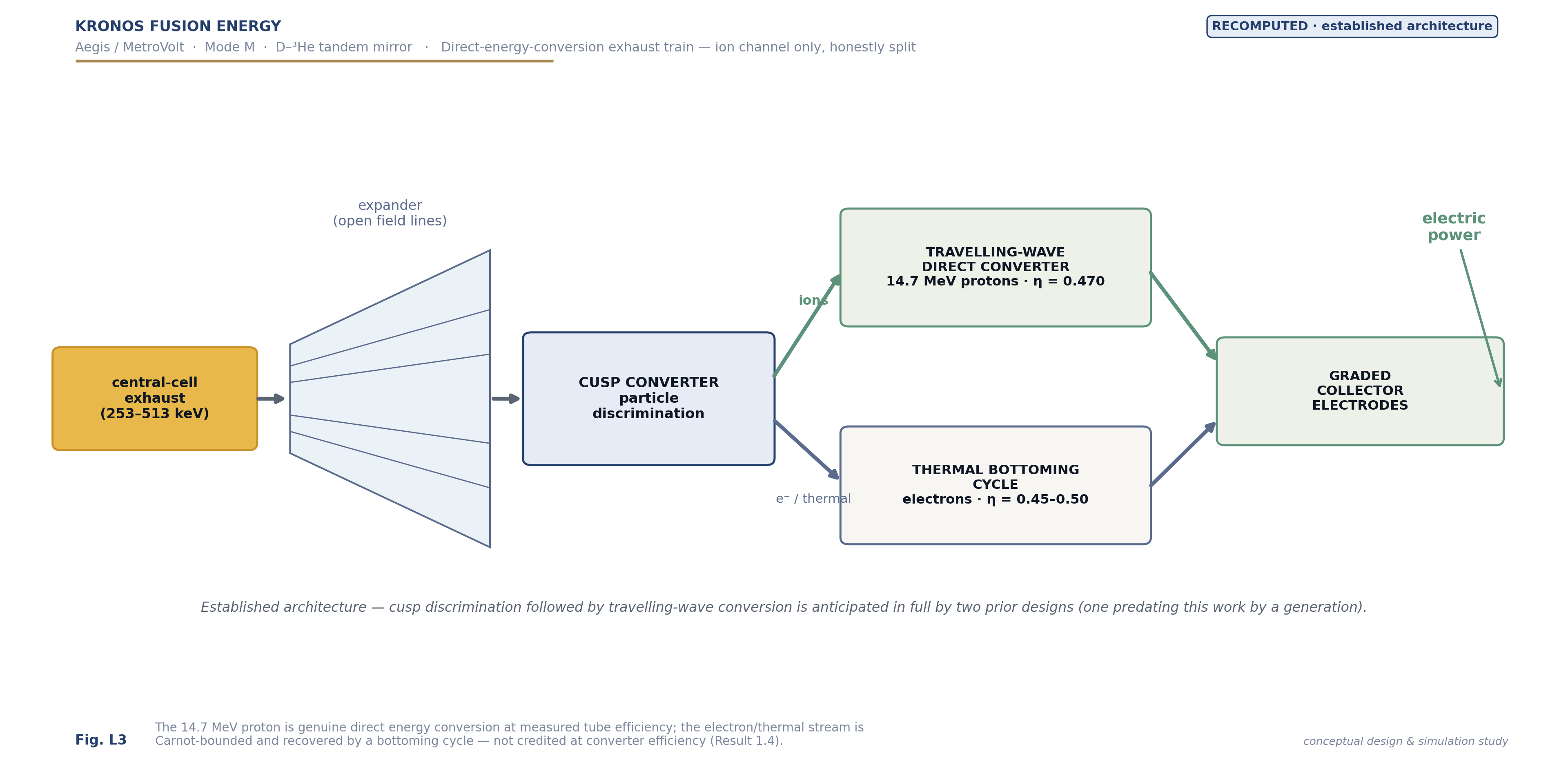
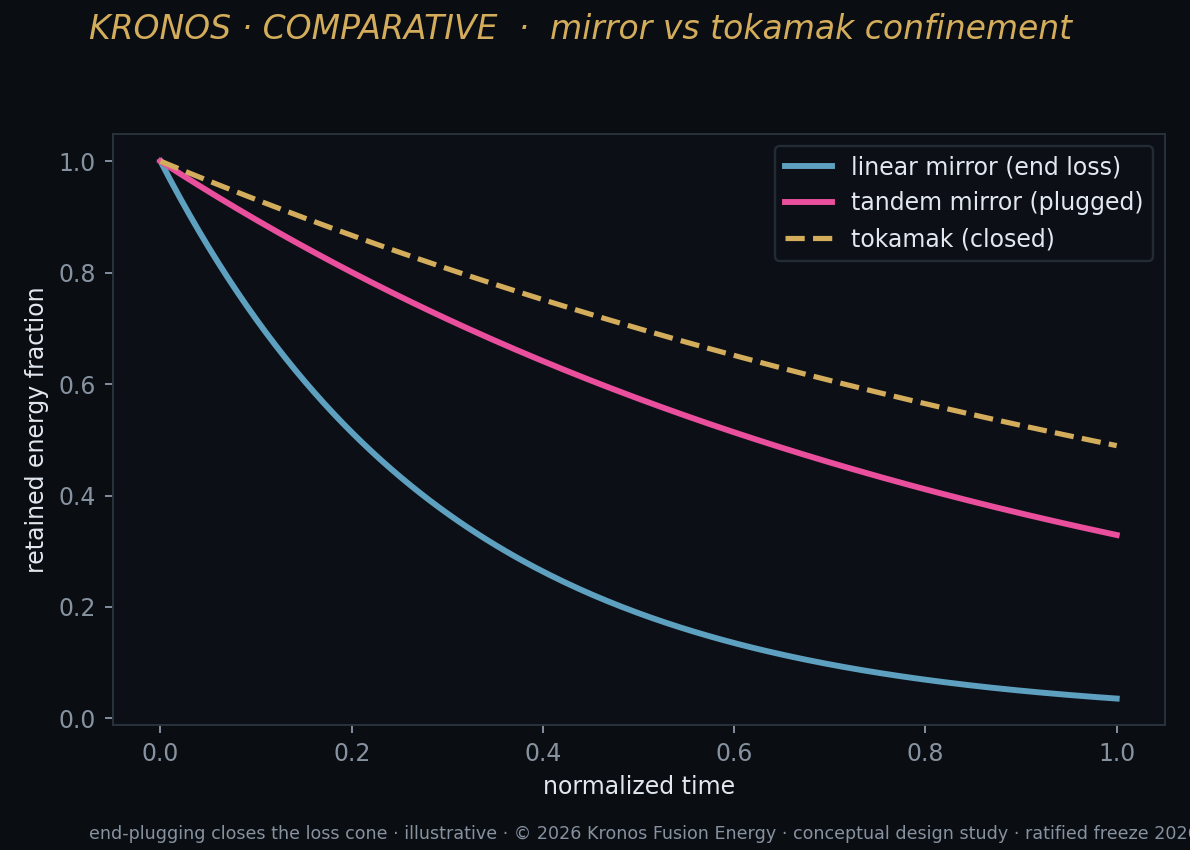
Honesty requires me to name what the mirror gives up in exchange. An open magnetic bottle leaks by design: any particle whose motion is aligned too closely with the field lines slips through the mirror plugs and escapes out the ends — the classic "loss cone" that has dogged mirror machines since the field's earliest days. It is exactly this leak that killed the simple mirror as a D–T reactor generations ago. The tandem configuration is the answer to it: the intense end plugs raise an electrostatic barrier that holds the bulk plasma against that loss, turning the ends from a fatal weakness into a manageable, and even useful, boundary. And for a clean fuel whose escaping particles are charged, the leak is no longer pure loss — it is the feed into the direct converter. We do not pretend the loss cone is gone. We route it into the collector and get paid for it.
This is the machine that eventually delivers the forty-dollar electron — the machine the 2024 version of this book was really dreaming of, finally given the right shape and the right fuel. I will be equally honest about its gate: the burner's economics only truly close when helium-3 is cheap and plentiful, which in the plan means lunar supply arriving around 2040. The physics home is right; the fuel supply is the long pole. But the shape is no longer fighting the fuel, and that is the difference that made the whole thing possible.
The doctrine, in one breath
So the two machines are not a hedge or a compromise. They are what the physics demanded once I stopped insisting that one reactor do two incompatible jobs.
I stopped arguing with the machine and started listening. It had been asking, all along, to be two machines.
Make the fuel where the physics makes fuel easily — a spherical-tokamak breeder that turns the neutron problem into a neutron product. Burn the fuel where the physics burns it cleanly — a tandem-mirror generator running on the helium-3 the breeder makes, converting charged particles straight to power. Fuel first, power second. One fuel doctrine, two machines, each doing only the thing it is genuinely excellent at, and neither asked to do the thing it cannot.
Laid side by side, the two machines are almost mirror opposites — the same physics pushed to opposite corners:
| Breeder (Hyperion) | Burner | |
|---|---|---|
| Geometry | Spherical tokamak (closed, toroidal) | Tandem mirror (open, linear) |
| Fuel | Deuterium–tritium | Deuterium–helium-3 |
| Product | Tritium, helium-3, 14 MeV neutrons | Firm electricity |
| Neutron fraction | ~80% (the point) | ~5.44% (low-neutron) |
| Bar it must clear | Fusion gain (Q ≈ 3.4) | Engineering gain (net electricity) |
| On the grid | Net consumer (~−79 MWe) | Net generator |
| Binding limit | Neutron lifetime at the centrepost | Plug density (and its magnet) |
| When | Buildable now | The later machine |
The staging follows the physics as strictly as the shapes do. The breeder is the near-term machine because its bar — fusion gain, not net electricity — is the one we can clear this decade; construction of the first one begins in 2027, with first tritium targeted around 2030. The burner is the later act, because its economics wait on helium-3 cheap enough to run a fleet, which in the honest plan means lunar supply arriving around 2040. Fuel first, then a small test generator, then a fleet — each step gated by a thing that is actually true rather than a date we would like to hit. That is the deliberately conservative reading of the third forty: not a promise of fusion soon, but a credible path to fusion within forty years.
It is a less romantic story than the single miracle reactor. It is also the first version of the story that is actually true — and, I have come to believe, the only version that ends with fusion on the grid within a human lifetime. Two machines, then: one to make the fuel of a star, one to burn it for light. It is a humbler blueprint than the one I started with, and a far more powerful one, because it is buildable.
I should tell you how I actually got here, because it was not through years of solitary calculation, and I did not get here alone. I came to fusion by a long and unlikely road — a childhood spread across three continents, a brief and frankly comic career in the military that ended the week the army realized it had recruited a yoga-doing vegetarian with no lust for combat, years in technology building companies and selling them, and a stubborn refusal to spend what I earned on anything smaller than this. When I founded this company, I thought I was going to build the fusion machine — the single reactor that would end our long dependence on fire. Then, about a month in, two magnet physicists I had only just met sat me down and, with the patience of people who had given their lives to this, drew the shape of the real answer on a single page. A fuel scientist and a veteran who had carried the American fusion dream for decades joined not long after, and between them they taught me the humbler and truer thing: that the honest answer was not one machine but two. The rest of this book is what we did with that page. The chapters that follow take each machine in turn, and show the work — number by number, gate by honest gate, until the whole of it stands up.