🎧 Prefer to listen? Open the audiobook
Hyperion — the Foundry That Makes the Fuel
In Greek myth Hyperion was the Titan who fathered Helios — the god who drove the Sun across the sky. It is the right name for this machine, because Hyperion does not shine. It fathers the fire that everything after it will burn. Every account of fusion I have ever read makes the same silent promise on the first page: that the machine on the table is a power plant, or the ancestor of one. Hyperion is not. I want to say that plainly, at the top, because the honesty is the whole point. Hyperion is a factory — the first true forge of the fusion age. Its product is not electricity — it is matter: tritium to fuel the machines that come after it, helium-3 as a clean and strategic commodity, and a torrent of fast neutrons that can qualify materials and manufacture isotopes nothing else on Earth can make at rate. It is the first machine our physics actually asks us to build, and it earns its keep the way a foundry has earned its keep since the Bronze Age — by making the stuff everything downstream is made from.
The previous chapter told the story of why the physics forced us to two machines instead of one. This chapter takes the first of them apart on the bench. It is the machine we can build now — not because we have relaxed our standards, but because the bar it has to clear is a modest one, and it clears it on gain already in hand.
A foundry, not a power plant — and it is net-negative on power
Let me be as blunt as the design is. Hyperion consumes more electricity than it produces. On the best defensible accounting, its net electrical output is about −79 MWe — negative seventy-nine. It is a net consumer of power, and it will be for its entire life. That is not a defect we are hoping to engineer away in a later revision. It is a direct, deliberate consequence of the job we gave it.
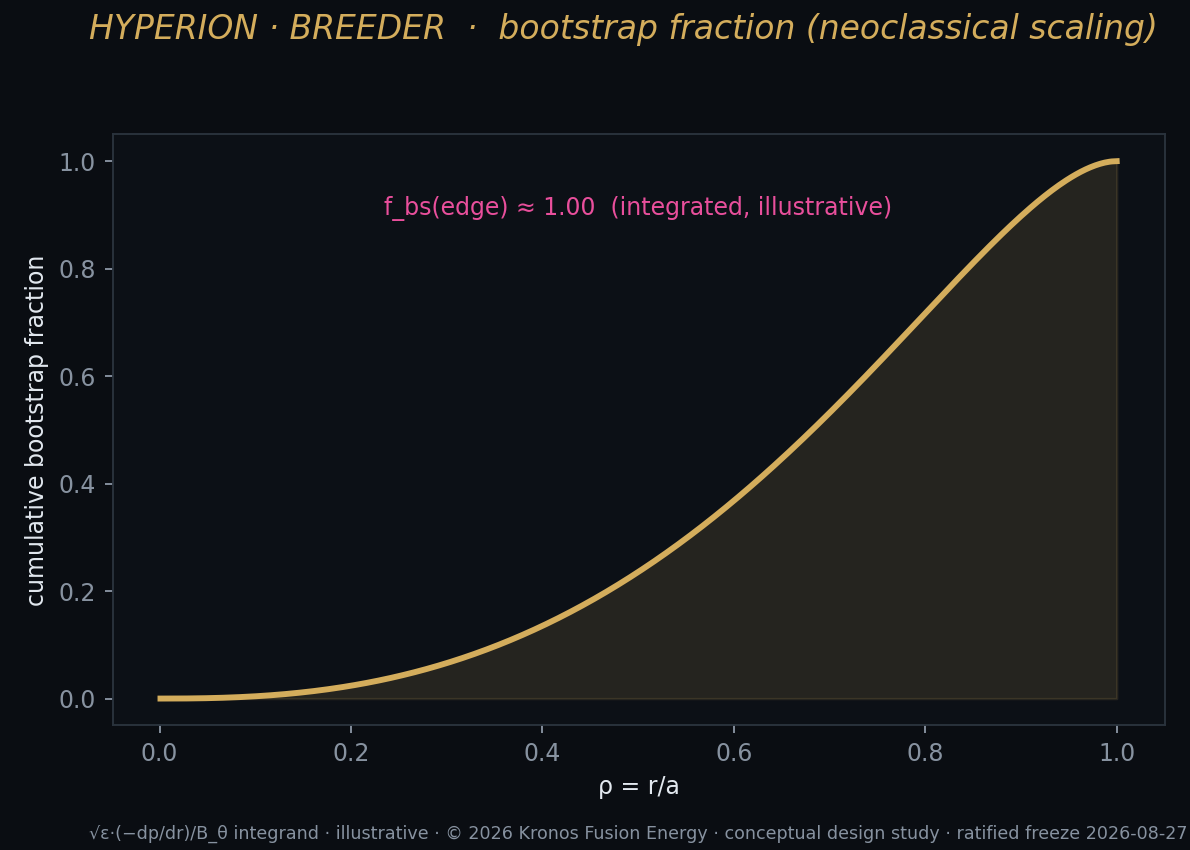
Here is why. A deuterium–tritium plasma at Hyperion's scale needs to be driven — its current sustained, its temperature held — and driving it costs power. Hyperion runs at a plasma current of 9.66 MA, and only a small fraction of that current arises self-consistently from the plasma's own pressure; the rest has to be driven externally with neutral beams and radio-frequency power. That current drive, plus the cryogenics that keep the magnets cold and the balance-of-plant, is a standing electrical bill of well over a hundred megawatts. The fusion reactions pay some of it back — but not all of it. The ledger is red, on purpose.
If you were building a power plant, this would be a catastrophe. But we are not, and the distinction is not rhetorical — it changes the physics bar the machine has to clear. A power plant has to win the full round trip: from wall socket, into the plasma, out as fusion, through a thermal cycle, back to the grid, with enough left over to sell. A breeder has to win only the first leg. It needs the plasma to return more fusion energy than it absorbs — it needs gain — and it can stop there, because its product walks out the door as matter rather than as current on a meter. That is a far easier target, and the difference between the two is the difference between a machine we can build this decade and one we cannot.
So the honest question to ask of Hyperion is not "does it make net electricity" but "does it reach gain." The whole argument of this book is that the near-term business of fusion is not megawatts. It is fuel and materials — a market that exists today, that the United States cannot presently source at scale, and that has nothing to do with feeding the grid. Hyperion's mission metrics — kilograms of tritium, litres of helium-3, neutron-hours for irradiation — share not a single input with any power-plant ledger. Asking whether Hyperion makes net electricity is like asking whether a lithium mine makes net electricity. It is the wrong question. The mine makes lithium. Hyperion makes fuel.
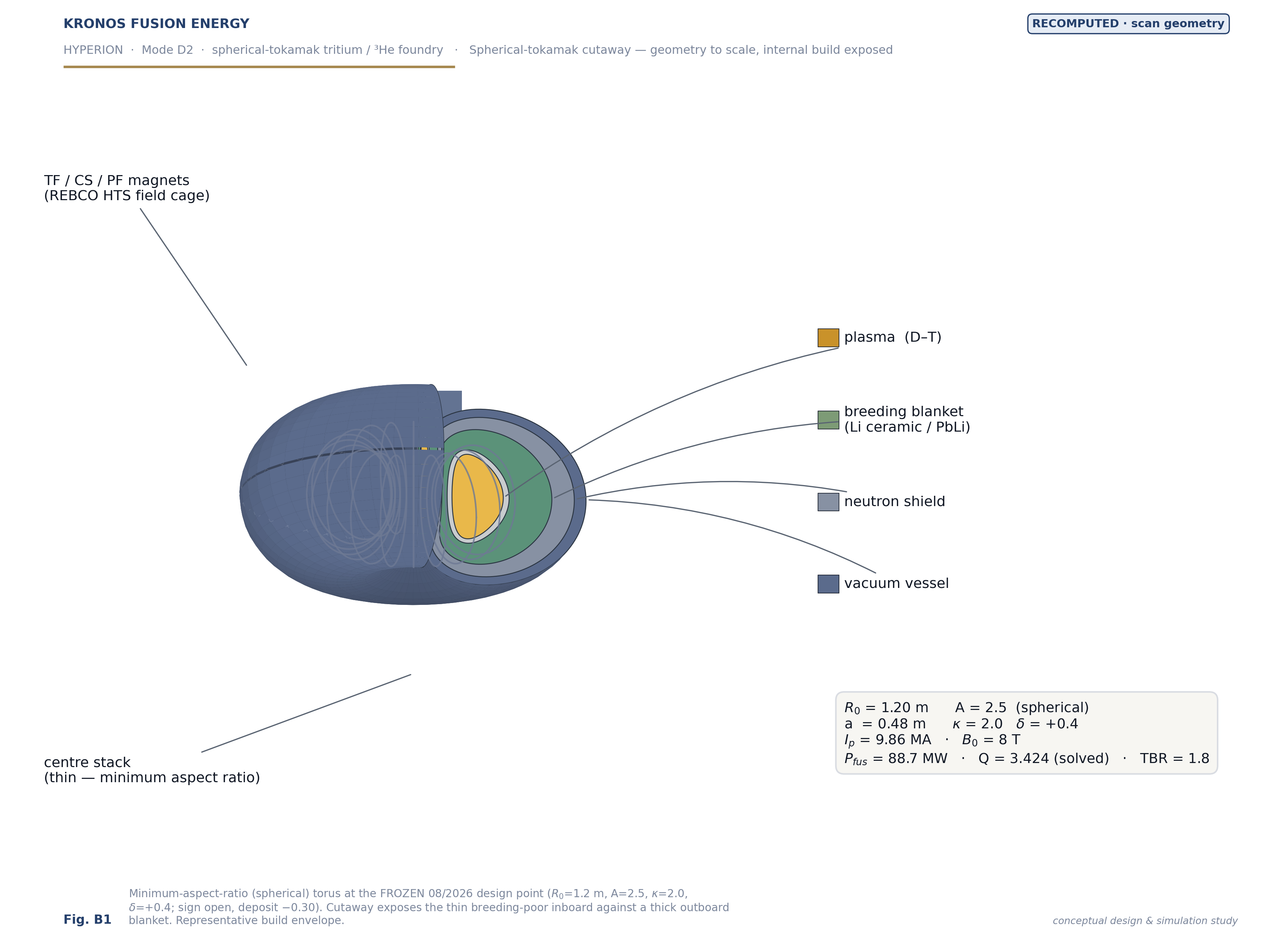
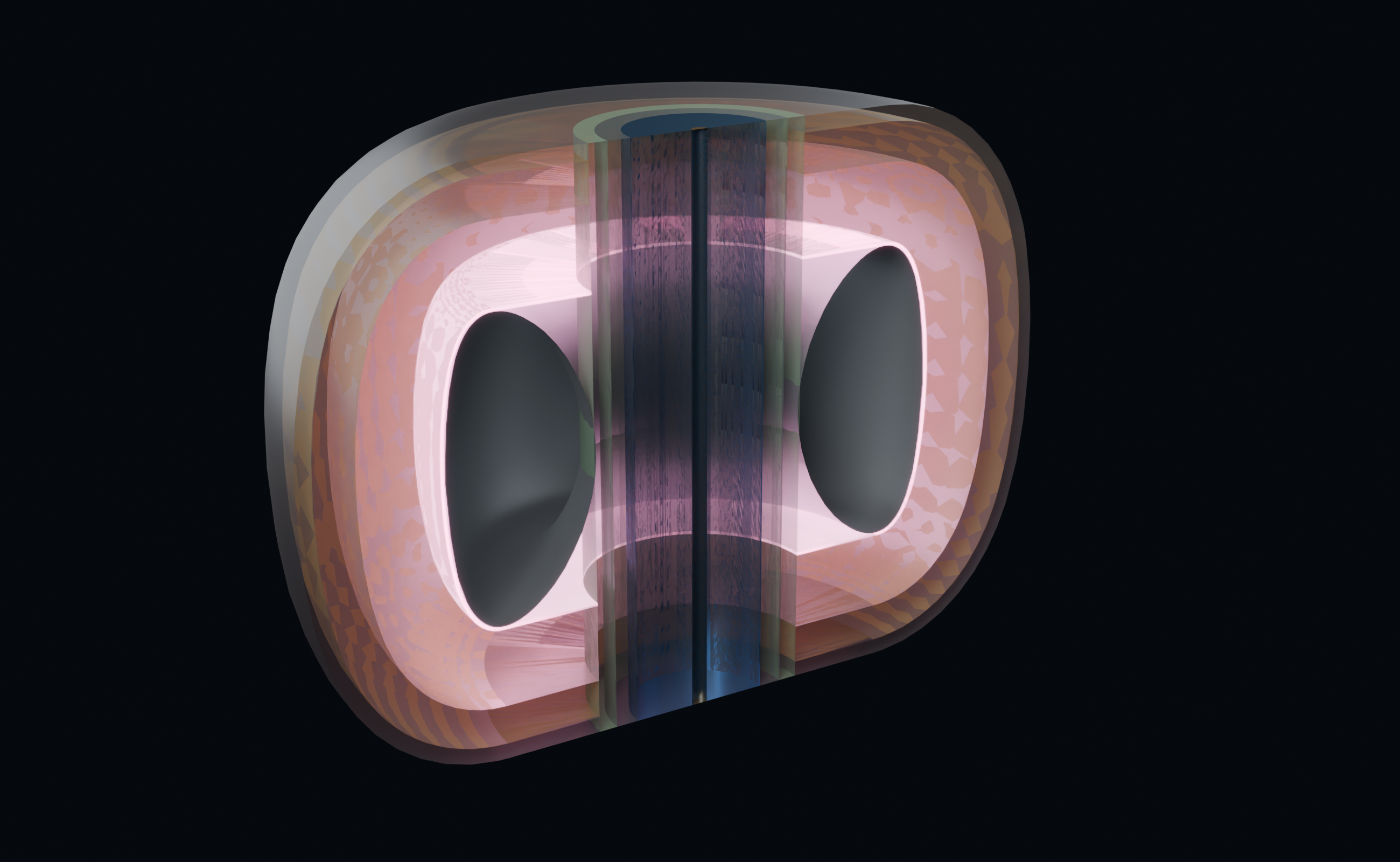
Hyperion is a net consumer of electricity, and that is the correct design. A foundry is judged by what it forges, not by the current on its own meter.
There is a real discipline hiding in that candour. It would have been easy — and it is common in this field — to quietly draw the system boundary so that the machine appears to break even, or to publish the fusion power and stay silent about the recirculating load. We publish both. The engineering power balance is stated, the minus sign is printed, and the case for the machine is built on top of it rather than around it. A design that has to hide its own power meter is a design that does not yet believe its own product.
Why the spherical tokamak is the right shape for this job
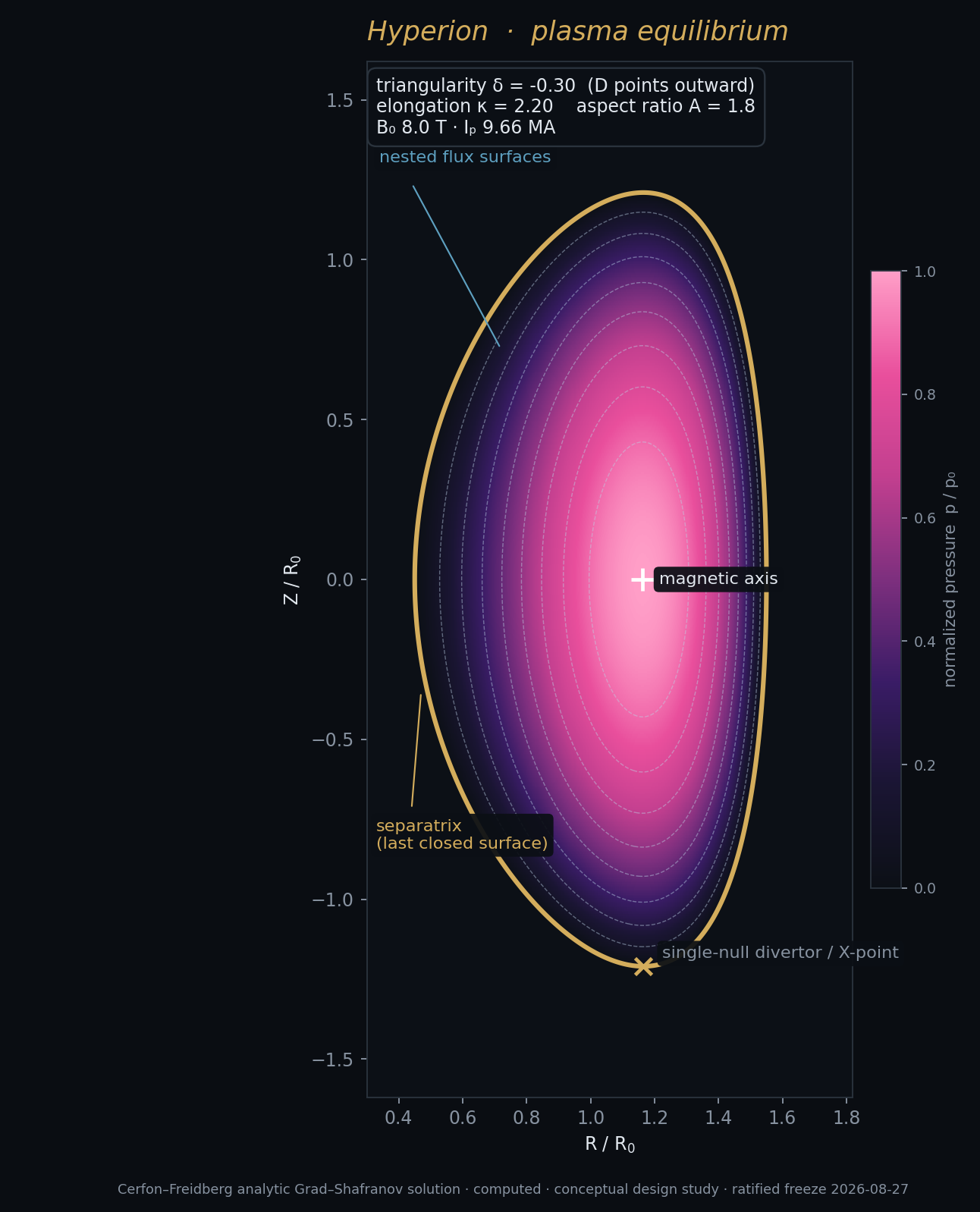
There is a principle I inherited, along with half my instincts, from my mother's side of the family, which is half Japanese: that a thing worth making should be functionally beautiful — that elegance is not decoration laid on top of an object but the visible sign that its form has been fitted, without waste, to its purpose. The Japanese have a word, ikigai, for one's reason for being; fusion is mine, and this idea of functional beauty is how I have tried to pursue it. I raise it here, at the foundry, because the shape of this machine is the cleanest illustration of it I know. Hyperion is not squat and strange because someone thought it looked futuristic. It is squat and strange because that is exactly the shape the job demands, and when you understand the job, the shape stops looking odd and starts looking inevitable — which is, to me, the definition of something well made.
If the job is to make neutrons and breed fuel, the spherical tokamak is very nearly the perfect tool — for reasons that are geometric before they are clever.
A conventional tokamak is a fat ring: a doughnut with a generous hole. A spherical tokamak squeezes that hole almost shut, until the plasma hugs a slender central column like the flesh of a cored apple. The relevant number is the aspect ratio — the ratio of the machine's major radius to its minor radius. Big tokamaks run at aspect ratios of three or more. Hyperion runs at 2.5, with a major radius of just 1.2 metres and a minor radius of 0.48 metres. It is a genuinely small machine.
That squat geometry buys two things a fuel foundry desperately wants. The first is pressure efficiency. A tokamak at a fixed magnetic field is pressure-limited: there is a ceiling on how much plasma pressure you can hold before the confinement gives way, and a fatter, lower-aspect-ratio torus wins more pressure from every tesla you spend on it. That efficiency is what lets a machine barely a metre across reach reactor-relevant conditions inside a build envelope existing heavy industry can actually fabricate. The second is power density. Hyperion's heating power density is about 2.37 megawatts per cubic metre — roughly 2.2 times that of a leading compact high-field tokamak already under construction. A small core working that hard is exactly what you want when the product is the neutron flux itself: you are concentrating fusion reactions into a small volume, and every one of them throws off a 14-MeV neutron you can put to work.
The geometry also decides the fuel, and here the design follows a rule I keep returning to: fuel follows purpose. We scanned tens of thousands of machine configurations across both candidate fuels, deuterium–tritium and pure deuterium–deuterium, and let each one find the plasma current it needed to meet a real tritium duty. The two fuels are genuinely different optima, and neither strictly dominates — pure D–D actually yields far more tritium per unit of fusion energy. But a tokamak is bound by its plasma current, not by its tritium-per-megawatt, and on that binding constraint D–T wins decisively. Because a D–T reaction is roughly nineteen times more reactive, a D–T machine can meet the same national fuel duty at about a third of the plasma current a D–D machine would need — 4.93 MA at the scan minimum, against 15.52 MA for D–D. That is a fraction of the roughly 15 megaamps a conventional flagship tokamak needs, rather than a multiple of it. Choosing the fuel that minimises the hardest engineering constraint, rather than the one that maximises a headline yield, is the difference between a buildable machine and a paper one.
The price of the geometry is the centrepost. Squeezing the hole shut leaves very little room for the central magnet leg, and that leg has to carry an enormous field. In Hyperion the on-axis field is 8 tesla, and the peak field on the REBCO high-temperature-superconductor conductor runs to a conductor peak — a working point only modern high-temperature superconductors make possible in so slender a column. The reassuring part is that, mechanically, this magnet is comfortable. The centrepost is a large-bore, low-current-density winding: it spreads its current over a wide cross-section, so the hoop stress that would tear a coil apart stays low — around three hundred megapascals at the realisable operating point, well inside what the reinforced structure allows. That working point sits well within the demonstrated REBCO envelope, and the conductor is nowhere near its stress limit. The binding constraint on the centrepost is not hoop stress at all. It is neutron lifetime — how long the coil can sit in the blast behind a compact inboard shield before the radiation degrades it.
So here we made a hard, honest choice: rather than pretend the centrepost can survive for decades, we treat it as a consumable. It is designed to be replaced on a schedule — a maintenance cadence, not a fundamental limit — the way you replace a crucible or a furnace liner. Naming the centrepost a scheduled-replacement part, instead of an impossible permanent one, is what lets the rest of the machine breed its own tritium at all, as we will see. The conductor architecture itself is strain-managed and was developed against the far more demanding case — the burner's plug coil, which has to hold nearly 26.5 tesla — so the breeder's centrepost inherits a magnet designed with margin to spare and sits, by comparison, in easy country.
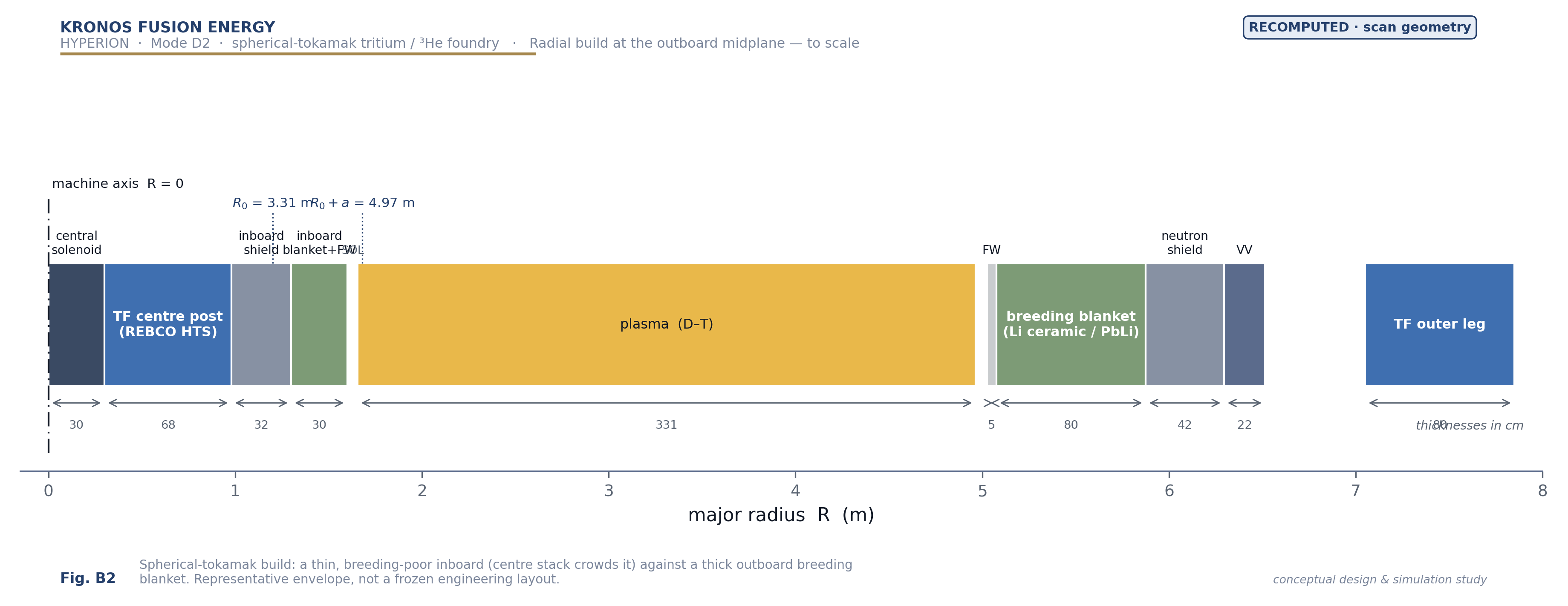
The radial build tells its own story if you read it from the axis outward. The spherical geometry crowds the inboard side: the centre stack eats the room where a fatter tokamak would put a breeding blanket, so the inboard leg is breeding-poor, given over almost entirely to the shield that protects the coil. The breeding is recovered on the outboard side, where the blanket is thick and the neutron flux is generous. That asymmetry — thin and protective inboard, thick and productive outboard — is not a compromise forced on us; it is the deliberate trade that keeps the centrepost a replaceable part rather than an impossible permanent one, and it is why the machine can breed at all inside so tight an envelope.
Why the current requirement is structural, not a bad operating point
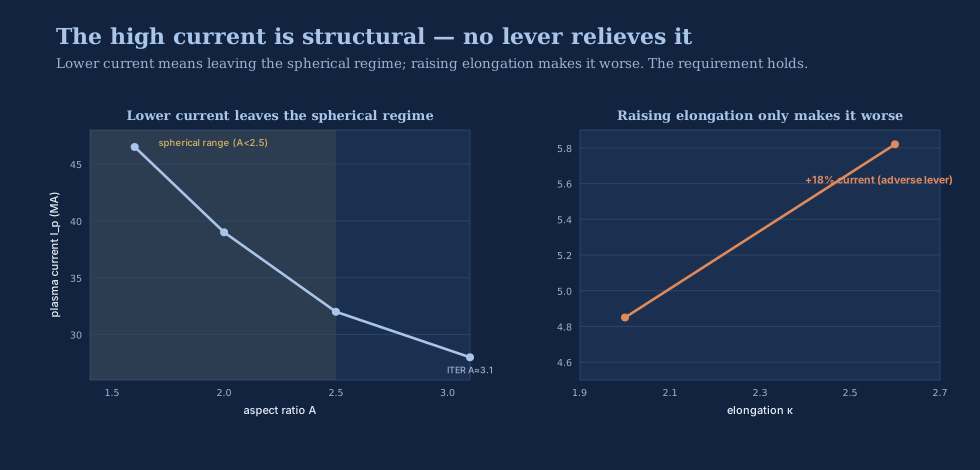
A sceptic's first move, seeing a 4.93-megaamp minimum, is to assume we simply chose a poor corner of the design space and that a cleverer operating point would relax it. We tested exactly that, and it does not. Three levers are the obvious candidates for buying the current down, and we swept all three.
Toroidal field is inert. Across the admissible range — sixteen to twenty tesla on the conductor — no configuration closes at a lower current than another. Field, the lever everyone reaches for first, simply does not move this constraint.
Elongation is adverse. Stretching the plasma taller — raising the elongation from 2.0 toward 2.6 — makes the current requirement worse, not better: the D–T minimum climbs from 4.93 to 5.82 megaamps. The lever runs the wrong way.
Aspect ratio offers relief only by leaving the machine. A full sweep of the aspect-ratio–elongation plane does find lower-current solutions, but they sit at aspect ratios of 3.4 to 3.5 — which is to say, at a conventional tokamak, not the spherical configuration under study. The relief exists, but only if you abandon the spherical machine that makes the geometry work in the first place, so we do not claim it.
The conclusion is one I hold to deliberately, because it is the kind of thing an optimistic design study glosses over: the current requirement is a property of the design space, not of a poorly chosen point within it. There is no free lunch hiding in the parameters. What makes the machine buildable is not a lucky operating point; it is the fuel choice — D–T's nineteen-fold reactivity advantage — pushing the whole space down to a current existing heavy industry can actually drive.
The design point, in numbers
Because this is a book that shows its work, here is Hyperion's design point stated flatly. Every one of these figures is public and reproducible from the openly deposited design.
| Quantity | Value |
|---|---|
| Machine | Compact spherical tokamak, D–T fuel |
| Major radius R₀ / aspect ratio A | 1.2 m / 2.5 |
| Triangularity δ | −0.30 (negative) |
| Plasma current I_p | 9.66 MA |
| On-axis field B₀ | 8.0 T |
| Fusion power P_fus | 85.04 MW |
| Neutron wall loading | ≈ 1.97 MW/m² |
| Scientific gain Q_sci | ≈ 3.076 |
| Net electric power | ≈ −79 MWe (a net consumer) |
| Tritium breeding ratio (advanced-blanket target) | 1.8 |
| Tritium stance | Marginal by design — breeding lever 1.03–1.20 |
| Equilibrium tritium inventory | 6.2 kg |
Two of those numbers deserve a word. The triangularity of −0.30 is negative, and that sign is deliberate. Most tokamaks run positive triangularity — a plasma cross-section shaped like a capital D. Hyperion inverts it. Negative triangularity suppresses the violent edge-localised instabilities — the ELMs — that plague conventional plasmas. An uncontrolled edge burst of that kind can dump a fifth of the plasma edge's stored energy onto the wall in under a millisecond, more than even tungsten can take in a single event. Negative triangularity does not manage that phenomenon; it removes it, which is a genuine virtue when the walls are already living under a neutron flux. The price is paid steadily instead — as a higher continuous heat load on the divertor — and a steady, predictable load is a load an engineer can design against.
The scientific gain of about 3.076 is the physics bar Hyperion has to clear, and it is the only one. It is worth boxing what the symbol means, because it is the most abused number in fusion:
Q_sci = P_fusion ÷ P_heating
>
the fusion power the plasma produces, divided by the heating power the plasma absorbs to sustain it. It measures the reaction — not the wall socket.
A Q of 3.4 means the fusion reactions return roughly three and a half times the power you pour into the plasma to sustain them. That is the whole physics ask of the machine — and note what it is not. It is not net-electricity gain, the round-trip figure where a Q of forty begins to matter economically; that belongs to the burner. A driven, sub-breakeven plasma that nonetheless reaches this fusion gain is a materially easier target than a power plant's full round trip, and it is exactly the target a foundry needs and a generator does not.
The neutron wall loading of about 1.97 megawatts per square metre deserves the same plain reading, because it is the number that makes the foundry a foundry. Wall loading is the neutron power crossing each square metre of the first wall, and for a power reactor a high value is a curse — it is the rate at which the machine is damaging itself. For Hyperion it is the delivery rate of the product. Nearly two megawatts of 14-MeV neutrons per square metre is a flux more intense than the dedicated materials-irradiation facilities the field has spent years trying to fund, concentrated into a core barely a metre across because the spherical geometry runs the power density so hard. The breeder is small precisely so that its neutrons are dense. It is not net-electricity gain — the sort where a Q of 40 begins to matter economically — and Hyperion does not pretend to reach for that. It reaches for gain, full stop. The forty-fold return an earlier version of this book was dreaming of belongs to the burner, later; Hyperion's honest bar is simply gain, in hand. I will be candid about exactly where that bar sits relative to the record, later in this chapter, because it is the one number in the design that is still a target rather than a measurement.
Exhaust: a violent problem traded for a steady one
The negative triangularity earns a second look, because the sign of that number decides how the machine handles its own exhaust — and exhaust, not breeding, is where most compact tokamaks quietly break.
Every confined plasma has to dump the heat it does not fuse somewhere, and in a conventional tokamak that heat leaves in part through edge-localised modes: periodic, violent bursts in which the plasma edge sheds a slug of its stored energy all at once. A single large ELM can deposit five to twenty percent of the pedestal's energy onto the wall in well under a millisecond — a pulse that exceeds what even tungsten can survive, event after event, over the hundreds of thousands of cycles a working machine demands. Negative triangularity does not manage that phenomenon; it removes it. The evidence is not ours and not theoretical: an entire experimental campaign on a major tokamak, run at strong negative triangularity, sustained a fully ELM-free edge across every single discharge. There was nothing to mitigate because there was nothing there.
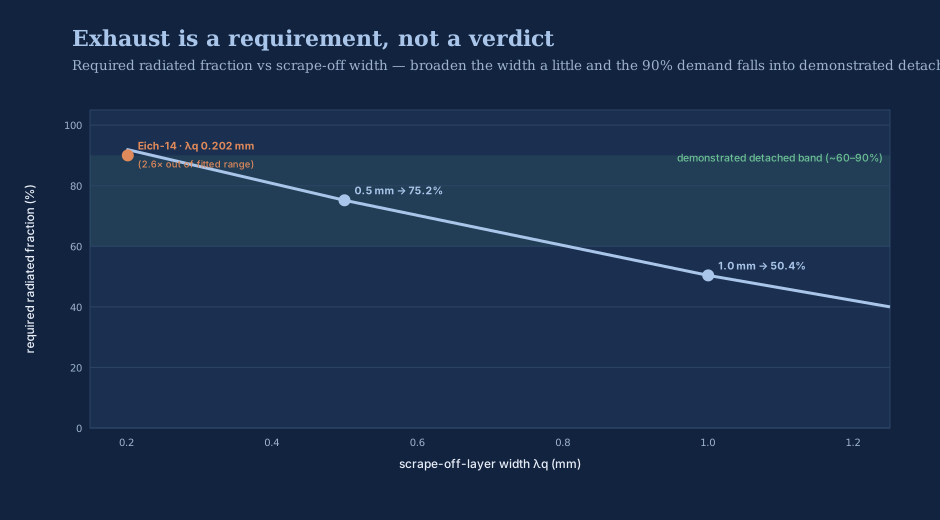
What you buy with that is a machine whose edge does not periodically try to destroy its own wall — a real virtue when that wall is already living under a neutron flux. What you pay is a steady price instead of a violent one, and it falls on the divertor, the component that takes the continuous exhaust. The honest accounting here is unforgiving, and I want to show it rather than smooth it. At the machine's poloidal field, the standard scaling for how wide the exhaust channel spreads gives a scrape-off layer only about 0.2 millimetres thick, which concentrates the parallel heat flux to something like 14 gigawatts per square metre — roughly fourteen times what the great international tokamak will face. Held at that width, keeping the divertor target under a survivable hundred megawatts per square metre would demand radiating away about 90 percent of the exhaust power before it lands.
Two things keep that from being a verdict. First, the width itself is an extrapolation: the scaling that produces the frightening 0.2-millimetre figure was fitted at poloidal fields several times lower than ours, so the machine sits well outside the range where the scaling was measured — a fact I would rather name than bury. Broaden the channel to a still-modest half-millimetre-to-millimetre and the required radiated fraction falls to between 75 and 50 percent — squarely inside what detached-divertor operation has already demonstrated elsewhere. So the exhaust is open at this field, not adverse: the ninety-percent figure is a requirement contingent on an extrapolated width, not a wall the machine is up against. Second, sustaining a high radiated fraction is not free — it means continuously seeding the edge with an impurity gas to do the radiating, and that seed raises the plasma's effective charge (from about 1.16 unseeded toward 1.66 for argon) and dilutes the fuel. Because fusion power scales as the square of the fuel density, the seeding pushes the tritium duty down — from around 2.2 toward 1.8 kilograms a year across the seeding range. This is the third of the four general laws made concrete: the tolerable seed is species-dependent, so we name the gas rather than quoting a single comfortable charge. The divertor is real work, but it is an engineering gate, paid through duty, not a physics wall.
Breeding the fuel: the blanket and the ratio above one
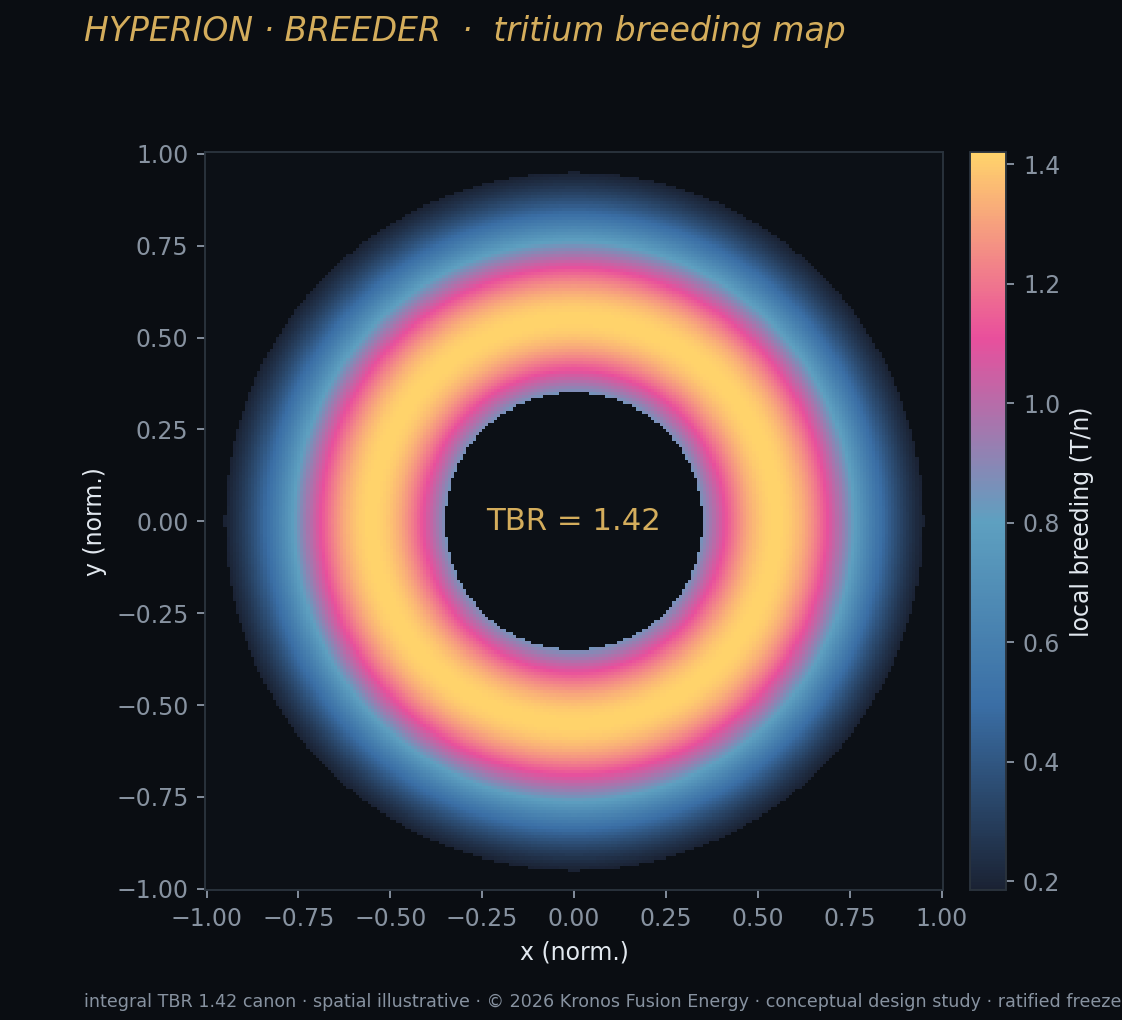
Now to the heart of it — the part that turns a fusion experiment into a fuel foundry. To see why it matters, you have to see the hole it fills.
The United States tritium supply is structurally fragile. Tritium for the weapons stockpile is produced through a single commercial reactor, and tritium is not a stockpile you can simply set aside — it decays at about 5.5 percent every year, so a fixed replacement requirement has to be met, year after year, just to stand still. For two decades that requirement has been met by loading the one available reactor harder, not by adding a second source. There is no civil tritium industry to fall back on. A machine that can make tritium — kilograms of it, on a schedule, from lithium and neutrons — is therefore filling a national gap that has no other filler in sight.
Here is how it does it. When deuterium fuses with tritium, it produces a helium nucleus and a fast neutron carrying about 14 million electron-volts. Of Hyperion's 85.04 megawatts of fusion power, about 70.9 MW leaves as those neutrons and only the balance as the charged helium. In a power plant that neutron fraction is the enemy, because a neutron cannot be turned into electricity efficiently and it damages everything it touches. In a breeder it is the entire business plan, because a fast neutron aimed at lithium makes tritium:
n + ⁶Li → T + ⁴He + 4.8 MeV
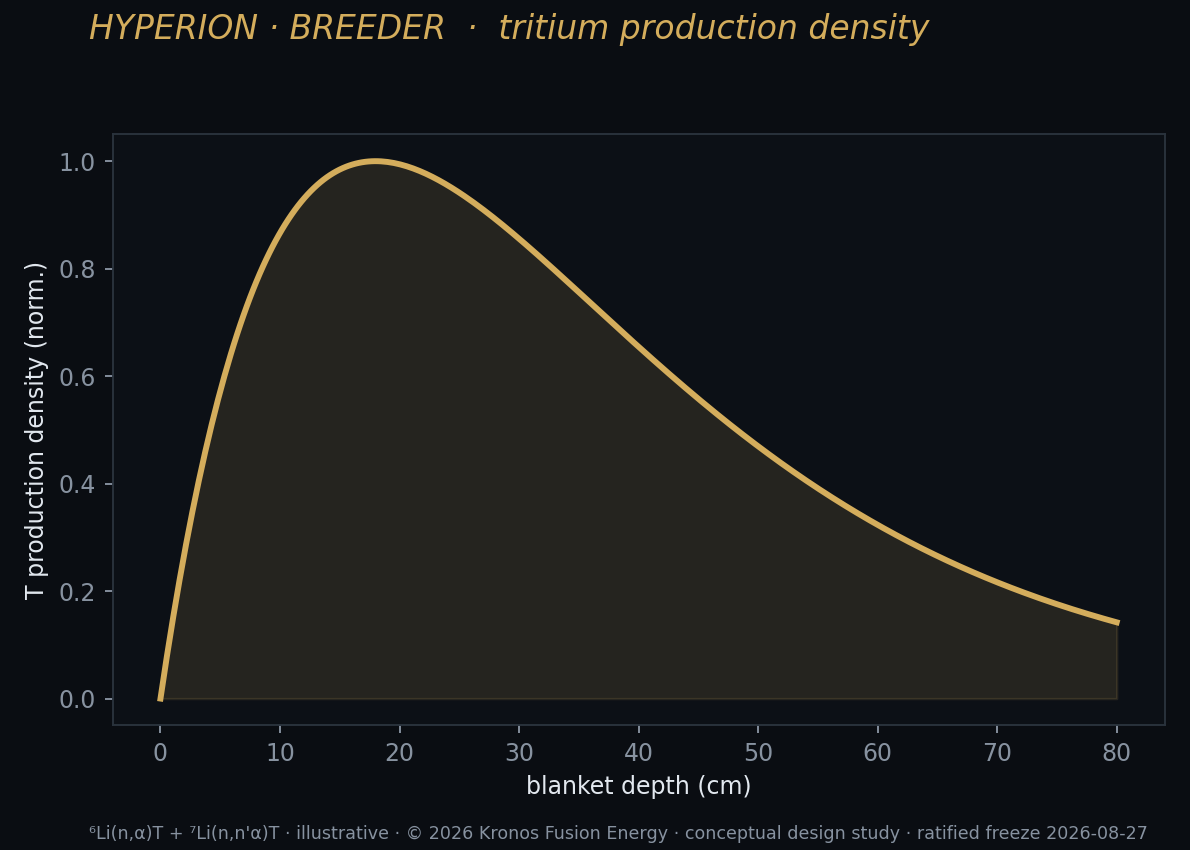
That single reaction is the reason a D–T machine can feed itself. Every neutron the plasma throws off is a chance to regenerate a tritium atom in a blanket of lithium wrapped around the core. Notice, too, that the reaction releases energy — 4.8 MeV of it — so breeding is not a tax on the neutron economy but a small bonus on top of it. Hyperion's blanket is a pebble bed of lithium ceramic — lithium oxide, Li₂O — with its lithium-6 enriched to ninety percent, far above the seven-and-a-half percent that occurs in nature, because lithium-6 is the isotope that does the breeding. One subtlety matters here and is easy to get wrong: a lithium blanket works by absorbing neutrons to make tritium, not by moderating them the way a fission reactor's water does. That distinction governs where the real radiological hazard lives — in hydrogen-rich materials that slow neutrons down, not in the lithium itself — and it is why the blanket can be designed around the hazard rather than in spite of it. The numbers make the point sharply. Run a proper Monte-Carlo neutron transport on evaluated nuclear data and the blanket-averaged capture cross-section that matters for the helium-3 destruction channel comes out at about 0.92 barns (a barn is the physicist's unit for how big a target a nucleus presents to a passing neutron — the bigger the number, the more likely a hit) — not the 114 barns you would wrongly infer by assuming a slowed-down, one-over-energy neutron spectrum. The genuinely large cross-section in the machine belongs to hydrogen in water — some 2,700 barns — which is exactly why the hazard analysis chases hydrogenous materials and long holdup times, and leaves the lithium comparatively alone. Get the spectrum wrong and you protect against the wrong thing.
One reaction alone is not enough, though, because a single neutron can breed at most a single tritium, and real machines leak neutrons through every port and absorb them in every structural wall. To claw the economy back above break-even we interleave beryllium pebbles as a neutron multiplier: a fast neutron striking beryllium knocks two neutrons loose where one went in, very nearly doubling the count before the lithium ever sees them. The measure of how well the whole arrangement works is the tritium breeding ratio, and it is worth boxing:
TBR = (tritium atoms bred in the blanket) ÷ (tritium atoms burned in the plasma)
>
If TBR > 1, the machine makes more fuel than it consumes.
Everything above 1.0 is deliverable product.
The plain-language translation matters more than the symbols. A tritium breeding ratio of exactly 1.0 would mean the machine breaks even on fuel: it replaces every tritium atom it burns and hands you nothing. A ratio below 1.0 — where every real machine starts — means the machine slowly starves. The entire game of blanket design is to push the ratio above one and then higher, because everything above 1.0 is surplus you can deliver to a customer or let decay into helium-3.
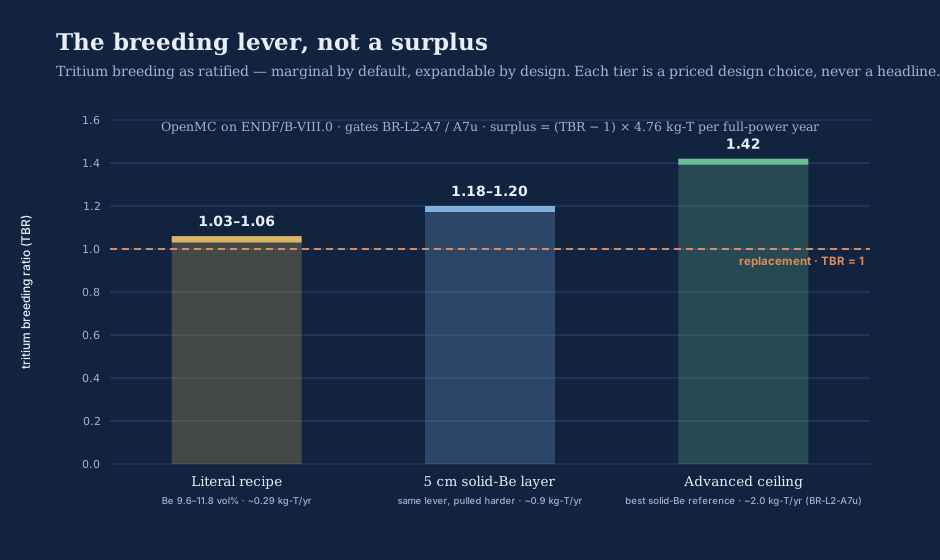
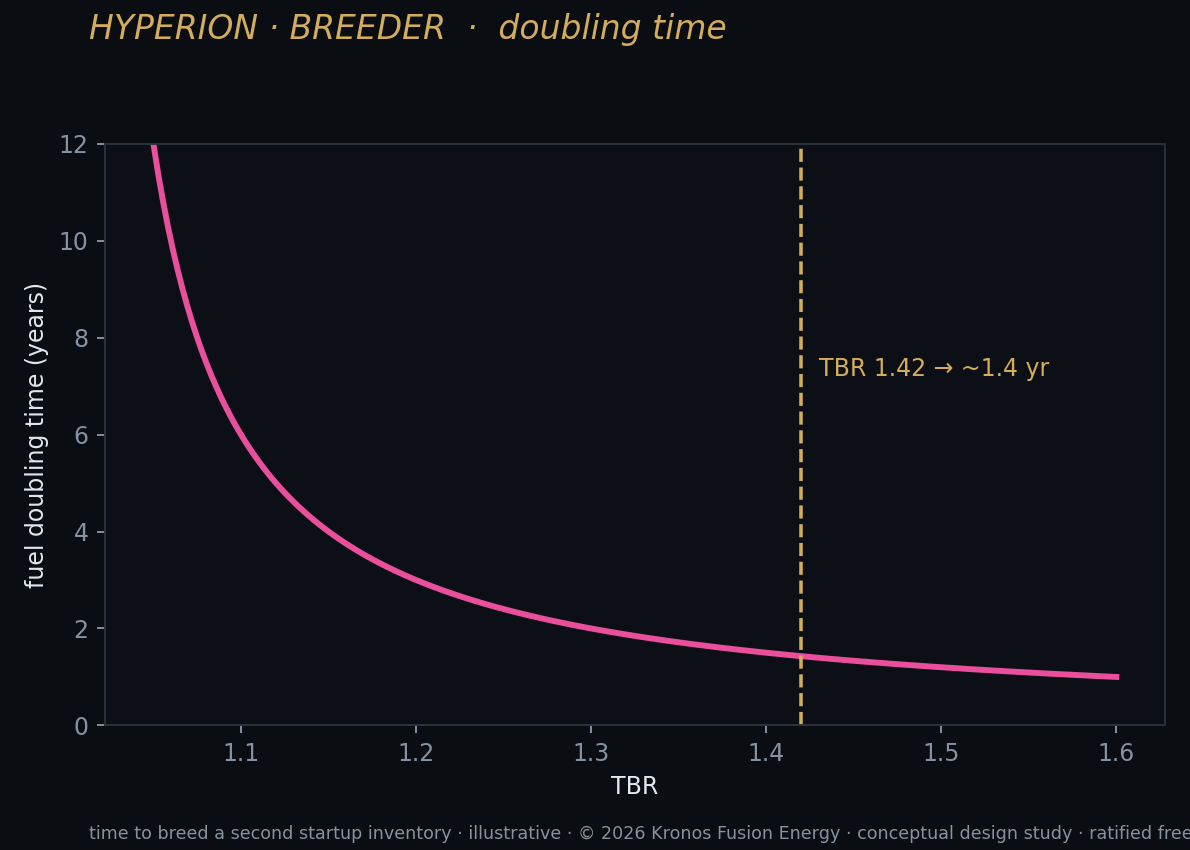
Now for the honesty this number demands, because it is the number a hopeful engineer most wants to round up. A bare lithium blanket, struck by the 14-MeV spectrum, breeds below one — left there, the machine starves. Beryllium is the fix: struck by one fast neutron it yields two, and packing it into the blanket is what buys breeding at all. On the frozen recipe — beryllium at 9.6 to 11.8 percent by volume — the deposited Monte-Carlo transport gives a lever of 1.03 to 1.06; a dedicated five-centimetre solid-beryllium layer lifts the same lever to 1.18 to 1.20 (gate BR-L2-A7). And the lever runs higher when asked: the advanced-blanket ceiling reaches TBR 1.42, which turns the surplus ladder into 0.29 → 0.9 → ~2.0 kilograms of tritium per unit per year (surplus = (TBR − 1) × 4.76 kg burned per full-power year; gate BR-L2-A7u). Read that the way the design intends: Hyperion is tritium-marginal by default and expandable by design — its fuel loop held just above replacement, with every step up the ladder a priced design choice, never a surplus headline.
That the ratio is a lever at all is the design's central move. Breeding depends on blanket geometry, on lithium enrichment, on how much beryllium you pack in, on how much of the plasma's surface the blanket covers — every one a design variable. That is what lets Hyperion be sized to a requirement: because the ratio is a knob, the tritium output can be dialed to a real national need rather than fixed at whatever a physics optimum happens to spit out. A requirement-sized machine is smaller, cheaper, and easier to license than a maximised one, and — as we are about to see — its on-site inventory stays inside established civil practice. Designing to a requirement is a different discipline from chasing a peak, and it is the discipline of a foundry.
Why a small breeder succeeds where large ones failed
There is a reason this chapter can be written at all, and it is worth pausing on, because a fusion tritium-and-helium-3 breeder is not a new idea. It has been proposed at least four times over the decades, and rejected in print at least once. The rejections were not foolish. They were correct — about the machine that was being proposed.
Every prior concept sized the breeder to support a fusion fleet: enough tritium to start and feed a whole generation of power plants. That is a demand measured in something like a hundred kilograms of product a year, and a machine built to that scale carries a tritium inventory on the order of 1.8 tonnes on site. An inventory that large is, in the reviewers' own word, essentially unlicensable — no civil regulator will permit that much of the most mobile radioisotope there is under one roof. The concept sank on its inventory, every time.
Hyperion changes exactly one thing, and it changes everything. It sizes to a named national requirement — a couple of kilograms a year, the real gap in the real supply — rather than to a hypothetical fleet. At that scale the equilibrium tritium inventory falls to about 6.2 kilograms, a roughly thirty-five-kilogram-class holding once handling and holdup are included. That is something like fifty times smaller than the tonne-scale concepts, and it sits comfortably inside established civil licensing precedent. The physics of breeding never changed between those failed proposals and this one. Only the size of the ask did.
The physics never forbade a small breeder. It forbade a large one.
The reframing shows cleanly when you set the concepts side by side. The physics of breeding is common prior art; what is distinctive is the sizing, the customer, and the inventory that follows from them.
| Prior fusion-breeder concepts | Hyperion | |
|---|---|---|
| Sizing driver | Support ratio to a fusion fleet | A named national requirement (~kg/yr) |
| Customer | Hypothetical satellite reactors | A present isotope market + procurement authority |
| Scale considered | ~100 kg/yr helium-3 | ~kg/yr tritium |
| On-site tritium inventory | ~1.8 tonne-class (rejected as unlicensable) | ~35 kg-class (inside civil precedent) |
That single reframing — build for the requirement, not for the fleet — is what turns a repeatedly-rejected idea into a buildable one. The customer is not a future fusion industry that does not yet exist; it is a present national market for isotopes and a procurement authority that needs them today.
Helium-3: the fuel that makes itself
Here is the quiet elegance of the whole architecture, and my favourite fact about the machine — the kind of fact that sounds like alchemy and is only physics.
Tritium is radioactive. It decays, with a half-life of about 12.3 years, into helium-3 — the very fuel the burner will need and the scarcest commodity in the entire fusion economy. Set a stock of tritium in a vault and walk away, and it transmutes itself, atom by atom, into the rarest fuel humanity knows, asking nothing of you but patience. So a tritium inventory is not a static stockpile. It is a helium-3 factory that runs by itself, needing no plasma, no power, no operator — just time. And crucially, this stream does not depend on the breeding gate at all: helium-3 accrues from the standing tritium inventory whether the blanket is breeding at 1.03 or 1.20 or anything else. It is bred independently of the lithium blanket, which is why we can count it even while we are honest about the breeding ratio still being a development target.
The scarcity it addresses is acute. The federal helium-3 auction that once distributed the isotope ceased in 2009. Since then, domestic supply has come almost entirely as a trickle from the decay of the weapons-tritium stockpile, and demand — for neutron detection at borders and ports, for sub-kelvin cryogenics, for medical imaging, and eventually for fusion fuel itself — chronically outstrips it. Hyperion turns a rationed national shortage into a scheduled output.
And the extraction is nearly free, for two reasons. First, helium refuses to condense until you reach a few degrees above absolute zero, which makes separating it from everything else a single cold step whose cryogenic load is a rounding error against the machine's own power bill. Second — and this is the fact that surprised even me — the intense neutron flux that fills the machine barely touches the helium-3 that is accruing. There is a destructive channel, in which a neutron converts a helium-3 nucleus back into a proton and a tritium (n + ³He → p + T), and on paper it looks alarming. In the real machine, on the staged-extraction path, it removes only about 0.18 parts per million of the helium-3 — and stays below eight parts per million even under a deliberately punishing bound that holds the entire inventory in peak flux for a full day. The strategic product survives the very flux that makes it. It is bred in the blanket's shadow and ripens in a place the neutrons cannot reach it.
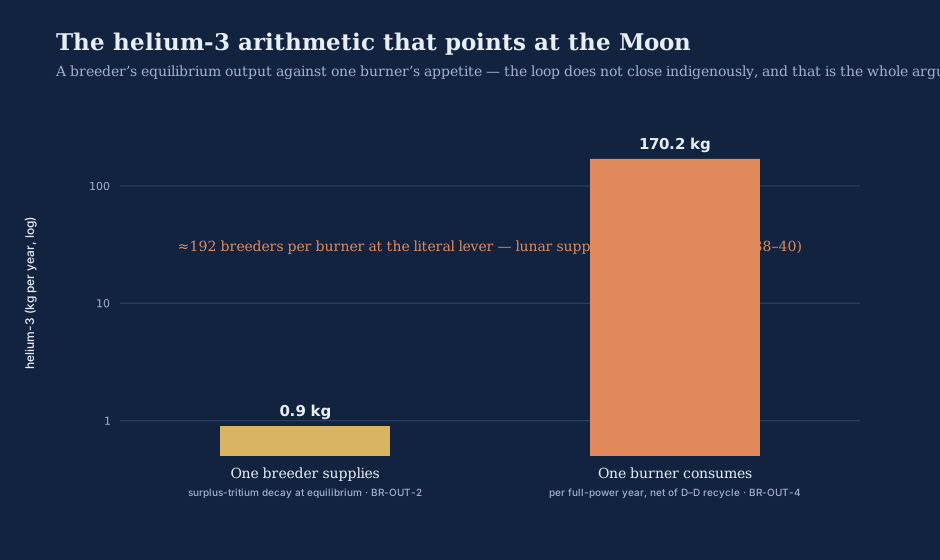
It is worth stating the accrual honestly, because a scarce co-product is exactly the number a hopeful engineer rounds up. The stream is radiogenic and slow: bred tritium decays with its 12.3-year half-life, and at equilibrium the surplus works out to about 0.9 kilograms of helium-3 per breeder per year (gate BR-OUT-2). That is real, strategic, and deliberately small — on the order of half of today’s entire terrestrial supply, from one machine — and the book carries it as exactly that.
I will hold one line of honesty here that our own accountants insist on, and rightly. We never let the helium-3 stream inflate the story. It is a slow accrual, governed by a twelve-year half-life, and it is carried as upside — real physics, booked conservatively — not banked as if it arrived tomorrow. A scarce co-product is exactly the kind of number a hopeful engineer over-credits, so we discipline it deliberately. The fuel makes itself, yes. It just makes itself slowly, and we say so.
The tokamak's temper, priced in
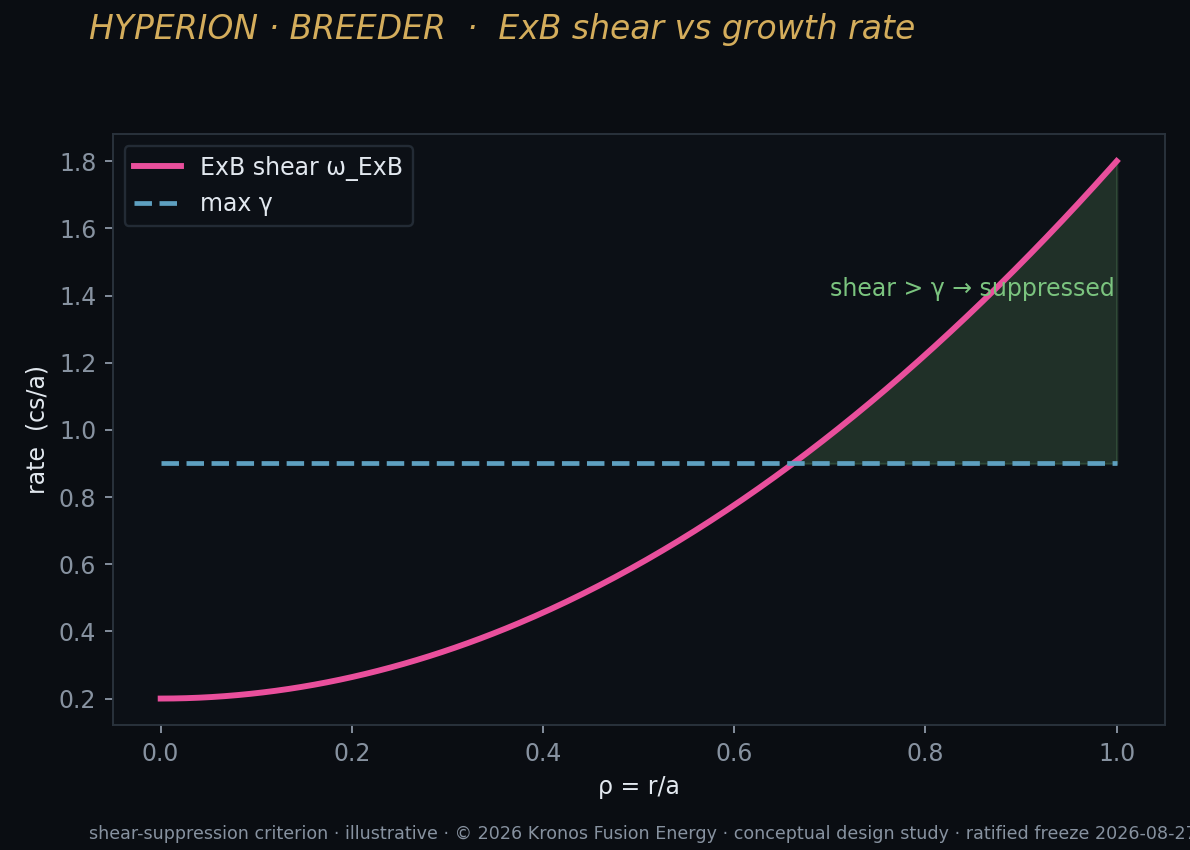
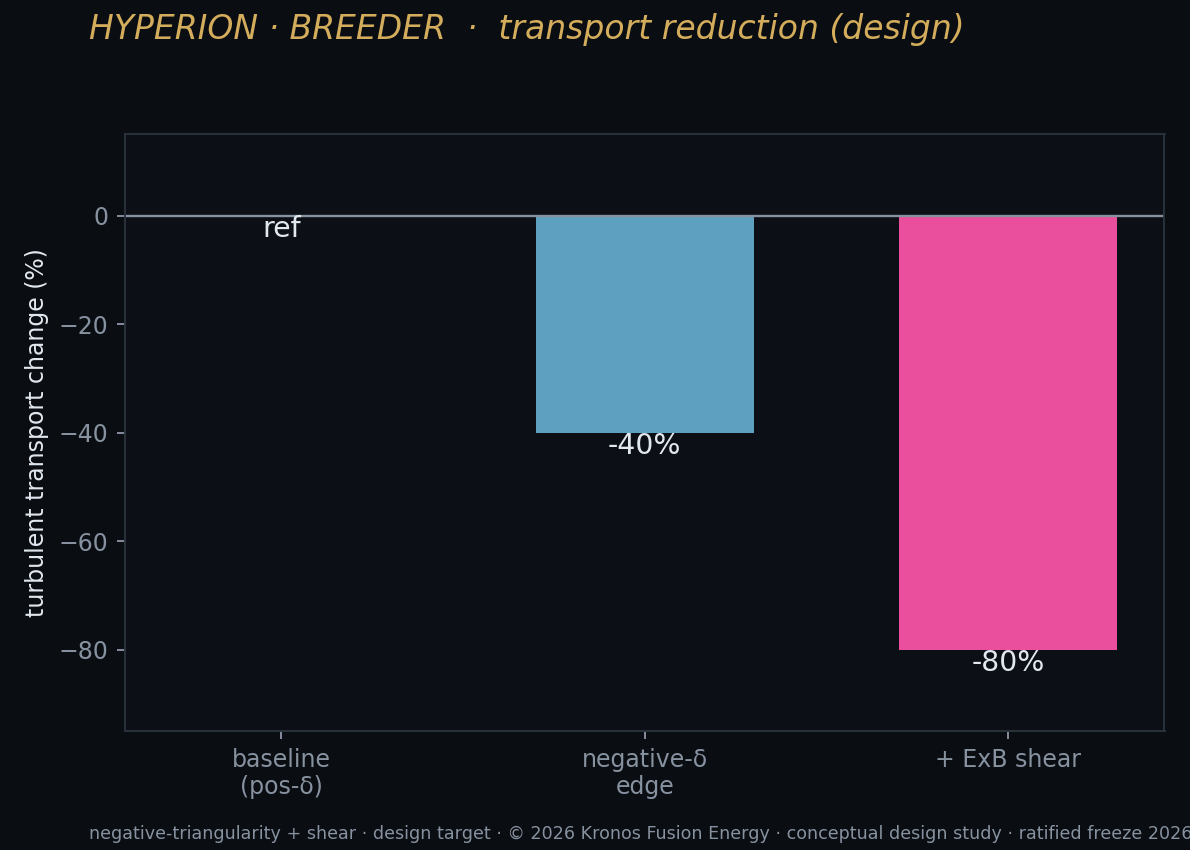
A tokamak carries a plasma current, and a plasma current can be lost suddenly. This design refuses to treat that politely. The frozen disruption analysis (gate BR-L2-A10) puts the current-quench time at 7–19 milliseconds, the halo currents at up to 35 percent of the plasma current — the mechanical load the vessel is built to carry — and the runaway-electron avalanche squarely in the severe regime: at these parameters, a multi-mega-amp electron beam can grow from an almost invisible seed. So the consequence is stated as a design fact, not a caveat: shattered-pellet injection is a hard requirement of this machine — a first-class mitigation system engineered in from day one, with the quench time setting how fast its trigger must fire. And one number on the brighter side of the same ledger, measured rather than assumed: fast-alpha confinement comes out at 99.98 percent (ASCOT5, 10⁵ markers, gate BR-L2-A20), with a prompt-loss wall load of just 0.083 kW/m² — the alphas stay in the fire, which is what lets a small machine heat itself. And the negative-triangularity bet — the shape this whole machine is built around — is now confirmed at first principles: nonlinear CGYRO gyrokinetics shows the dented plasma suppressing turbulence by about 40 percent at ion scales (converged and saturated at the real electron mass; gate BR-L2-A1c) and about 80 percent at electron scales (REG-P13), a result that holds across a sixteen-fold sweep in collisionality (BR-L2-A13) and across the full spectrum of turbulent wavelengths (BR-L2-A18c). Four independent calculations, mutually consistent, all pointing the same way: the quiet basin is a property of the shape, not an artifact of any one simulation.
The neutron as a resource
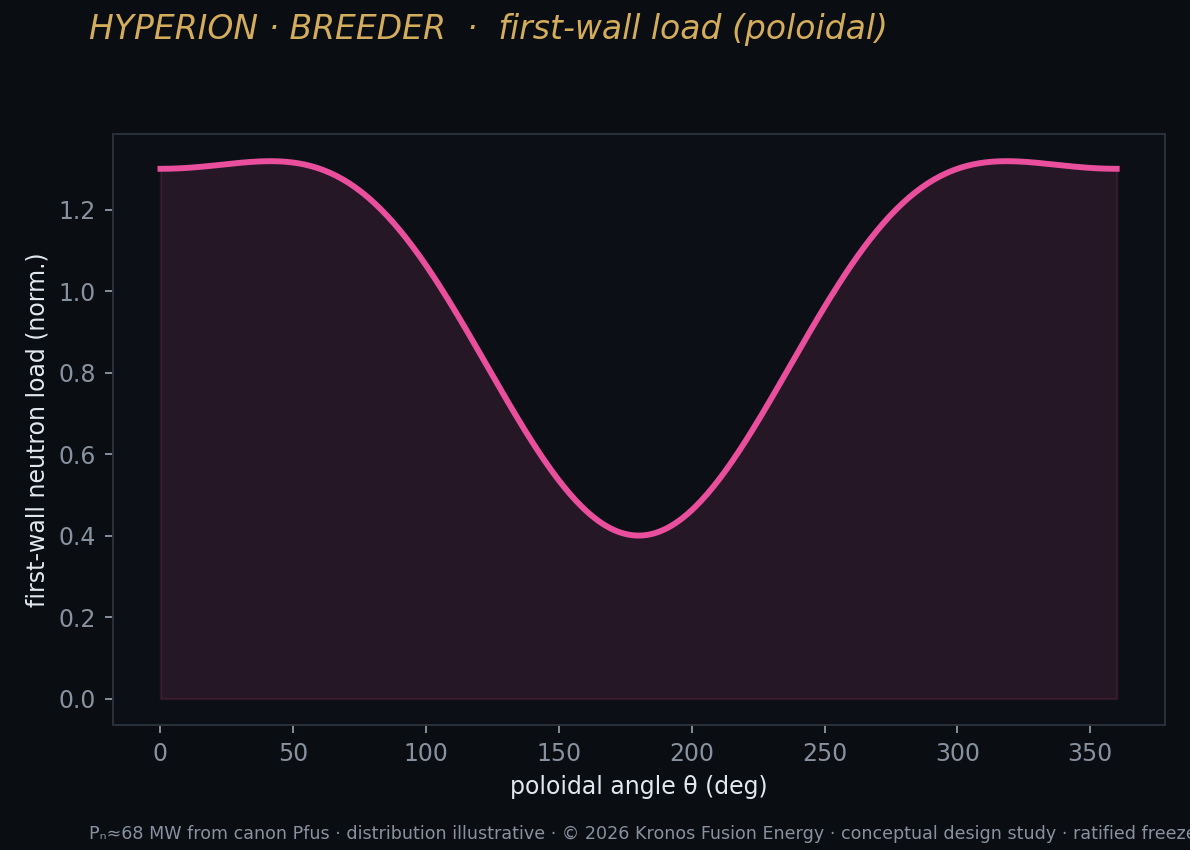
The third product comes off the same plasma as the first two, and it is the one the field spent fifty years treating as its enemy — building walls, blankets, and whole reactor budgets to keep it out: the fast neutron itself. We invite it in and hand it a job.
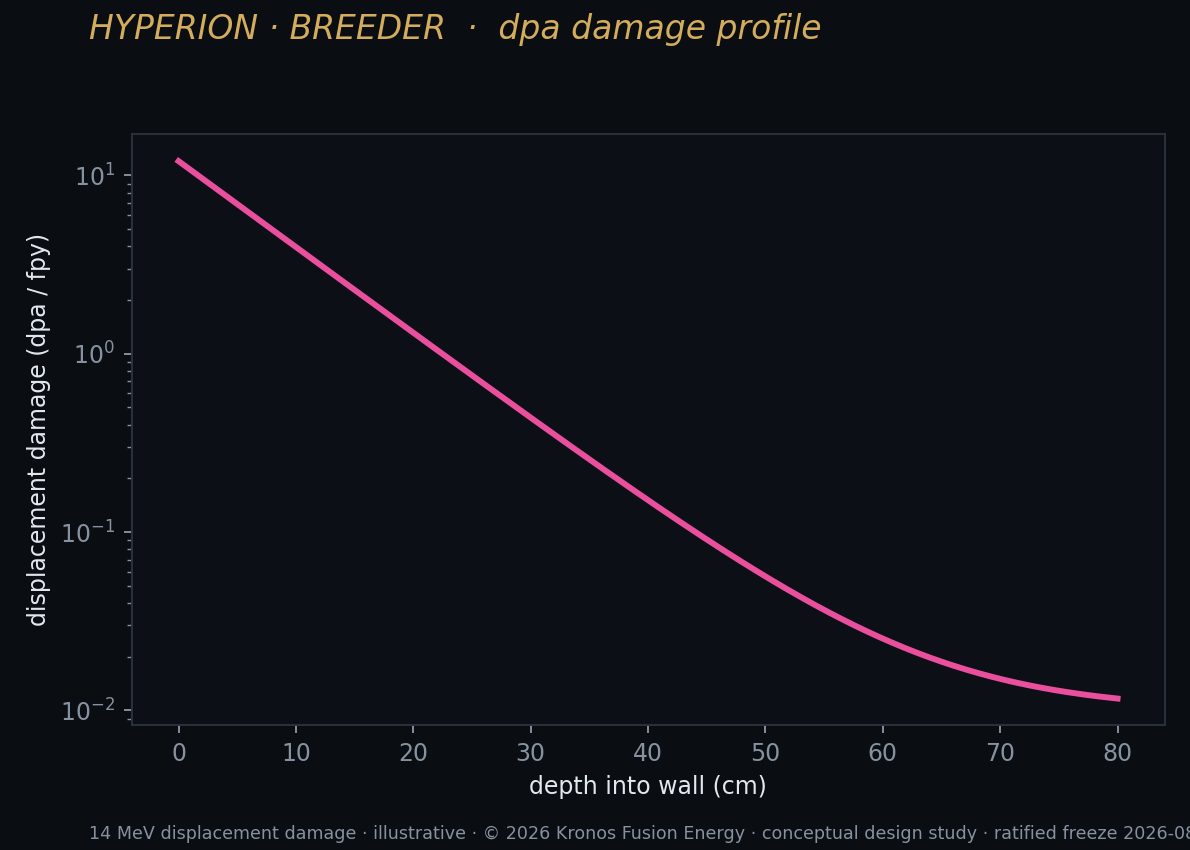
Hyperion produces 14-MeV neutrons at a source strength of about 3.1 × 10¹⁹ per second, delivering a neutron wall loading near 1.97 megawatts per square metre — a flux far more intense than the dedicated fusion-materials irradiation facilities the field has proposed and, in some cases, is still struggling to fund. This matters for a reason that sounds circular but is not: every future fusion power plant, ours included, will be built from structural materials that must first be qualified against fusion-spectrum neutrons, and a 14-MeV neutron does damage that a fission reactor's slower neutrons cannot faithfully mimic — it knocks atoms out of a crystal lattice harder, and it transmutes them into helium and hydrogen inside the metal in a way lower-energy neutrons do not. There has never been a place on Earth to do that qualification at rate. Hyperion is one. The neutron that a clean D–³He burner deliberately refuses to make is exactly the neutron the breeder makes by the trillion — which is why the breeder, not the burner, serves the irradiation and isotope market. The two machines are complementary down to the neutron.
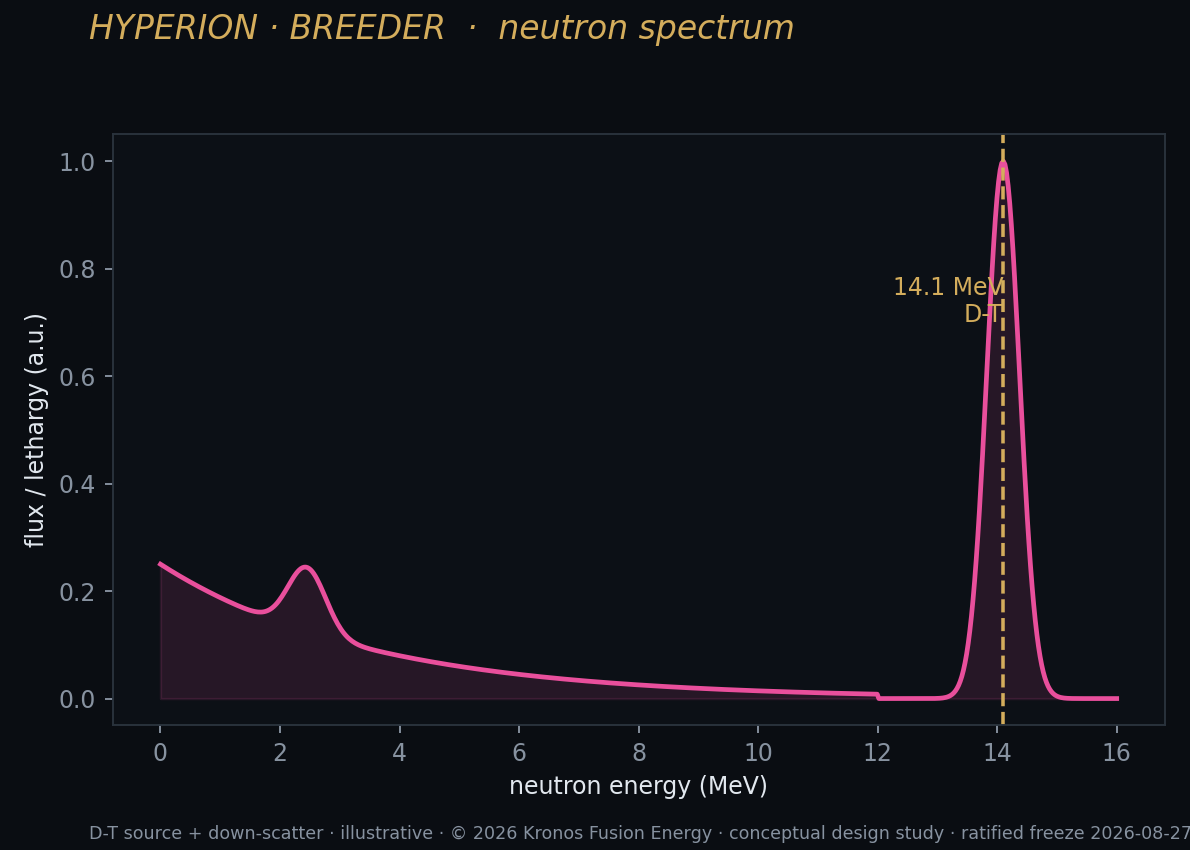
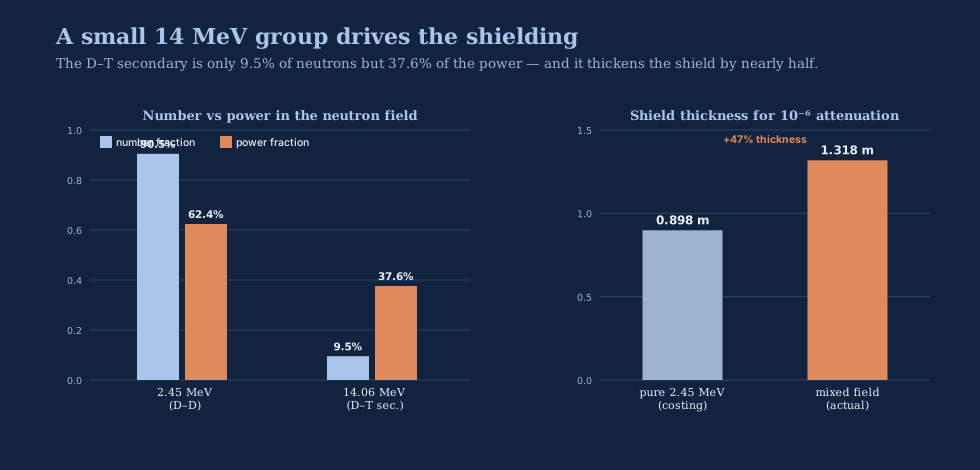
The breeder's neutron field is not monochromatic, and the detail matters for how the machine is shielded and how well it qualifies materials. Most of the neutrons come off the deuterium–deuterium side reactions at 2.45 million electron-volts, but the D–T burn opens a second, harder group at 14 megaelectron-volts. That hard group is a minority by count — under a tenth of the neutrons — yet it carries more than a third of the neutron power, and it is the group that does the qualification work no fission reactor can mimic: it drives threshold reactions that lower-energy neutrons cannot, and it generates roughly eleven times as much helium inside steel. It also sets the shield. A shield designed for a pure 2.45-MeV spectrum is undersized by nearly half against the real mixed field; the 14-MeV group demands about 47 percent more shielding thickness, and therefore mass, than the soft group alone would. This is the sort of number that is invisible until you compute the spectrum honestly, and expensive if you do not.
And a neutron flux that intense is also an isotope factory. Aimed at the right targets, Hyperion's neutrons produce medical and industrial isotopes as co-products of the same core — molybdenum-99, the workhorse of nuclear-medicine imaging, at roughly 1,945 curies per full-power-year; terbium-161, a promising successor to today's targeted radiotherapies, at some 3,689 curies per year; with actinium-225 for targeted-alpha cancer therapy carried honestly as further upside. These are not speculative markets. They are supply gaps the medical world lives with today, filled as a side effect of making fuel.
The fuel cycle, whole
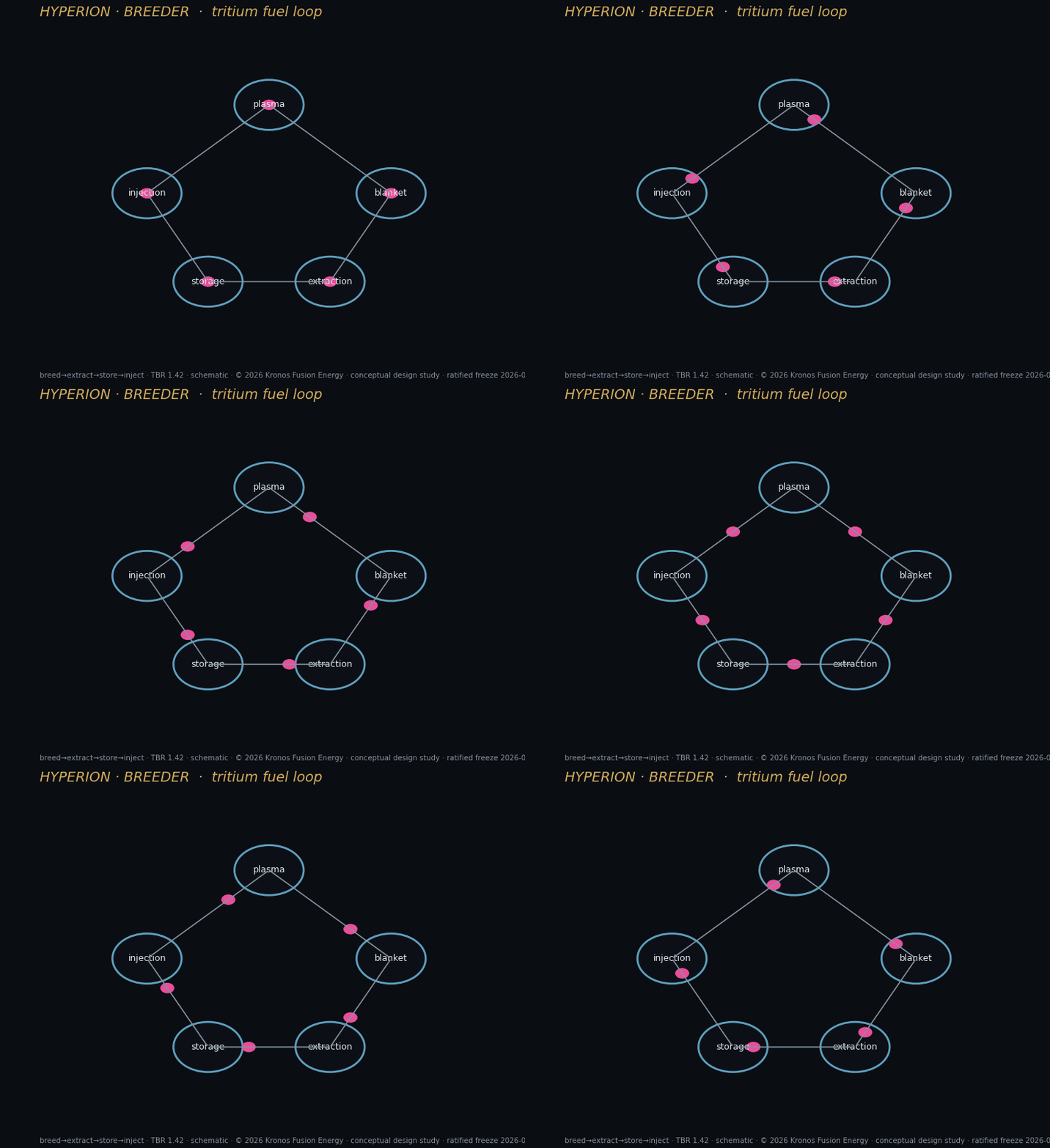
Step back and the machine resolves into a single loop.
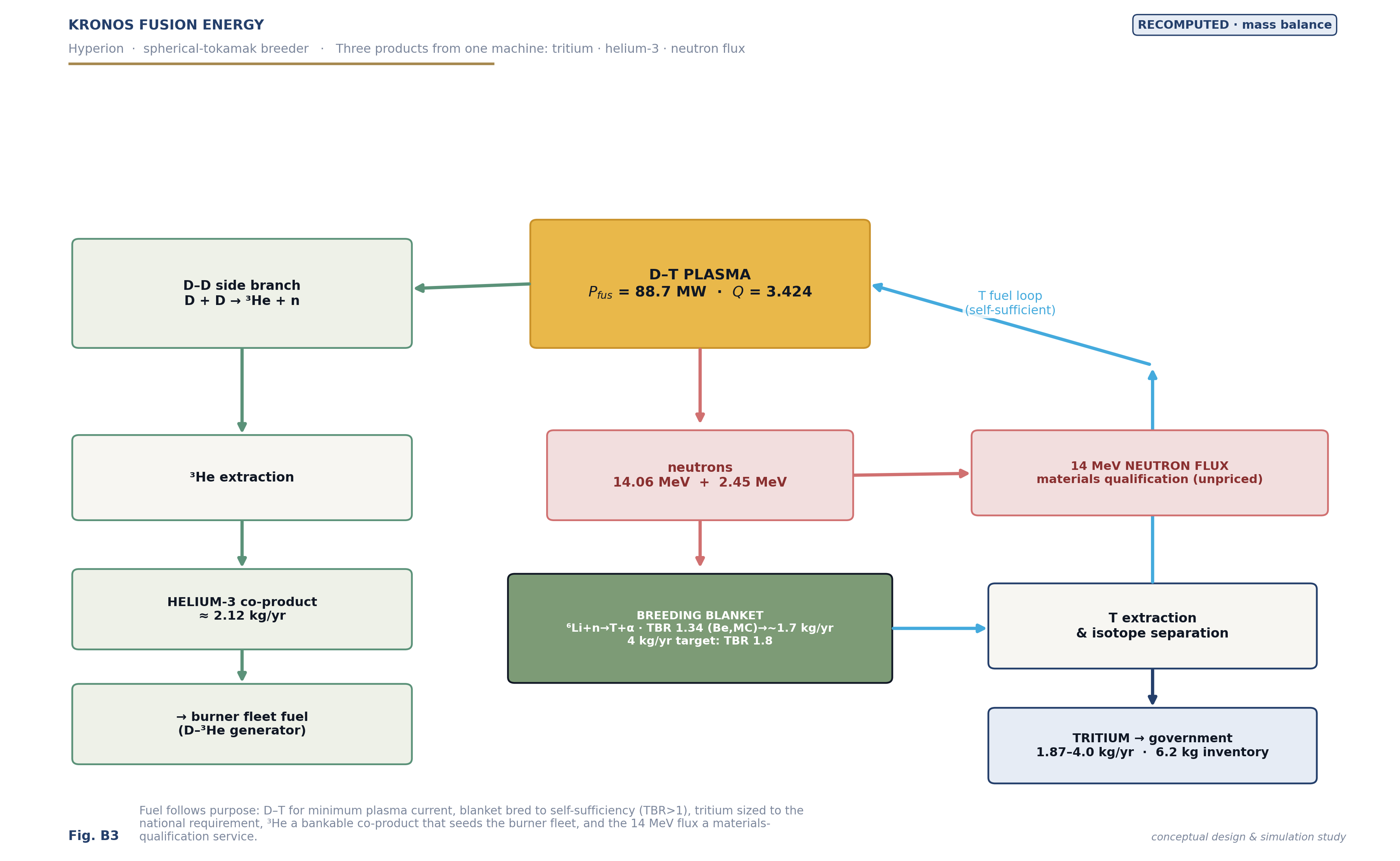
Deuterium and tritium go in. The plasma burns, throwing off charged helium and — mostly — fast neutrons. The neutrons strike the lithium blanket and, with the beryllium multiplier's help, breed new tritium to replace what was burned. The surplus tritium is drawn off: some delivered to the national requirement as tritium, some set aside to decay quietly into helium-3. The same neutron flux, on its way to the blanket, qualifies materials samples and transmutes target isotopes. One plasma, three products — tritium, helium-3, and neutrons — each addressing a real and unmet need, and each accounted for separately so that no stream is counted twice. That last point is a matter of integrity: the neutron irradiation hours, for instance, we book at zero value, because no established market price for them exists anywhere in the world, and we would rather sweep a real product than bank a speculative one.
The machine that watches it
One more enabling subsystem is worth a paragraph here, because Hyperion inherits it from work done for the harder machine, and inheriting it is part of why the breeder is the near-term build. (The other such inheritance, the centrepost magnet, we have already met — a strain-managed conductor developed against the burner's far more demanding plug coil, sitting stress-comfortable at its frozen working point and bound not by stress but by neutron lifetime, which is why we treat it as a scheduled-replacement part.)
The subsystem is the control layer. A nuclear-regulated device has to be operated, certified, and kept inside a safe envelope in real time, and that is handled by a layered digital-twin architecture treated in its own chapter elsewhere in this book. The honest framing for the breeder is that none of this chapter's physics depends on that layer: physics-informed machine learning is deployable now inside a deterministically clamped safe set, quantum sensing is a near-term diagnostic tier, and quantum computation is an offline calibration tier with no resource advantage this decade. The control system is the certification-and-operations path, carried alongside the design rather than baked into its power balance.
The honest gates, and the clock
So where does that leave us, and when?
Let me state the gates the way I state them to reviewers and to myself. Hyperion is buildable on gain already in hand — the design is solved, published open-access, and independently reproducible; the reduced-order physics engines that produce these numbers can be run in a browser by anyone who wants to check them. But the load-bearing figure is the scientific gain, and here is the sharpest honesty in the chapter: no fusion device anywhere has yet exceeded a Q of about 0.7. Hyperion's design point sits at Q ≈ 3.076, several times higher, and we carry that openly as a design-point target that remains to be demonstrated — not as a result. It has no hardware built yet, and I will not pretend otherwise. The gain is solved on paper and in code, not yet demonstrated in steel; hardware validation comes with the first machine's operation, not before.
Two smaller declarations belong in the same spirit, because the record requires them and because leaving them out would be the kind of quiet rounding this book exists to refuse. The first is the triangularity. The design value carried through the deposit is negative, δ = −0.30; a variant in the configuration scan carried a positive value, and although the two differ by only a couple of percent in current, they must not be conflated — the negative sign is the design, the positive one an artefact of the sweep. The second is the helium ash. The scan applied a five-percent helium-4 fraction to the D–T cases and zero to pure D–D. The zero is physically correct — neither D–D branch makes helium-4 — but the asymmetry runs against the fuel that wins, so if anything it understates D–T's three-fold current advantage rather than inflating it. The machine's own equilibrium ash fraction we report as genuinely undetermined, somewhere in a band the particle balance admits, rather than pinning it to a convenient value. None of this changes the verdict; all of it is the difference between a scan you can trust and one you cannot.
The reason I can still call this the buildable machine is the very thing this chapter has been circling. A breeder needs gain, not net electricity — a driven, sub-breakeven plasma at demonstrated confinement is a materially easier target than the full round-trip a power plant must win. The hard part of a fusion breeder was never the nuclear physics of breeding, which is textbook; it was the two obstacles that sank every prior proposal — machine scale and tritium inventory — and both of those now fall below their binding thresholds. What remains load-bearing is the plasma gain, and what remains after that is engineering. The old slogan of "net gain in 2027" is retired for good — 2027 is when we begin to build, not when a milestone lands.
The schedule follows from that discipline. Construction of the first machine begins in the second quarter of 2027. The first tritium is targeted for around 2030, on a build of roughly three and a half years, and we carry 2031 as the sober planning basis in case the first-of-a-kind takes the longer road that first-of-a-kinds usually take. And because this is a foundry serving a finite requirement for fuel and materials — not a fleet meant to blanket the grid — we build few of these, deliberately: a small number over the following decade, each one faster than the last as the learning curve bites.
That is the machine. Not a power plant, and never dressed up as one. A compact spherical tokamak, barely a metre across at its heart, that embraces the neutron it was built to make, breeds more fuel than it burns, manufactures the scarcest commodity in fusion as a matter of radioactive patience, and qualifies the materials every reactor after it will be made from. Consider what that means: a machine the size of a small room, quietly minting the fuel of stars and the isotopes of modern medicine from lithium and time. It starts the whole clock — the deliberately conservative clock of within forty years — by making, at last, the fuel that everything downstream will burn. Prometheus stole fire from the gods; Hyperion will make it, on a schedule, inside a building heavy industry already knows how to pour. The next chapters follow that fuel out of the foundry and into the machine that finally turns it into power.