Public Dose Closes, With Room to Spare
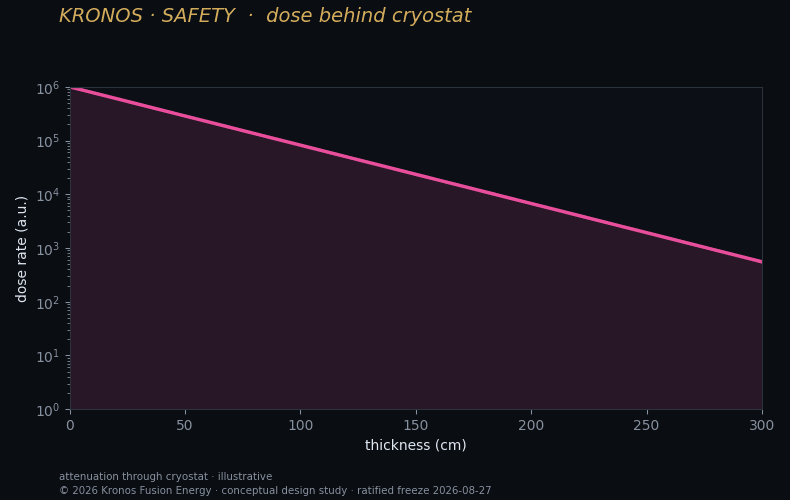
The breeder's public-dose case closes as an achievable requirement. Meeting the offsite dose target needs a detritiation factor between 1 and 34 — against an ITER-class demonstrated capability of 1,000 to 10,000. The margin is two to four orders of magnitude; this is a design task with a known solution, not a physics gap.
The science
The required detritiation factor to meet the public-dose target is 1 to 34. Demonstrated ITER-class detritiation runs 1,000 to 10,000 — so the requirement sits far inside proven capability, with remote siting reducing it further. Detritiation is off-the-shelf technology, not a first-of-a-kind development.
Why it matters
Public dose is often assumed to be a hard barrier for a tritium facility. Showing it needs only a single-to-double-digit detritiation factor, against demonstrated four-digit capability, converts a feared unknown into a routine engineering specification — part of why the non-physics items are the easy part.
The numbers
| Required detritiation factor | 1-34 |
| Demonstrated ITER-class | 1,000-10,000 |
| Margin | ~2-4 orders of magnitude |
| Detritiation | off-the-shelf technology |
| Status | closes as an achievable requirement (D2-45) |