Breeding at 1.8: How Hyperion Makes More Than It Burns
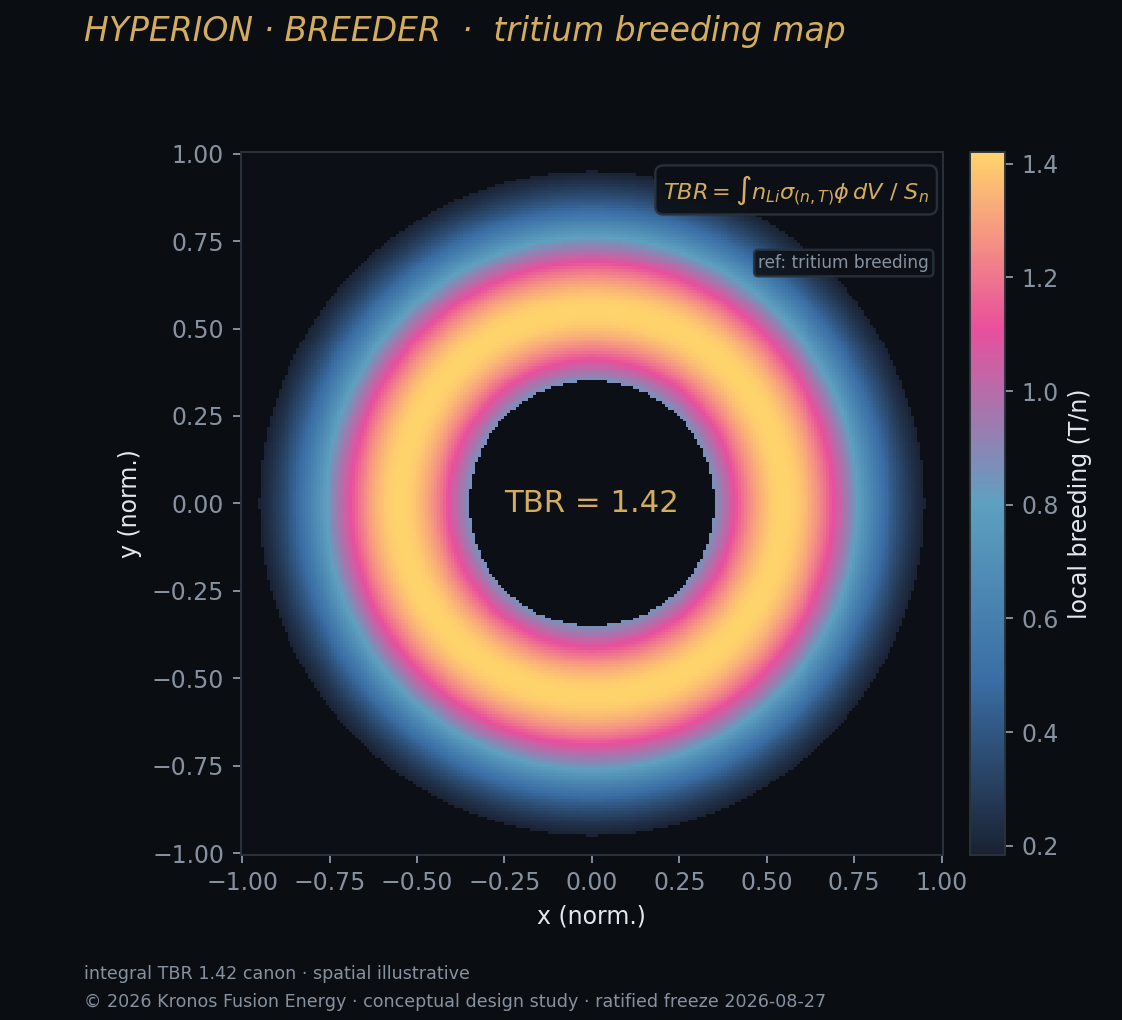
Hyperion breeds 1.8 units of tritium for every unit it burns. That surplus above self-supply is what lets the breeder deliver tritium to the national requirement and seed the helium-3 stream at once — and the ratio is a lever the design sets, not a constant it inherits.
The science
A tritium breeding ratio above 1.0 means net production. Hyperion's blanket scan sets the ratio at 1.8, leaving a 0.8 surplus above what the plasma consumes. That surplus, sized by the breeding-ratio lever, is delivered as product tritium — some to the national requirement, some ripening into helium-3.
Why it matters
The breeding ratio is the knob that makes Hyperion a foundry rather than a self-consuming reactor. Setting it at 1.8 sizes the surplus to a real requirement, and treating it as a lever means the output can be tuned to demand rather than fixed by physics.
The numbers
| Tritium breeding ratio | 1.8 |
| Surplus over self-supply | 0.8 |
| Surplus delivered as | product tritium + He-3 accrual |
| Ratio type | design lever |
| Source | blanket scan |