The Neutron Fraction Is Not a Fuel Constant
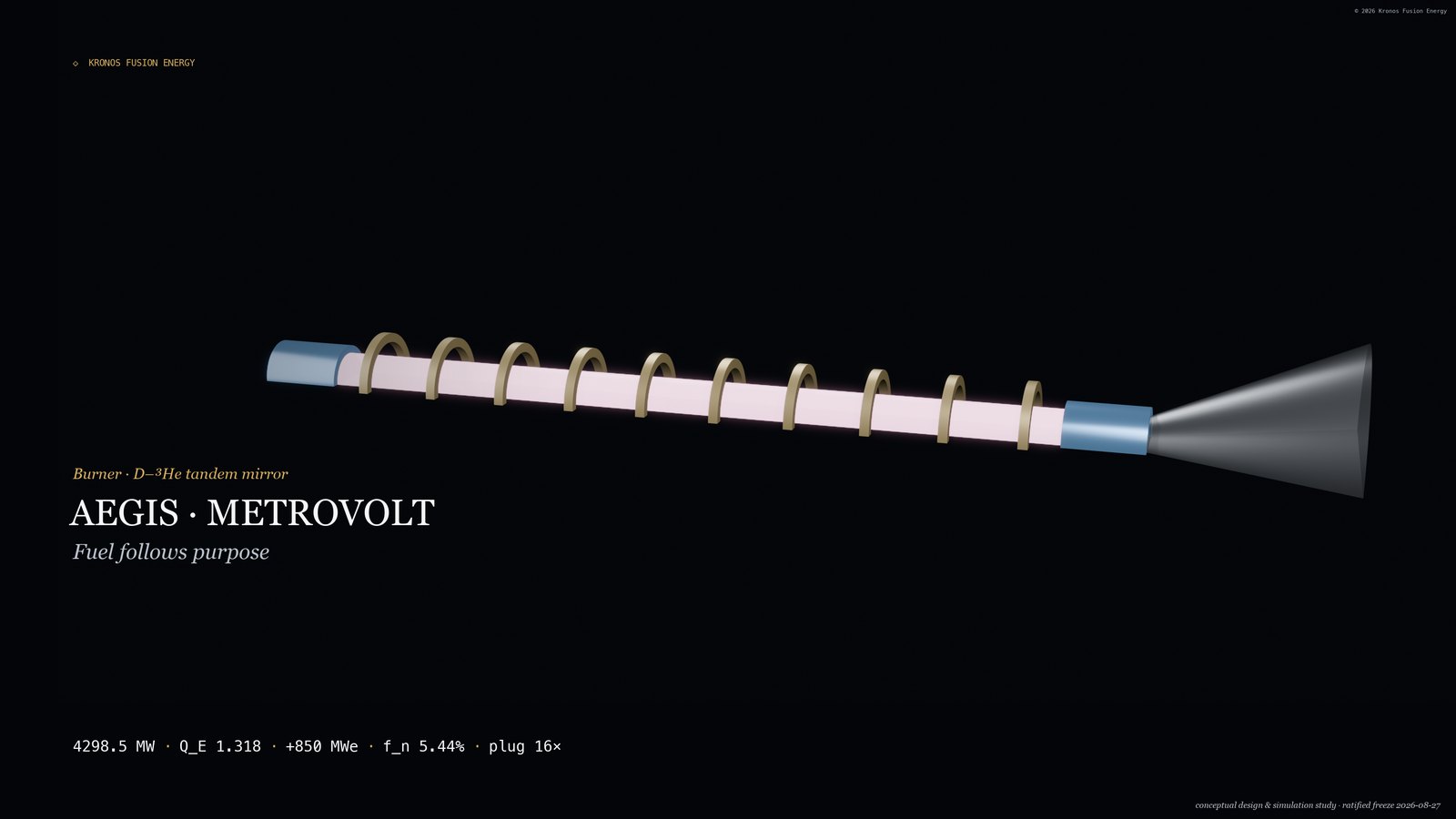
The burner's neutron fraction is not a fixed property of its fuel. Computed from cross sections with every reaction channel, it is 5.44% at the locked design point and varies with the fuel mix and confinement — from 9.53% at the x=0.20 floor to 2.77% at the clean edge — because tritium burnup, and therefore neutron output, scales with both.
The science
The prior evaluator carried the neutron fraction as a constant, 4.8%. Recomputed from the stored cross sections with all D-D channels and the secondary D-T burn, it is not constant at all: better confinement means longer particle residence, more tritium burnup, and more neutrons. The fraction moves from 1% to 17.3% across the 51,840-point scan.
Why it matters
This is a real, counterintuitive coupling: a design that improves confinement makes itself more neutronic. A model with a constant neutron fraction cannot see it. Publishing the coupling is what lets the shielding and materials cases be sized to the operating point rather than to an average.
The numbers
| Design-point neutron fraction | 5.44% (locked config) |
| Fuel-mix range | 9.53% (x=0.20) -> 2.77% (clean edge) |
| Driver | tritium burnup ~ confinement + fuel mix |
| Prior model | constant 4.8% (superseded) |
| Free clean-shift | 4.18% at x=0.35 |