The Fuel Mix Is a Neutron Knob — and the Machine Gets Cleaner With Time
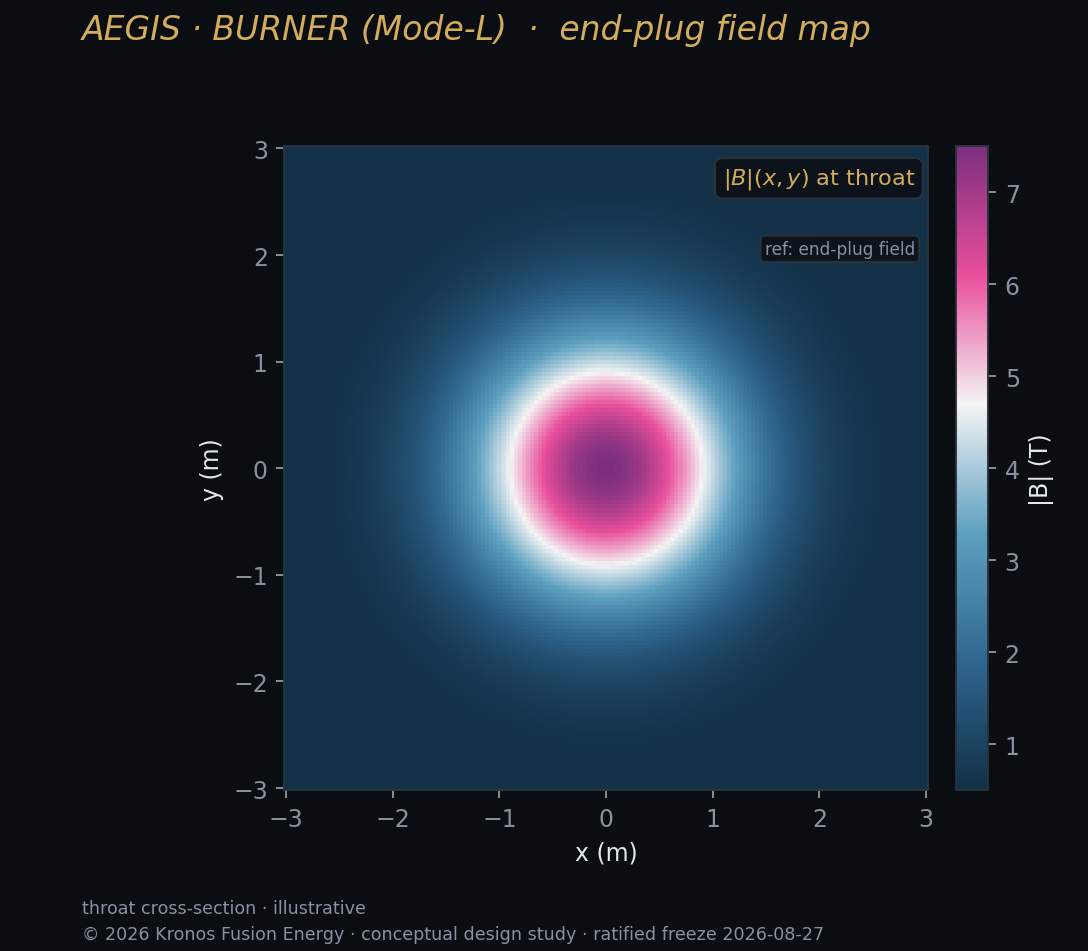
The burner's helium-3 fraction is a lever on neutron production, computed on the locked closing config. Across the closure window x_He3 ∈ [0.20, ~0.43] the neutron fraction falls about 3.4-fold, from 9.53% at the x=0.20 floor to 2.77% at the clean edge. So as lunar helium-3 matures, the same machine can be run measurably cleaner over its life.
The science
A higher helium-3 fraction means fewer D-D reactions, the neutron source, so the neutron fraction falls steeply while gain stays strong. On the locked config (n_p/n_c=16): the x=0.30 design point runs f_n 5.44% at Q_E 1.31; shifting to x=0.35 cleans it to f_n 4.18% while staying net-positive — the FREE clean-shift. Below x=0.20 and above ~0.43 the machine no longer closes; true near-aneutronic operation (x ≥ 0.45) needs a redesigned machine, not just more fuel.
Why it matters
The mix is a tuned operating choice, not luck, and it improves with the fuel supply: a leaner helium-3 fraction burns less scarce fuel but makes more neutrons, a richer one does the reverse — up to the closure edge. Publishing the whole trajectory, and naming the free clean-shift on it, makes the burner's low-neutron character a design decision the reader can second-guess.
The numbers
| Lever | helium-3 fraction x_He3 (locked config) |
| Closure window | x in [0.20, ~0.43] |
| x=0.30 design point | f_n 5.44%, Q_E 1.31 |
| x=0.35 free clean-shift | f_n 4.18% (still net-positive) |
| x >= 0.45 | closure lost; needs a REDESIGN |