Why Pure Deuterium Does Not Close in a Mirror
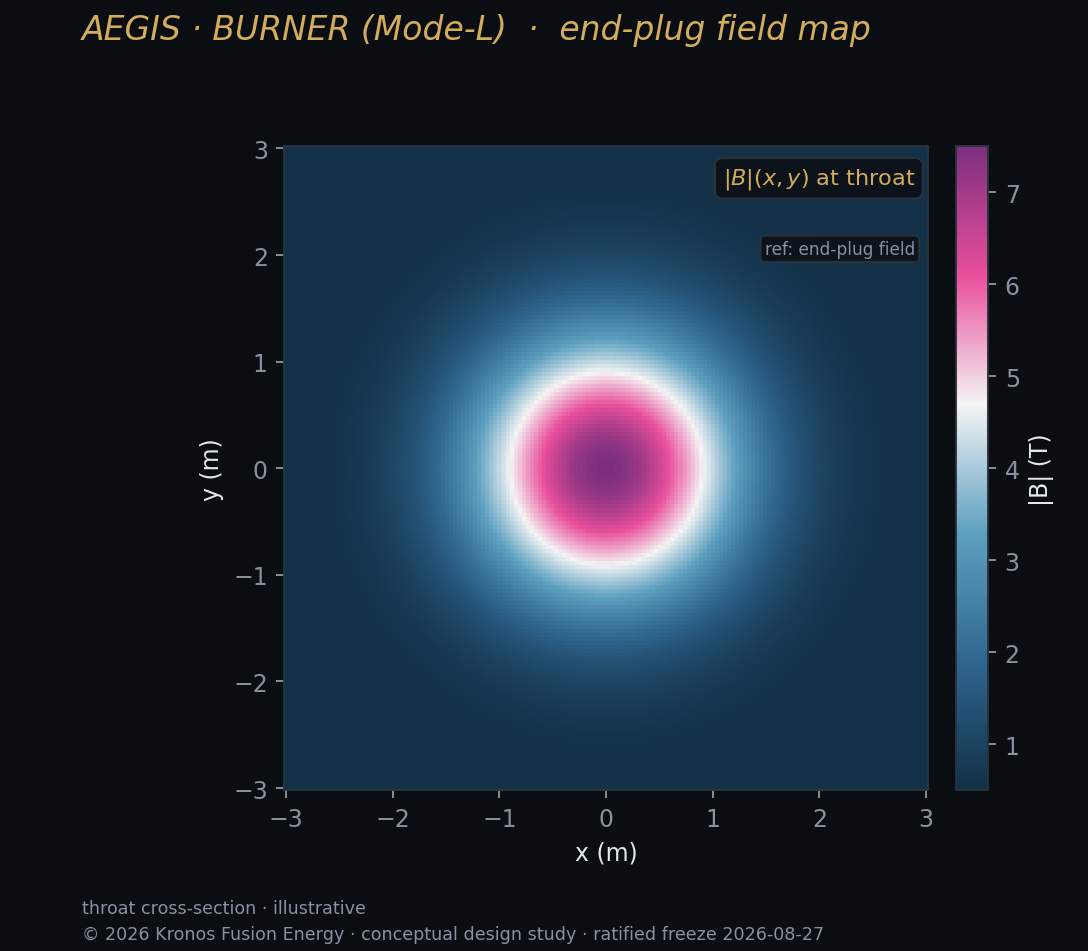
Pure deuterium-deuterium fuel actually confines better in the burner's mirror than D-3He does — yet it cannot reach net electricity. The failure is not confinement; it is that at a high neutron fraction, too little charged power is left to fund the axial loss.
The science
In the deposited arbiter, pure D-D reaches an engineering gain of only 0.4314, a net deficit (-8,255 MWe), despite a longer confinement time than D-3He. The reason is the charged-power budget: at the deposited point (ion temperature 90 keV), a 41.4% neutron fraction leaves just 173.7 MW of charged power against an 8,779 MW axial loss — a 51-fold shortfall. (A higher-temperature 250 keV scan reports 47.3% / 420 MW / 7,815 MW; those are scan values at a different temperature, not the deposited point.) The machine starves regardless of how well it confines.
Why it matters
This is the counterintuitive result that proves the mechanism. Better confinement does not rescue a fuel whose energy leaves as neutrons, because neutrons cannot pay end losses. It is the cleanest demonstration of why the burner must run helium-3-rich.
The numbers
| D-D engineering gain Q_E | 0.4314 (net -8,255 MWe) |
| D-D confinement | longer than D-3He, still fails |
| Deposited point (Ti 90 keV) | f_n 41.4%, 173.7 MW charged vs 8,779 MW axial (51x) |
| Ti 250 keV scan (labeled) | 47.3% / 420 MW / 7,815 MW |