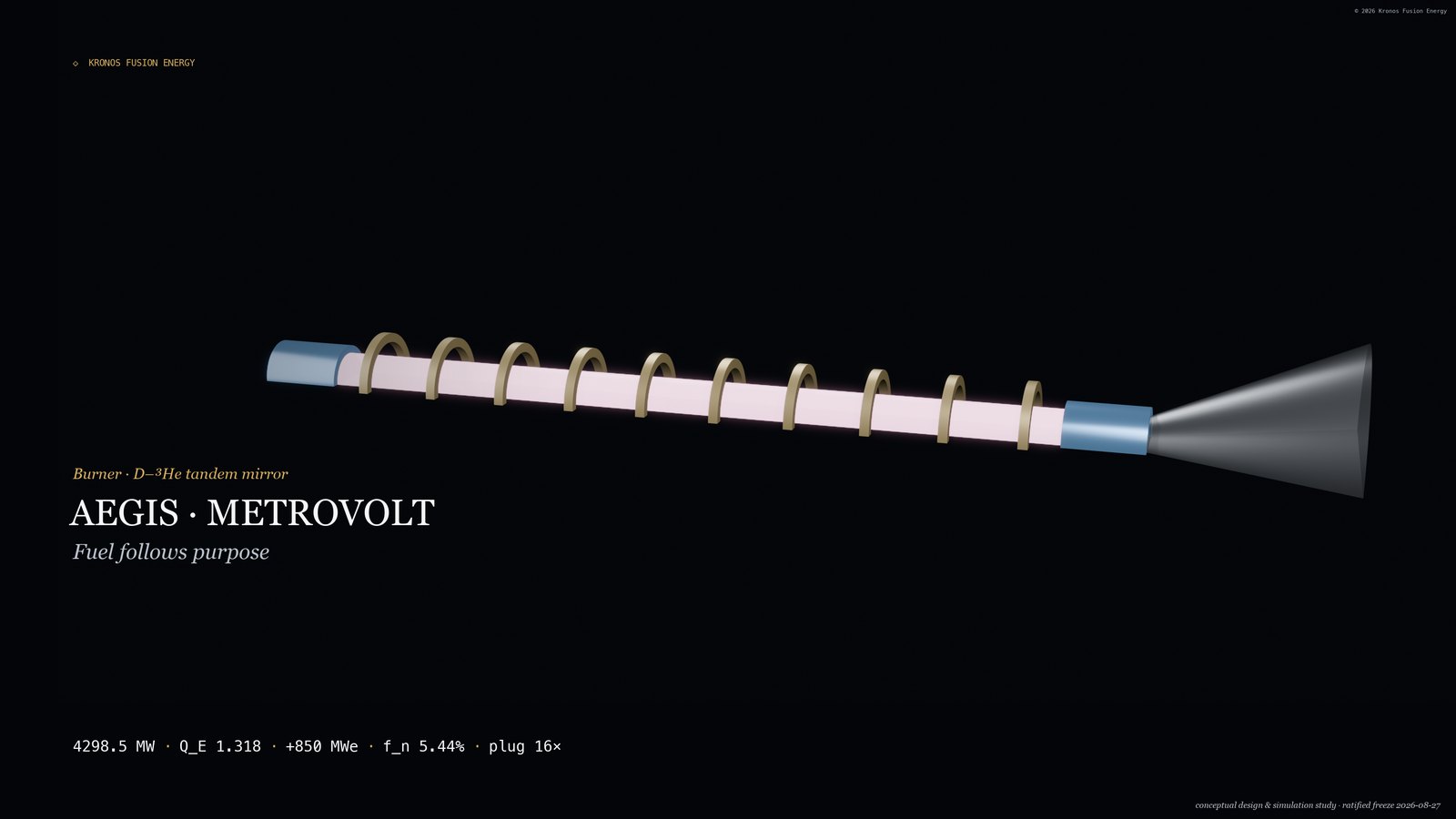
The Locked Mode M Closing Point: Q_E 1.31, On One Hard Requirement
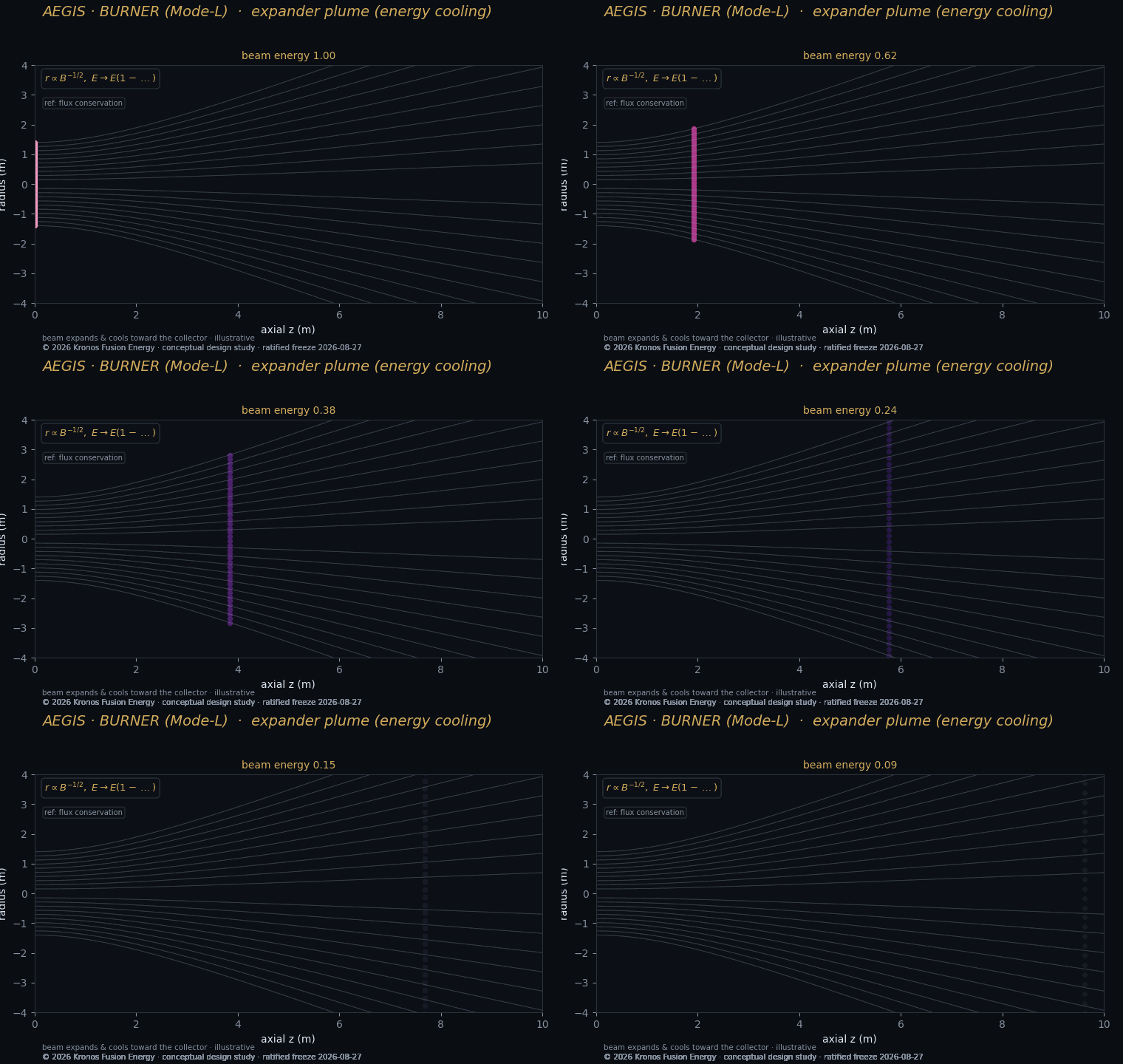
The burner's closing point is locked and reproduces on the deposit's own solver: engineering gain Q_E 1.31 at a helium-3 fraction of 0.30. But it is honest about the price. At the reference end-plug density ratio of 10 the machine does not close (Q_E 0.63, net -160 MWe); closure needs a plug density ratio near 16 — a requirement, not a demonstrated result.
The science
The solve computes every channel: fusion power by cross section, radiation by synchrotron and bremsstrahlung, axial loss by ambipolar theory, confinement from Pastukhov theory. At the design point (n_p/n_c=16, x=0.30, Ti=90 keV, ne=2.6×10²⁰ m⁻³) it reproduces Q_E 1.31 and f_n 5.44%, both length-independent. Net electric then scales with central-cell length: +104 MWe at 55 m, +850 at Aegis (440 m), +2832 at MetroVolt (1400 m).
Why it matters
A closing point is only as good as its reproducibility and its honesty about what it assumes. This one reproduces from the shipped code, and it names the single hard condition it rests on — the end-plug density — rather than burying it. Alpha channelling is assumed nowhere.
The numbers
| Design-point gain Q_E | 1.31 (length-independent) |
| Neutron fraction | 5.44% (length-independent) |
| Reference n_p/n_c=10 | does NOT close (Q_E 0.63, -160 MWe) |
| Net at l_c 55/440/1400 m | +104 / +850 / +2832 MWe |
| Closure status | requirement-class (plug ~16), not demonstrated |