Capacity Factor: Damage-Life-Limited, Not Duty-Limited
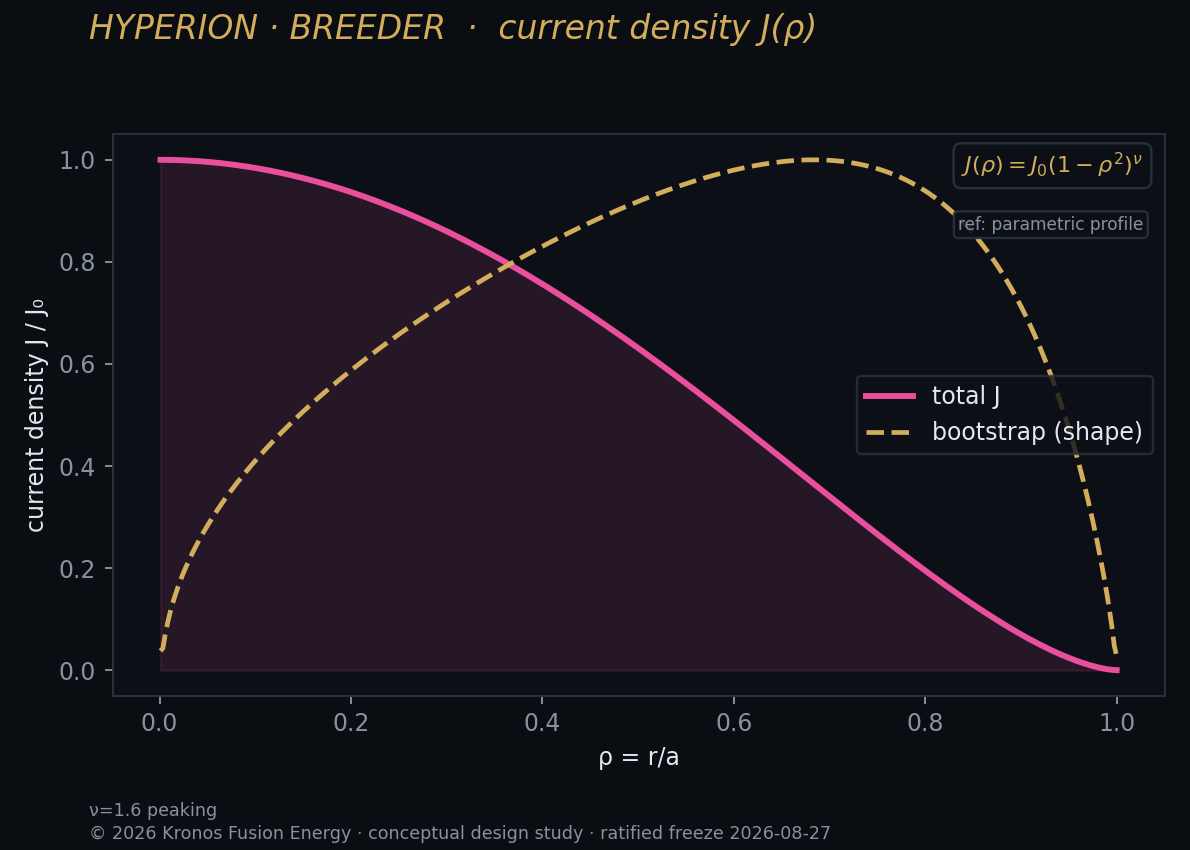
A breeder's product is fuel per year, and that depends on capacity factor — the fraction of time the machine actually runs. Hyperion runs steady-state (bootstrap plus driven current together carry the full plasma current), so its capacity factor is damage-life-limited, not duty-limited: a defensible band of 0.58 to 0.83, central 0.69.
The science
Because the machine is steady-state, there is no pulse duty cycle to cap uptime; what limits it is first-wall damage. At about 19.66 displacements-per-atom per full-power year the wall reaches a life of roughly 2.5 full-power years, which sets the capacity-factor band at 0.58 to 0.83 (central 0.69). This supersedes the older pulsed 0.1442 figure, which assumed the wrong operating mode.
Why it matters
Because tritium delivered per year scales directly with capacity factor, and availability is the dominant lever on the breeder's whole case, the basis matters: a steady-state, damage-life-limited band is a physically grounded number, where a pulsed duty figure was simply the wrong model. The band is wide because it is contingent on three research inputs, and the record says so.
The numbers
| Operating mode | steady-state (bootstrap + driven = Ip) |
| Capacity factor | 0.58-0.83 (central 0.69) |
| Limit | damage-life, not duty cycle |
| First-wall damage | ~19.66 dpa/fpy -> life ~2.5 fpy |
| Supersedes | the pulsed 0.1442 basis |