KRONOS FUSION ENERGYWHITEPAPER 008 / 104
Hyperion — The Breeder

Breeding Ratio Is a Lever, Not a Constant
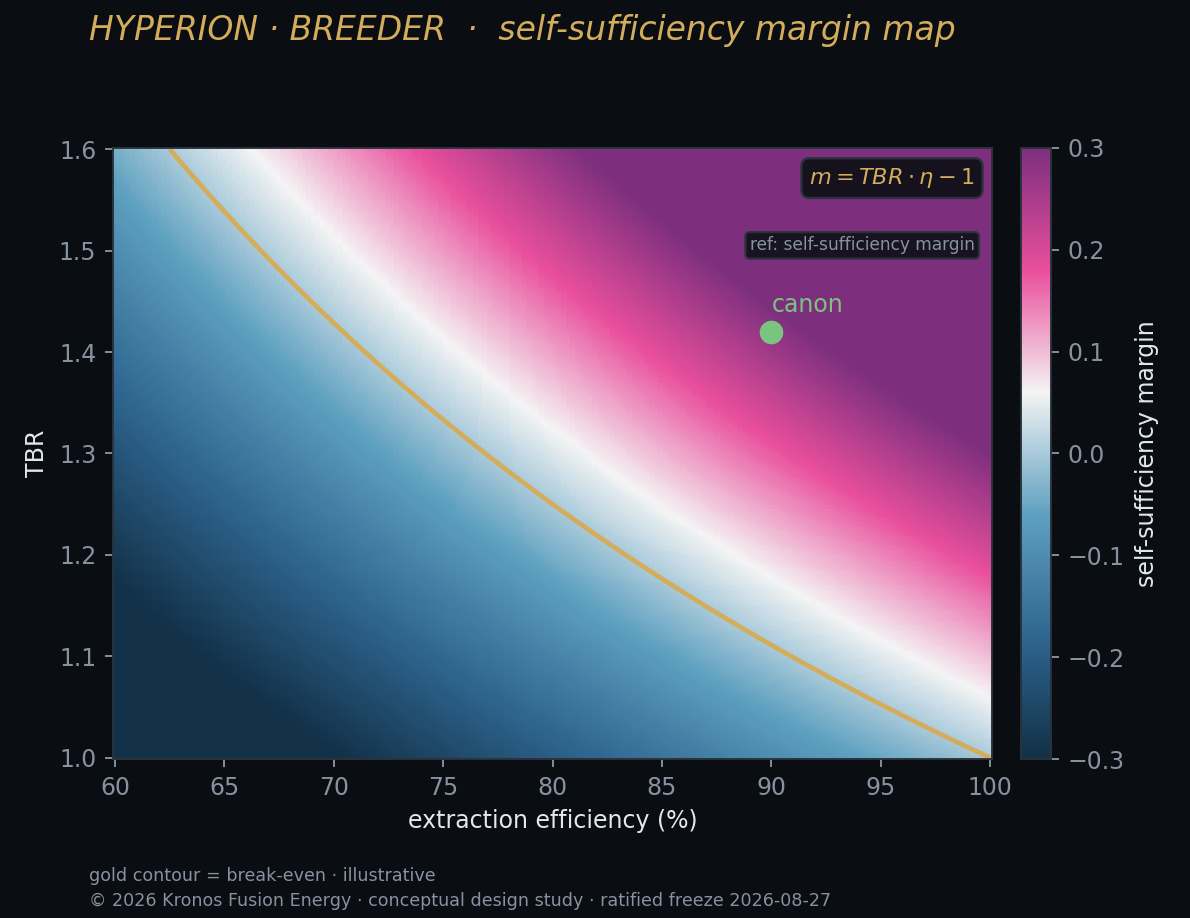
How much tritium Hyperion makes per tritium burned is a design choice, and the design chose 1.8.
Hyperion's tritium breeding ratio is 1.8 — but the important claim is that breeding ratio is a lever the design sets, computed from the blanket scan's own values, not a fixed constant of nature.
The science
Tritium breeding ratio depends on blanket geometry, material, and neutron spectrum — all design variables. Hyperion's 1.8 comes out of a scan over those variables, so it can be traded against other requirements rather than quoted as an immovable given.
Why it matters
Treating breeding ratio as a lever is what lets Hyperion be sized to a customer's tritium requirement instead of to a physics optimum. The surplus above 1.0 is the margin that lets the machine supply the national requirement and seed the helium-3 stream at once.
The numbers
| Tritium breeding ratio | 1.8 (design lever) |
| Source | blanket scan values |
| Not | a fixed constant |
| Surplus over self-supply | 0.8 |
| Enables | sizing to the requirement |
Straight answers1.8 is a computed lever setting, not a guarantee of the as-built blanket; the breeding programme is where that value is demonstrated, and the scan that produced it is deposited.
Kronos is the fusion company that shows its work. Every figure here traces to the openly deposited Kronos simulation programme and design-point records (CC BY 4.0).
Read the series, run the code, check us. — All whitepapers
· Read the formal papers & open data
Building toward first construction in 2027 — isotopes first, electricity next. Quantitative values
are simulation-derived and carry the feasibility gates named in the text; superseded values are kept
in the record with era labels. This document is informational and is not an offer of securities.
© 2026 Kronos Fusion Energy, Inc. · Los Angeles, California.
← Back to the whitepaper library