🎧 Prefer to listen? Open the audiobook
The Staged Road to Q40
This is the chapter where the three forties stop being ideas and harden into a calendar. Everything up to now has argued the physics and the doctrine: why forty is the number that matters for gain, for price, and for patience; why the physics forces two machines instead of one; why the near-term business of fusion is fuel and materials rather than electricity. A vision without a calendar is just weather — a mood that drifts overhead and moves on. So now I owe you the harder, riskier, more honest thing: the schedule. Not a manifesto, not a mood board of the shining future, but dated milestones, in order, with the honest gates marked exactly where they fall — so that a reader in any given year can hold this page up against the world and check us against our own word.
I want to be exact about what kind of promise this is. It is not a promise that a miracle descends on a particular Tuesday. It is a construction sequence — foundations poured, machines commissioned, fuel accumulated, a fleet grown — laid over a learning curve that gets faster as we repeat ourselves. The dates that follow are the public planning basis. Some are targets, and some are the more conservative number we actually plan against; where the two differ, I give you both, out loud, on the same line. That difference is not hedging. It is the method of this book made visible.
A schedule is also a form of exposure, and I know it. Once a date is written down, it can be missed in public, and every fusion program that ever missed one in public paid for it in the only currency that matters. I am writing these dates down anyway, because a roadmap that cannot be checked is not a plan — it is a mood with numbers painted on it. What follows is built, deliberately, to be checked.
Two clocks, not one
The single most important thing to understand about our timeline is that it does not run on one clock. It runs on two, and they tick at different rates, for different reasons, toward different ends.
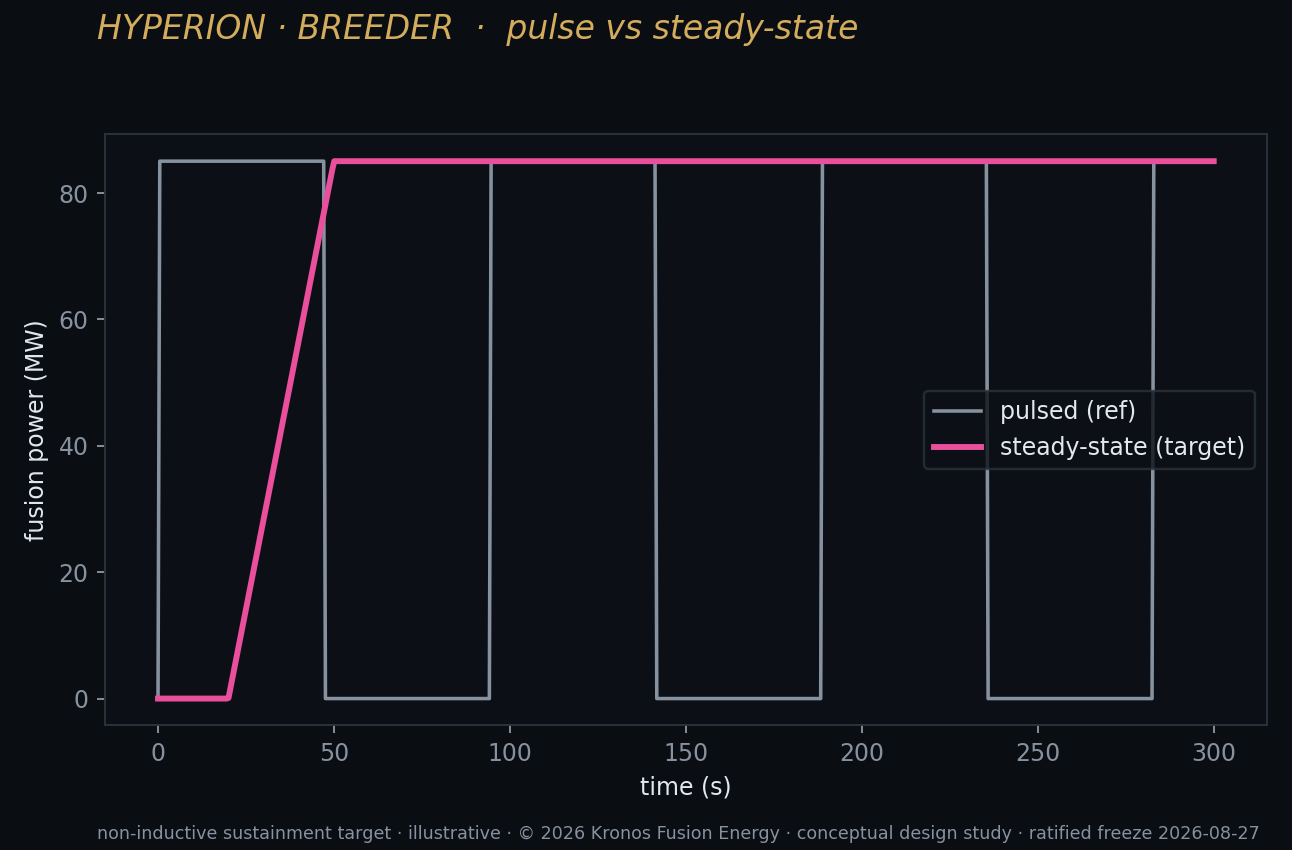
The first clock is the breeder clock. The breeder — our spherical-tokamak "Hyperion" — is the foundry: a deuterium–tritium machine that makes fuel, not power. It manufactures tritium, helium-3, and a torrent of 14-MeV neutrons. We build breeders few and deliberately, because the market for what they make is finite. Tritium is measured in kilograms a year, not gigawatts; helium-3 and the neutron flux for advanced materials and isotopes serve real but bounded markets. You do not need a hundred foundries to supply a materials-and-fuel market; you need a handful, sited and staged with care, like the great forges of an earlier industrial age. The breeder clock is therefore slow and short: a small number of large, deliberate machines, each one added only as demand for what it makes actually grows.
The second clock is the burner clock. The burner — the D–³He tandem-mirror generator, housed as Aegis for fixed defense sites and MetroVolt for data centers — is the power fleet. This is where electricity, and eventually the forty-dollar electron, actually lives. The burner clock is later, and it is built to run fast and wide: many machines, thrown up at accelerating pace, multiplying toward a fleet. But it is gated — held deliberately in check by a fuel constraint — until cheap helium-3 arrives from the Moon around 2040. Before that gate lifts, the burner fleet is small on purpose, running on the limited helium-3 the breeders make. After it lifts, the fleet is free to scale, and the character of the whole enterprise changes.
The breeder is a foundry we build a few times, on purpose. The burner is a power fleet we intend to build a great many times — but only once the fuel is cheap enough to earn its keep.
The reason the two clocks are offset, and not simply run side by side, is that each one supplies something the other cannot move without. The breeder produces the helium-3 that the first burners burn; you cannot demonstrate a D–³He generator without the fuel that only a D–T foundry can make. And the breeder's materials business — tritium, isotopes, neutron flux — is what carries the whole program financially across the years before any burner sells firm power at scale. The foundry is not merely first in time; it is the thing that earns the right to build the fleet. The burner, in turn, is what the entire enterprise is ultimately for: the foundry exists so that the fleet may one day exist, cheaply, everywhere.
Hold those two clocks in your mind at once and the whole roadmap organizes itself around them like filings around two poles. The breeder clock lays the foundation — proven hardware, a fuel supply, a materials business that pays. The burner clock builds the scale — the firm, clean, cheap power that reorganizes the grid of a civilization. One is few-and-early; the other is many-and-later. Neither is a hedge against the other. They are sequenced because the physics and the fuel economy demand that order, and no amount of impatience can rearrange them.
What the foundry actually makes
Because the whole plan rests on the claim that a fusion machine can earn its keep years before it sells a single electron, I owe you a concrete account of what a breeder foundry produces and who is already waiting, wallet open, to buy it. "Materials, not electricity" is not a slogan to be chanted. It is a bill of goods you can inspect.
A deuterium–tritium machine, running, throws off three things of real value. The first is tritium itself. Tritium is the radioactive heavy isotope of hydrogen that nearly every deuterium–tritium fusion effort on Earth needs simply to strike its first spark, and it is desperately, almost comically scarce — the entire civilian world stock is on the order of a few tens of kilograms, it decays away at more than five percent a year, and its only significant current source is a dwindling fleet of a particular kind of fission reactor. Every fusion program that intends to burn deuterium and tritium is therefore a customer for tritium before it can ever be a competitor in power, and there is today no scaled, purpose-built supplier anywhere in the world. Our breeder is designed to breed more tritium than it consumes — the frozen design basis is a breeding lever of 1.03–1.20 (literal recipe to solid-beryllium layer), meaning it aims to make nearly two atoms for every one it burns — so that after fueling itself it holds a genuine surplus to sell straight into that shortage.
The second product is helium-3, a light, stable, and even rarer isotope, coveted for cryogenics, for certain classes of radiation and security detectors, for quantum-device and low-temperature research, and — critically for our own second act — as the clean fuel the burner is built around. Some of it arises directly from the machine and some as the decay product of the tritium it makes. There is essentially no terrestrial mine for it. A foundry that produces it at rate is not entering a market. It is calling one into existence.
The third product is the one almost everyone forgets is a product at all: the 14-MeV neutrons themselves. In an electricity plant those neutrons are a burden, a hazard to be shielded against and endured. In a foundry they are inventory. A controlled, intense flux of fast neutrons is exactly the tool you need to test how materials survive the fusion environment — the single largest open question standing between the field and durable power plants — and to breed isotopes for medicine and industry that nothing else on Earth can make at scale. The breeder sells access to that flux. It is, in effect, the most useful neutron source the world does not yet have, and the world will notice the moment it exists.
Put the three together and the early business model needs no cheap fusion electricity to close. It needs a running foundry, selling into three real, pre-existing shortages that the world is already straining against. That is the whole point of leading with the breeder: it converts the hardest, most expensive, first-of-a-kind lessons of fusion engineering into a machine that pays while it teaches.
The roadmap, year by year
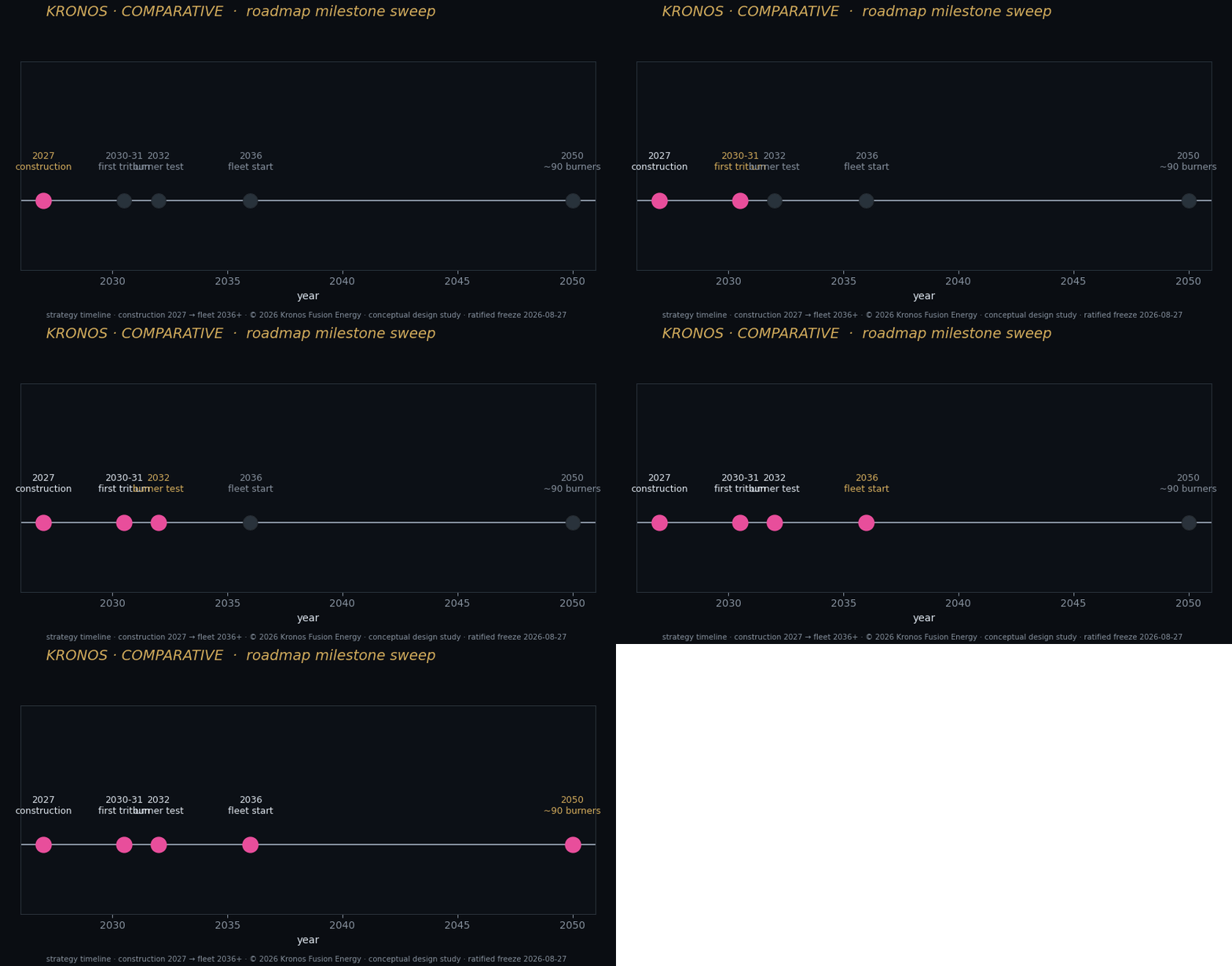
Here is the public timeline, laid out plainly, with nothing up its sleeve. Read it as two interleaved sequences — foundry milestones and fleet milestones — sharing one calendar.
| Year | Milestone | Clock |
|---|---|---|
| 2026 | Design closed, solved, and published open-access — reproducible by any physicist | foundation |
| Q2 2027 | FOAK breeder construction begins ("net gain 2027" is retired: 2027 is a start, not a result) | breeder |
| ~2030 | FOAK breeder produces first tritium (target; 2031 planning basis) — first hardware validation | breeder |
| 2032 | First test burner begins — a ~100 MW D–³He demonstrator to prove the burner physics | burner |
| ~2033–35 | Second and third breeders (NOAK, then BOAK) — the foundry reaches three units | breeder |
| 2036 | Commercial burner fleet begins — ~1 GW units, built at accelerating pace | burner |
| ~2040 | Lunar helium-3 arrives — the fuel gate lifts; burner economics turn | both |
| ~2040s | Burner fleet scales; breeder cadence slows as the Moon supplies helium-3 | both |
| ~2050 | Internal plan: ~90 burner units (~90 GW) and ~5–6 breeders in service | both |
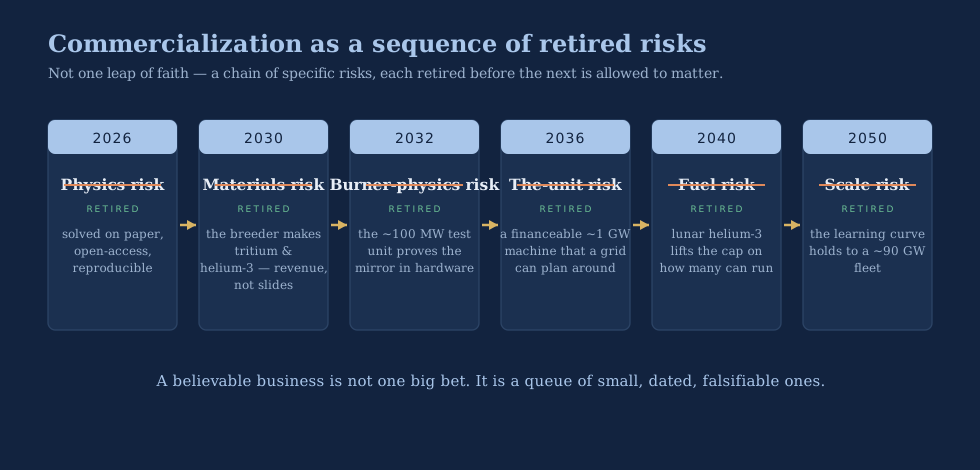
Walk it slowly, because each date carries a specific claim — and, more importantly, each date carries a specific thing that must be proven true before the next date is permitted to arrive. This is not a wish list where the items are independent. It is a chain, and every link is load-bearing.
2026 — the design is closed and published. This is the milestone that separates this book from what I first wrote, and it separates us from most of the field. We are not promising a design; we have one — solved on paper, deposited in the open, and built to be re-run by anyone on Earth who wants to try to break it. Both machines have a published physics basis: the breeder at scientific gain Q_sci ≈ 3.076, 85.04 MW of fusion power, 9.66 MA of plasma current, an 8.0-tesla on-axis field on rare-earth superconducting magnets, a tritium-breeding lever of 1.03–1.20 (literal recipe to solid-beryllium layer), and the negative triangularity — δ = −0.30 — that tames the plasma edge; the burner as a low-neutron D–³He design (neutron fraction f_n ≈ 5.44%) with direct energy conversion, a 26.49 T peak field at its high-field plug, and a 17 T throat in a central cell some 440 m along its axis. No hardware has been built. And the thing that must be proven at this gate is not a temperature or a current; it is reproducibility — that an independent physicist, handed the open files, arrives at the same numbers we did. Gain is closed on model, not demonstrated — and the honesty of that distinction is the entire reason you should believe the rest of the calendar.
Q2 2027 — first breeder construction begins. Note carefully what this milestone is, and what it emphatically is not. When I first wrote this, there was talk of "net gain in 2027." That claim is retired. 2027 is not the year a machine returns more energy than it consumes; it is the year we break ground on the first one. What must be proven to reach this gate is engineering readiness rather than plasma physics: that the magnets can actually be wound to the design’s peak field and survive the bore stresses that field imposes, that the blanket and tritium-handling systems have a manufacturable design, that a site and a supply chain genuinely exist. Construction beginning is a statement that the paper has passed out of physics and into procurement — out of the seminar room and onto the flatbed truck. The distinction between a start and a result matters enormously, and I would sooner lose a headline than blur it by a single word.
~2030 — first tritium. This is the first time our physics meets steel and plasma at full scale — the moment the equations stop being ink and start being a machine. The FOAK breeder, under construction since 2027 on a roughly three-and-a-half-year build, produces its first tritium around 2030. Here the things that must be proven are the load-bearing claims of the whole design: that the plasma reaches and holds the design current, that the blanket actually breeds at a ratio above unity — the frozen lever, 1.03 to 1.20, is deliberately marginal, and the FOAK’s measured TBR is itself the demonstration gate — and that tritium can be bred, extracted, and accounted for as a real, salable product, not a laboratory trace measured in atoms. I give you the honest pair of numbers, side by side: 2030 is the target; 2031 is the planning basis. No hardware net-gain milestone exists before this point. If you want the single moment when a paper design becomes a working foundry, this is it.
2032 — the first test burner. While the foundry comes online, we begin the first burner: a roughly 100 MW D–³He demonstrator whose only job is to prove the burner physics in hardware. Its target is narrow and specific — the end-plug density and confinement that the tandem-mirror architecture depends on, the exact condition that lets a straight magnetic bottle hold a clean, low-neutron burn where the pioneers' bottles leaked. It must also show that the direct-conversion train can catch the charged-particle energy the reaction throws off and steer it toward electricity without the full penalty of a steam cycle. It is deliberately modest in size, because its product is not power but confidence: it exists to convert the one open physics question of the burner into a measured, published answer.
~2033–2035 — the foundry fills out. The second breeder (NOAK) and the third (BOAK) follow the first down a learning curve I will describe in a moment. What these units must prove is not new physics — the FOAK already settled that — but repeatability: that the second machine is genuinely a copy of a solved thing and comes together faster than the first, and the third faster still. By roughly 2035 the foundry is three units strong — enough tritium and helium-3 to fuel the early burners, and enough neutron flux to run a real materials business. Beyond these three, breeders are added only about one every four or five years, as demand for what they make actually grows.
2036 — the commercial burner fleet begins. Now the power story starts in earnest. Commercial burners are sized at about 1 GW each — chosen over larger, grander designs deliberately, because a 1 GW unit is easier to finance, easier to site, and, crucially, lets us climb the learning curve faster by building more of them. What this gate must prove is different in kind from everything before it: not that fusion works, but that a unit works — a repeatable, financeable, sitable machine that delivers firm power on a schedule a grid operator can actually plan a city around. This is the first year the burner exists to sell firm power rather than to prove a point.
~2040 — lunar helium-3. This is the gate — the one the whole second half of the plan pivots upon. Early commercial burners run on the limited helium-3 the breeders make, which caps how many can operate at once. What must be proven here lies partly outside the fusion machine altogether: that a lunar supply chain can actually deliver helium-3 to Earth at the scale a growing fleet needs. When it does — the plan is roughly 2038 to 2040 — the fuel constraint lifts. The Moon becomes the fuel depot of the human race, and the burner fleet is set free to scale.
~2040s and ~2050 — the fleet at scale. With the fuel gate open, the internal plan grows the burner fleet toward roughly 90 units — on the order of 90 GW of firm, clean power — supported by about five or six breeders whose cadence has by now slowed, because once the Moon supplies helium-3 the foundry no longer needs to grow. What must be proven across this stretch is endurance and cadence: that build times keep falling, that units keep coming online, that the fleet behaves in aggregate exactly the way the learning curve predicts. I present this as the shape of the plan, not a financial projection: few breeders, many burners, the whole thing paced by fuel.
The learning curve: why the road gets faster
A roadmap that assumed every machine took as long to build as the first would be a roadmap that never scaled — a staircase with only one step. The premise underneath our dates is that we get faster as we repeat ourselves — the same first-of-a-kind to nth-of-a-kind to best-of-a-kind (FOAK → NOAK → BOAK) learning that every real industry has shown, from the shipyards to the aircraft plants to the solar panel that now undercuts coal. This is not a fusion trick. It is one of the most reliable regularities in the entire industrial history of our species, and we are simply choosing, at last, to build fusion in a way that can benefit from it.
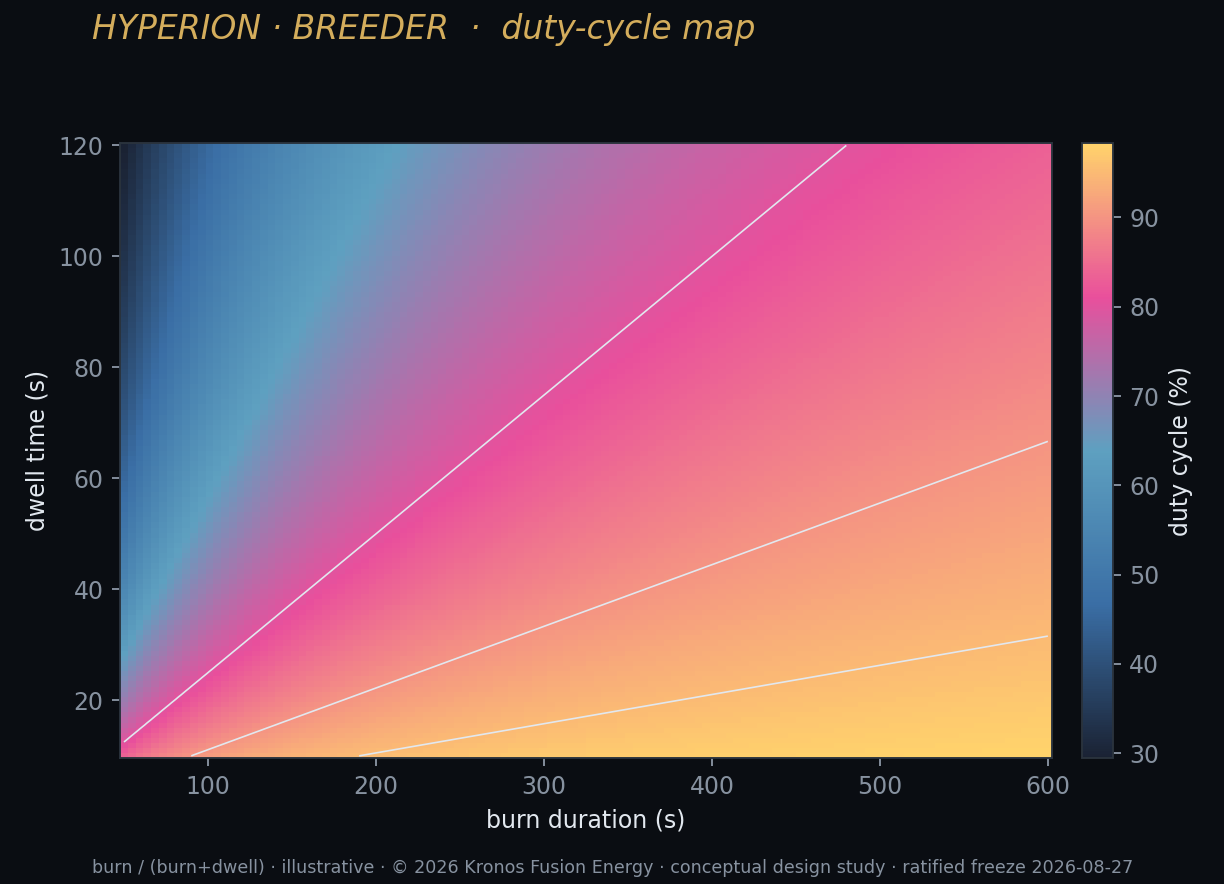
For the breeders, the build time falls from about 3.5 years for the first unit to roughly 3 years for the next and about 2.5 years for the one after. For the burners, the same shape, one notch faster: from about 3 years for the first commercial unit toward 2.5 and then 2 years. This is not optimism painted onto a chart to make it climb. It is the most reliable pattern in industrial history, applied deliberately to machines whose design we have made reproducible on purpose, so that the second one is genuinely a copy of a solved thing rather than a fresh adventure into the unknown.
It is worth being concrete about where the time actually goes, because "learning curve" can sound like a wish dressed up as a mechanism, and I want you to see the gears turning. The first machine pays a whole set of costs exactly once. The design has to be turned from a solved physics basis into a full set of manufacturable drawings, and the inevitable first-of-a-kind rework — the coil that does not quite fit, the port that has to move six inches to the left — is discovered and fixed in the field, on the clock, at the worst possible moment. The tooling to wind and support the high-field magnets is designed and built from scratch. The workforce is learning the machine even as it assembles it. The supply chain is being qualified vendor by vendor, and the rare-earth superconducting tape is being ordered at a volume no one has ever ordered it at before. The first regulatory license is the hardest one anyone will ever file, because there is no precedent on Earth to point to.
The second machine inherits nearly all of that hard-won ground. The drawings already exist, and the worst mistakes have already been made and corrected. The winding jigs and assembly fixtures are already built and simply used again. The crews that built the first one build the second with their hands already trained. The vendors are qualified and the tape is flowing. The license has a precedent to lean on. None of this is speculative; it is simply what happens, reliably, when you build the same thing twice on purpose. The third machine compounds the same effects a third time, which is exactly why BOAK is faster than NOAK, which is faster than FOAK.
The learning curve is also why the two-clock structure works at all. The breeder foundry is where we take our lumps first — a small number of large machines where the hardest first-of-a-kind lessons get learned, funded by a materials business that does not depend on cracking burner economics. By the time the commercial burner fleet begins in 2036, we are not learning to build fusion machines for the first time under the pressure of a power contract. We are applying a foundry's worth of hard-won practice — magnet manufacturing, cryogenics, tritium handling, high-field engineering — to a fleet designed, from its very first line, to be built over and over and over. The burner curve starts one notch faster than the breeder curve for exactly one reason: the breeder curve came first, and paid the tuition.
The honest gates, stated plainly
Every honest roadmap is defined less by its milestones than by its gates — the places where a thing genuinely is not yet true and we say so, out loud, without softening. A milestone is a boast. A gate is a confession, and it is the confessions that earn the boasts their credibility. Let me restate ours in the plainest language I can build, because a reader deserves to know exactly where the load-bearing assumptions sit.
The near-term business is materials, not electricity. The breeder is net-negative on power — on the order of −79 MWe. That is not a defect to be apologized for or buried in a footnote; it is the job. Hyperion is a foundry, and a foundry sells what it makes: tritium, helium-3, and 14-MeV neutrons for advanced materials and isotopes. Anyone who tells you fusion is selling cheap electricity in the early 2030s is not describing our plan. We are selling fuel and materials first, and we are candid, on every page, that the electricity comes later.
No hardware net-gain before the FOAK breeder — around 2030. The design achieves gain on paper, published and reproducible. But paper is paper, and I will not let you mistake it for steel. The first time our physics is validated in operating hardware is first tritium, around 2030 (2031 planning basis). Until then, the honest statement is precise and unwavering: gain is solved, not scaled; no hardware has been built.
"Net gain 2027" is retired. I said it above, and I will say it again here, in the gates section, in bold if I could shout it, because it is the single claim most likely to be mis-remembered from the old story. 2027 is when construction begins. It is a groundbreaking, not a result. A shovel in the earth, not a spark in a plasma.
The burner has one real physics gate, one named engineering gate, and economics that depend on cheap helium-3. The tandem-mirror burner's remaining physics question is end-plug density — the condition that lets a straight magnetic bottle hold a clean D–³He burn. That is what the 2032 test burner exists to settle, in hardware, in public. Beside it sits one engineering item, distinct and less fundamental: building the 26.49 T plug field at its small required bore over-stresses the winding "as drawn," and is recovered — on paper, pending detailed finite-element confirmation — by the stress-managed magnet architecture the magnet chapter lays out. I separate the two deliberately: the density is a question about nature that only an experiment can close; the bore stress is a question about structure that already has a drawn answer. Naming both, and ranking them, is the honesty the single-gate phrasing would cost. And even with the physics closed, the burner's economics depend on fuel cost. On terrestrial helium-3 the fuel alone would swamp any plausible power price; the burner only becomes cheap when lunar helium-3 does. That is why the fleet is gated on the Moon, and why I will not pretend the forty-dollar electron arrives before its fuel does.
State those four gates out loud and the roadmap becomes something you can actually audit, year by year, claim by claim. Each gate is a place where, in some future year, you can check whether we did what we said — and, just as important, whether we kept saying the true thing while we waited for it.
The burner's one gate, in detail
Of the four gates, one deserves a closer look than a single line can give it, because it is the load-bearing physics question of the entire second act, and I would rather you understand it in your bones than take my word that it is manageable.
The burner is a tandem mirror — a straight magnetic bottle, not a doughnut. The oldest objection to a straight bottle is exactly the one I described in the history: the ends leak. Particles moving nearly along the axis are not turned back by the magnetic pinch at each end; they slip out, and the plasma drains away. The tandem solution is to build, at each end, a small region of very high magnetic field — a plug — and to use the physics of that plug to raise an electrostatic barrier, a voltage hill, a dam made of pure potential, that turns escaping ions back into the central cell where the burning happens. The central cell does the fusing; the two plugs do the holding. It is an elegant division of labor, seventy years in the waiting.
Everything about the burner's viability comes down, in the end, to one quantity: whether the plug can build a tall enough barrier, which in turn depends on sustaining a high enough plasma density in the plug relative to the central cell. This is the end-plug density gate. Build the plug density high enough, and the barrier holds and the bottle stops leaking; fall short, and you are right back to the leaking tube that defeated the pioneers and sent a generation of physicists to the doughnut. The reason this is now a question worth reopening — rather than the settled failure the textbooks record — is a single changed input: magnets. The published design calls for a peak field at the high-field plug of 26.49 T, with a 17 T throat in the central cell, fields that simply could not be produced in a plug small enough when the idea was first tried. The rare-earth superconducting tape that makes such fields buildable is the material advance that turns a seventy-year-old dead end back into a live experiment — that reaches into the graveyard of abandoned approaches and finds one of them still breathing.
That is precisely, and only, what the 2032 test burner exists to settle: a roughly 100 MW demonstrator whose narrow, specific job is to show the end-plug density and confinement in operating hardware rather than in a simulation, however beautiful the simulation. It is not there to make a fleet or sell power. It is there to convert the one open physics question of the burner into a measured number that anyone can read. I state the gate this sharply on purpose. A program that can name its single largest remaining physics risk, and point to the exact machine and the exact year meant to retire it, is telling you a fundamentally different kind of truth than one that gestures vaguely at "engineering challenges ahead."
There is a second half of the burner's promise that is not a physics gate at all but an engineering advantage, and it is worth stating in the same breath because it is why the burner is the machine that carries the forty-dollar electron. The D–³He reaction the burner runs is low-neutron by design — only about 5.44% of its energy leaves as neutrons, against the four-fifths a deuterium–tritium plant must forever contend with. The overwhelming majority of its output comes off as charged particles, and charged particles can be decelerated against an electric field to recover their energy as electricity directly, without first degrading it into heat and paying the steam cycle's brutal thermodynamic tax. A conventional thermal plant throws away well over half of its heat as a matter of physical law — a law as old and unbreakable as the second law of thermodynamics itself. Direct conversion sidesteps most of that loss. This is not a gate to be passed; it is a structural reason the mature burner can reach a plant-level return that a neutron-dominated, steam-cycle machine simply never can. The gate is the plug. The prize behind the gate is the clean, directly converted electron.
Where the three forties actually land
Now to the payoff — the part where the three forties come home to roost. Q40, forty dollars a megawatt-hour, within forty years: they do not all land in the same place, or the same year, or even on the same clock. Part of being honest about them is being specific about where on this road each one lives.
Q40 — the physics, forty-fold return — lands with the mature burner. It does not live in the breeder, and I will not let it pretend to. The breeder's published gain is Q_sci ≈ 3.076, and it is net-negative on electricity by design; a foundry is not, and was never meant to be, where a fortyfold plant return appears. Q40 is a burner property, because the burner is the machine built to turn fusion into net electricity: a low-neutron reaction — only about 5.44% of its energy carried off by neutrons — whose output comes out mostly as charged particles, converted toward electricity directly rather than bled through the full penalty of a steam cycle. It is that direct conversion of charged-particle energy, sidestepping the thermodynamic tax a thermal plant can never escape, that makes a fortyfold plant return reachable at all. In time, Q40 belongs to the commercial burner as it matures — the machine that begins as a test in 2032, becomes a commercial unit in 2036, and comes fully into its own as the fleet scales through the 2040s. It is a physics-and-engineering achievement, and it arrives when the machine that carries it is mature, not on the day the first one is switched on.
Forty dollars a megawatt-hour — the price — lands after the lunar fuel gate. This is the most gated of the three, and I want no ambiguity about it whatsoever. The forty-dollar electron lives with the burner and depends on cheap helium-3. Before lunar supply, the fuel cost alone keeps a burner well above that line, no matter how elegant the machine or how clever the engineer. After lunar helium-3 arrives around 2040, and as the fleet climbs its learning curve toward two-year builds, two things move in the same direction at once, reinforcing each other: the fuel gets cheap and the machines get cheaper to build. That is when the price target comes into reach. So $40/MWh is a 2040s number — later than the first hardware, later than the first commercial unit, deliberately downstream of the fuel that makes it real. Of the three forties, this is the one I would most caution a reader against expecting early, because it depends on a gate that opens not on Earth at all, but a quarter of a million miles away.
Within forty years — the horizon — is the promise I most want you to hold me to. Measured from now, "within forty years" points at the mid-2060s. And here is the deliberate gap, laid bare: the internal plan lands the mature fleet — roughly 90 GW of firm clean power — around 2050, some fifteen years inside the public promise. I have chosen, everywhere in this book, to promise the conservative number and plan against the faster one. The forty-year horizon is drawn wide on purpose, because fusion earned its "always thirty years away" reputation the hard way, and the only cure for a broken clock is to set a deadline you can beat, and then beat it, and then do it again until the beating is your reputation.
So the three forties resolve like this: Q40 is the physics goal the burner is built to reach, coming into its own as the fleet matures in the 2040s; $40/MWh is the price that follows the lunar-helium-3 gate, a 2040s achievement downstream of cheap fuel; and within forty years is the outer bound — the mid-2060s — against which an internal ~2050 plan is meant to look, in hindsight, conservative. Three numbers, three different places on one road, each stated with its gate riveted firmly to it.
Why the conservative horizon is the honest one
I could have written this chapter as a thundering countdown to 2050. The internal plan supports it, and it would read as far more exciting — a clean, cinematic arc to a triumphant date. I chose not to, and it is worth saying why, because the choice is the whole ethic of the book compressed into a single date.
A roadmap is a form of promise, and a promise is only worth making if the person receiving it can rely on it when everything else is uncertain. The failure mode of fusion for seventy years has not been a shortage of ambition; the field never lacked for dreamers. It has been a surplus of confident dates that did not arrive. Every one of those missed dates spent down the field's credibility, coin by coin, until "fusion by 20XX" became a punchline told at dinner parties rather than a plan a serious person could defend. I am not willing to spend the next increment of that hard-won, barely-recovering credibility on a headline that reads well for one news cycle.
So the discipline is this, and I hold to it without exception. Where a milestone has a target and a planning basis, I give you both — 2030 and 2031 for first tritium — and I plan against the later one. Where the whole program has an internal timeline and a public promise, I publish the promise wide — forty years, the mid-2060s — and hold the faster plan to myself as something to beat, not something to claim. And where a number depends on a gate that has not yet opened — the forty-dollar electron waiting on lunar helium-3 — I bolt the gate to the number every single time, so that no one, ever, mistakes an aspiration for an achievement.
How the two clocks pay for each other
I have promised no dollar figures in this book, and I will keep that promise here as everywhere. But you do not need a single number to understand the shape of how this program funds itself, and the shape is the part that matters for judging whether the calendar is real or a beautiful wish.
The failure mode of ambitious energy programs is not usually that the final product turns out to be uneconomic. It is that the long years of building before the final product arrives have no way to pay for themselves, so the whole enterprise lives hand to mouth on outside faith until, one grey day, the faith runs out and the machines go quiet. The two-clock structure exists, in large part, to defeat exactly that failure mode — the one that has buried more fusion dreams than any plasma instability ever did. The breeder foundry begins earning — selling tritium, helium-3, and neutron flux into real shortages — years before the first commercial burner sells firm power. The early money does not come from cheap fusion electricity, which does not yet exist and will not for years; it comes from materials the world already needs and cannot readily get. That revenue is what carries the program across the long, expensive middle where every prior generation of fusion ran out of patience and out of cash.
This is why the order is not arbitrary and, more to the point, not reversible. You could not begin with the burner even if you wished to with all your heart, because the burner needs helium-3 that only the breeder makes, and because the burner's own economics do not close until the lunar fuel gate opens around 2040. Start with the burner and you would be asking the least-proven machine, running on the scarcest fuel in the solar system, to carry the entire program financially in its infancy — the shortest, surest road to becoming one more fusion effort that died waiting for its fuel. Start with the breeder and each stage funds the ambition of the next: the foundry's materials business funds the first burners, the first commercial burners establish the fleet, and the fleet — once cheap lunar fuel arrives — is what finally delivers power at a price that changes the world. Each clock hands the next one the exact thing it needs to move.
It also means the program degrades gracefully rather than catastrophically — it bends where a lesser structure would break. If the burner's physics gate takes longer to close than 2032, or if the lunar fuel supply arrives late, the breeder foundry keeps running and keeps earning in the meantime, because its business does not depend on either of those things. A structure in which the near-term revenue is decoupled from the long-term gamble is a structure that can survive its own delays — which, given that this is fusion, and given seventy years of delays as reliable as sunrise, is not a luxury but a design requirement. I built the roadmap to keep moving even when a piece of it runs late, because history is unambiguous that some piece of it will.
The transitions, one gate at a time
The milestones are the easy part to write, because a milestone is a destination and destinations are pleasant to describe. The hard part — the honest part — is the space between two milestones: the specific set of things that must become true to carry the program from one dated point to the next, and the specific ways each passage could go slow. A roadmap is only as trustworthy as its transitions, because a transition is where the real work, and the real risk, actually lives. So let me do the uncomfortable thing and walk the gaps rather than the posts. For each passage I will state plainly what has to be true to make it, and what could slip if the world declines to cooperate.
From published design (2026) to broken ground (Q2 2027). What has to be true: the passage from paper to procurement is not a physics passage at all — the physics is already solved and deposited — it is an engineering-readiness passage, and it turns on four concrete things. The high-field magnets must be shown to be windable to the design's peak field on rare-earth superconducting tape, not merely specifiable on a datasheet. The structure that holds them must be shown to survive the bore stress that field imposes, because a field is a pressure, and a field of this magnitude pushes on its own coil with a force that wants to tear it open. The breeding blanket and the tritium-handling plant must exist as manufacturable drawings rather than as a target breeding ratio. And a site, a first regulatory license, and a qualified supply chain for the tape must genuinely be in hand. What could slip: the license is the likeliest culprit, because it is the first of its kind and there is no precedent on Earth for a privately built tritium-breeding fusion foundry — the regulator and the builder are, in effect, writing the rulebook together in real time. The tape supply is the second, because we would be ordering rare-earth superconductor at a volume the world has never been asked to produce. Neither of these is a physics failure; both are the ordinary friction of doing a thing for the first time, and both push the groundbreaking to the right rather than off the calendar.
From broken ground (2027) to first tritium (~2030). What has to be true: this is the passage where ink becomes steel, and it carries the heaviest load in the entire calendar. On a roughly three-and-a-half-year build, the FOAK breeder must reach and hold its design plasma current of 9.66 MA; the negative-triangularity edge — δ = −0.30 — must tame the plasma boundary in hardware the way it does in the solved design; and, above all, the blanket must breed. The frozen basis is the breeding lever — 1.03 to 1.20 — and the load-bearing claim is not the exact figure but the inequality: the foundry must make more tritium than it burns, or it is not a foundry at all. Then that bred tritium must be extracted, purified, and accounted for atom by atom as a salable, regulated product rather than a laboratory trace. What could slip: first-of-a-kind rework is nearly certain somewhere — a coil that does not quite seat, a port that must move — and rework is discovered in the field, on the clock. The blanket breeding could come in below the ratio the design needs, which would not stop the machine but would thin the surplus it can sell. Tritium extraction chemistry at rate is genuinely hard. This is exactly why I give you the honest pair — 2030 target, 2031 planning basis — and plan against the later one.
From first tritium (~2030) to the first test burner (2032). What has to be true: two things must line up, and one of them is a matter of inventory. The test burner is a D–³He machine, and it cannot run without helium-3 — which only the breeder makes. So the foundry must have accumulated enough helium-3 to fuel a roughly 100 MW demonstrator before that demonstrator can fire. On the machine itself, the plug magnet must be buildable to its 26.49 T peak field, with the 17 T central-cell throat, and the direct-conversion train must be shown to catch charged-particle energy and steer it toward electricity. What could slip: this transition contains the single largest remaining physics question in the whole program — end-plug density, the condition that lets a straight magnetic bottle stop leaking — and I will not soften it. If the plug is harder to sustain in hardware than in simulation, the burner timeline stretches. The fuel-accumulation clock could also bind: too few grams of helium-3 by 2032 and the demonstrator waits on its own fuel.
From test burner (2032) to commercial fleet (2036). What has to be true: the test burner must have answered its one question in public — a measured, published end-plug density, not a hopeful one — because the fleet is not permitted to begin on an unsettled gate. Then the physics of a 100 MW demonstrator must scale to a financeable, sitable ~1 GW commercial unit; the foundry must be supplying enough helium-3 to fuel those early units; and a grid operator must be willing to interconnect and plan around firm fusion power. What could slip: scale-up from a demonstrator to a gigawatt unit is real engineering risk even with the physics closed, and — more binding still — the early fleet is capped by fuel. Before the Moon supplies helium-3, only so many burners can run at once on the trickle the breeders make. That cap is not a failure; it is the designed-in reason the fleet stays deliberately small until 2040.
From early fleet (2036) to lunar helium-3 (~2040). What has to be true: this is the transition that reaches off the Earth, and most of what must become true lies outside the fusion machine and outside our own hands entirely. A lunar supply chain must deliver helium-3 to Earth at the scale a growing fleet needs — which means the bulk processing of lunar regolith, an extraction problem closer to winning salt from the sea than gold from a vein, must be industrialized, along with the transport to carry the product home. What could slip: nearly all of it, and I say so without flinching. This is the single largest dependency in the book that is not ours to control. If it arrives late, the consequence is bounded and specific: the fleet keeps scaling slowly on breeder-made helium-3, firm fusion power stays dearer for longer, and the forty-dollar electron waits. The physics still works; the foundry still earns; nothing collapses. A late gate delays abundance. It does not cancel it.
From the fuel gate (~2040) to the fleet at scale (~2050). What has to be true: with cheap fuel flowing, the last passage is one of pure repetition — the learning curve must keep delivering. Build times must keep falling toward two-year burner units; roughly ninety burners must actually be built and interconnected; and the breeder cadence must be allowed to slow, because once the Moon supplies helium-3 the foundry no longer needs to grow, settling toward five or six units. What could slip: the learning curve could stall if each unit is treated as a fresh adventure rather than a copy of a solved thing — which is precisely the failure the whole two-clock, FOAK→NOAK→BOAK discipline is built to prevent. Siting cadence and interconnection queues could throttle the count. This transition is the most forecastable of them all, because it depends least on new physics and most on the oldest, most reliable regularity in industrial history: that we get faster as we repeat ourselves.
Walk those six passages and a pattern emerges that the milestone list alone conceals. The early transitions are gated by engineering — magnets, blankets, licenses, rework — the kind of risk a learning curve is expressly designed to absorb. The middle transition is gated by the burner's one physics question, quarantined in a single demonstrator so it can be settled before anything is staked on it. And the late transitions are gated by things largely outside fusion altogether — a lunar supply chain, a build cadence — where our only defense is a structure that keeps earning while it waits. The risk does not vanish as you go; it changes character, from physics we have solved, to engineering we can practice, to logistics we must partner for. Naming which kind of risk lives in each gap is, I think, the most honest thing a roadmap can do.
The one supply chain beneath every gate
If you press on the transitions above, looking for the single thread that runs through the most of them, you will find it quickly, because it is the same thread every time: the magnets. Nearly every gate in this book, on both clocks, rests in the end on one material advance — rare-earth barium copper oxide superconducting tape, wound to fields that were simply unbuildable when these architectures were first dreamed. The breeder needs a high-field centrepost to confine its plasma in a machine small enough to build and repeat. The burner needs a 26.49 T peak field at its high-field plug — with a 17 T throat in the central cell — to raise the electrostatic barrier that stops a straight bottle from leaking. Neither number was reachable in a coil the right size and shape a generation ago. Both are reachable now, on the same family of tape, and that single fact is what lets a spherical-tokamak foundry and a seventy-year-old tandem-mirror idea both come back to life in the same decade, in the same company, on the same roadmap.
It is worth being blunt about what this concentration means for risk. A single enabling material that unlocks two machines is a gift and an exposure at once. The gift is obvious: master the winding, the joints, the cryogenics, and the bore-stress structure once, on the breeder foundry, and you have paid the hardest tuition for the burner fleet before the fleet begins — which is exactly why the burner learning curve starts one notch faster than the breeder's. The exposure is just as real: if the tape supply cannot scale, or the winding and support of these fields proves harder in the field than on the bench, the difficulty does not land on one gate but ripples across many, because so many gates lean on the same tape. A field at the breeder's conductor peak, and still more one of 26.49 T, is a mechanical event as much as a magnetic one — the coil must survive the outward pressure of its own field, a force measured in the same breath as the deep ocean — and that structural problem is the quiet engineering gate sitting underneath the glamorous physics ones.
I flag this not to alarm but because honesty demands it: when a plan's separate risks share a common root, a reader deserves to see the root named, not diffused across a dozen milestones as if each were independent. They are not fully independent. The tape is the taproot. The good news — and it is genuine, not consoling — is that this is manufacturing risk, the most tractable kind there is, the kind that yields to volume, practice, and time in a way that a fundamental physics wall never does. It is the reason the foundry goes first: to turn the hardest first-of-a-kind magnet lessons into routine, funded practice, before a single power contract depends on getting them right.
How to hold us to it
I have written this roadmap so that it can be used against me, and I mean that as the highest compliment a plan can pay its reader. A promise you cannot check is not a promise at all; it is decoration. So here, gate by gate, is how to keep score — the specific thing you can look for in each dated year, without taking my word for anything.
In 2026, the test is not a claim but a document. The design is either published open-access and reproducible or it is not. Download it. Hand it to a physicist you trust. If the numbers in this book cannot be re-derived from what we deposited in the open, then the foundation has failed its own first test, and everything downstream deserves your skepticism.
In 2027, look for a groundbreaking, and — this is the part that matters most — check that we still call it a groundbreaking. If anyone associated with the program describes 2027 as a net-gain year, hold up this page. The retirement of that old claim is itself a milestone you can audit.
Around 2030, the question is tritium: is the FOAK breeder producing it, and is it doing so at a breeding ratio that lets the foundry make more than it consumes? If first tritium slips to 2031, that is the planning basis arriving exactly on schedule, not a failure. If it slips past 2031, ask why, and ask whether we said so plainly and early.
In 2032, watch the test burner answer its one question: end-plug density, in hardware. A test burner that runs but quietly dodges that measurement has not earned its place on the calendar.
By 2035, count the breeders — there should be three — and look hard at how long each one took to build. The learning curve is a falsifiable prediction, not a hope: FOAK slower than NOAK, NOAK slower than BOAK. If the second and third machines did not come together faster than the first, the premise under every later date is weaker than I claimed.
From 2036, watch for a commercial unit selling firm power, and watch for the fleet to begin multiplying. Around 2040, watch the sky as much as the ground: the fuel gate is lunar, and either helium-3 begins to arrive from the Moon or the fleet's scaling stalls exactly where I said it would. And through the 2040s toward 2050, keep counting units and keep timing builds. The shape of the plan — few breeders, many burners, paced by fuel — is either visible in the count or it is not.
The internal plan aims for the 2050s. The public promise says the 2060s. The fifteen-year gap between them is not slack I am hiding — it is slack I am handing you, in writing, to hold me to.
That is the staged road to Q40. Ground broken in 2027. First tritium around 2030, from a foundry that sells materials, not electricity. A test burner in 2032, a commercial fleet from 2036, the lunar fuel gate around 2040, and a fleet at scale by 2050 — offered to you as the mid-2060s, so that if we are early, we have kept our word, and if we are exactly on the public schedule, we have still done what no one before us has ever done. The physics is solved and published. The rest is construction, repetition, and the patience to say the true thing at every gate along the way. A star built to a schedule, and a schedule built to be kept.