🎧 Prefer to listen? Open the audiobook
The Road to $40 a Megawatt-Hour, Worked
Everything in this chapter has been building to a single number, and it is time to show the arithmetic behind it. Not the company's private ledgers — those stay private, and I will say plainly where the line is — but the structure of the number: the equation every power plant on Earth is judged by, and the specific physical levers by which this machine is engineered to drive that equation down to forty dollars a megawatt-hour. You do not have to take the number on faith. You have to see how it is built.
The one equation that decides everything
The price of electricity from any plant is captured by a single ratio the whole industry uses — the levelized cost of energy, or LCOE. Stripped to its bones it is this:
**LCOE = ( CRF · Capital + Fixed O&M + Fuel ) ÷ ( 8,760 · Power · Capacity Factor )**
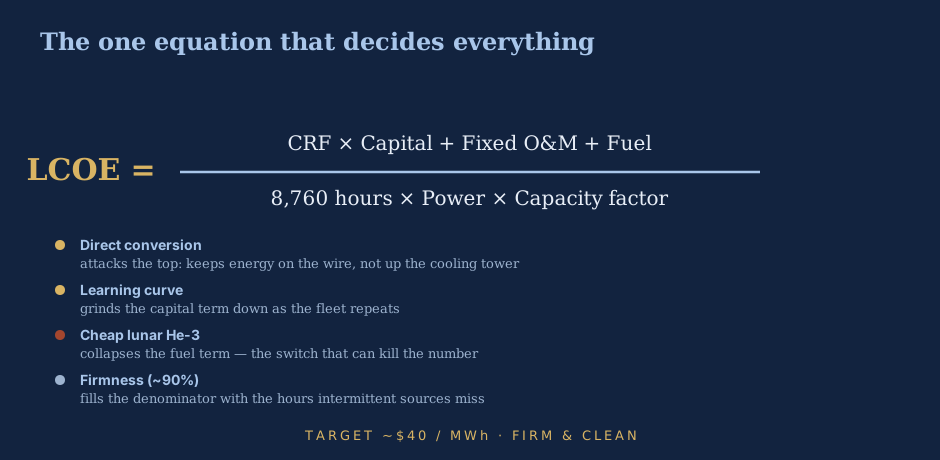
Read it slowly, because the whole strategy of this book lives inside it. The top is what the plant costs to build and run each year: the capital cost spread out over the plant's life by a capital-recovery factor (CRF), plus the annual cost of operating it, plus the annual cost of its fuel. The bottom is how many megawatt-hours it actually sells in a year: the number of hours in a year (8,760), times the plant's power rating, times the fraction of the time it is actually running — its capacity factor.
To make the electron cheap, you make the top small and the bottom large. That is the entire game. And a fusion machine has four levers on that ratio that no fossil or fission plant can pull the same way.
The price of power is one ratio: what it costs to build and feed, over how much it actually makes. Every design choice in this book is a move on that ratio.
Lever one — direct conversion attacks the bottom of the ratio
Every thermal power plant on Earth — coal, gas, fission, and most fusion concepts — makes electricity the same way James-Watt-era way: heat water, spin a turbine, and surrender more than half the energy to the laws of thermodynamics as waste heat. That Carnot penalty is a tax on the bottom of the LCOE ratio: you paid to make the energy, then you throw most of it away before it reaches the wire.
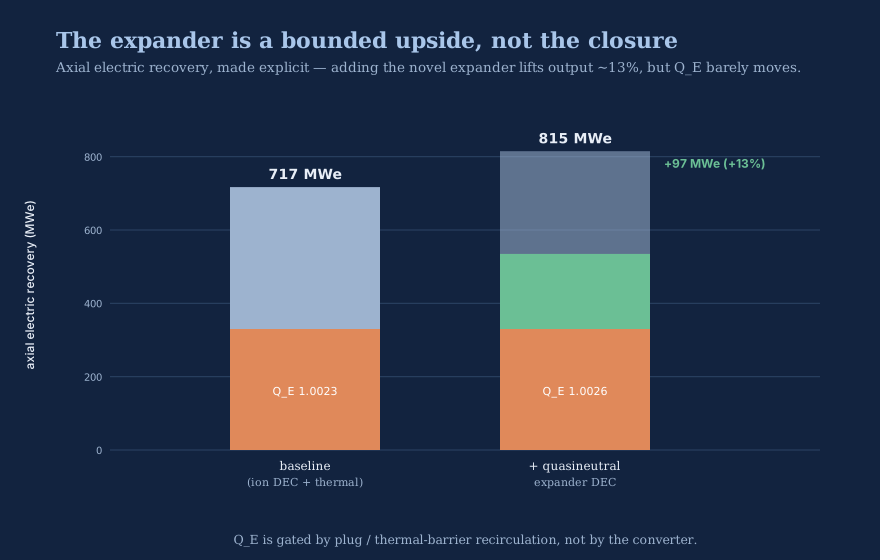
The burner refuses that tax. Because its D–³He reaction releases its energy as charged particles rather than neutrons — a neutron fraction of just 5.44 percent — most of that energy can be caught and turned to electricity directly, decelerated against a voltage instead of boiled into steam. The worked power balance in this chapter lands the engineering gain at Q_E ≈ 1.318, with direct conversion recovering hundreds of megawatts that a steam cycle would have thrown away. More electricity out of the same reaction means more megawatt-hours on the bottom of the ratio — and every megawatt-hour added there pushes the price down.
Lever two — firm power fills the hours
Look again at the bottom of the equation: capacity factor, the fraction of the year the plant actually runs. This is where intermittent sources bleed. A solar farm's capacity factor sits near a quarter; a wind farm's near a third. They are cheap to build and then idle most of the time, which quietly triples or quadruples the price of every hour they do deliver, because the capital is spread over far fewer megawatt-hours.
Fusion is firm: it runs day and night, in any weather, on demand. A fusion plant is engineered for the capacity factors of baseload infrastructure — the high-eighties to mid-nineties percent — the same league as the best fission plants. That is not a small edit to the LCOE; it is a doubling or tripling of the denominator against an intermittent competitor. Firmness is not just a grid-reliability virtue. It is one of the largest single levers on the price.
Lever three — the fuel term, and why it runs through the Moon
Here is the lever that decides whether the whole thing works, and the one I will be most honest about. The fuel term sits on top of the ratio, and for the burner it is dominated by the cost of helium-3.
On Earth, helium-3 is so scarce that the fuel alone would swamp any plausible power price — the burner, run on terrestrial helium-3, simply loses. That is not a number I am hiding; it is a physical fact about a substance that barely exists on this planet. The fuel term only becomes small when helium-3 becomes abundant and cheap, and the only place we know of that holds it in quantity is the lunar regolith. This is why the road to forty dollars runs, improbably, through the Moon — and why I place the $40/MWh milestone after the lunar-helium-3 gate around 2040, not before. Before that gate, the fuel term dominates and the price is high; after it, the fuel term collapses and the target comes into reach. The sensitivity of the whole LCOE to this one input is the honest heart of the economics.
Lever four — the learning curve attacks the capital term
The last lever is the capital term, and it falls the oldest way in industry: by building the same machine more than once. The first-of-a-kind unit pays for every mistake exactly once — the drawings, the jigs, the untrained crews, the first regulatory license. The second unit inherits all of it. Build times fall down the curve — for the burners, roughly three years to two and a half to two — and every repetition drives the capital term of the ratio down. A single heroic reactor never gets cheap. A fleet does. The commercial units are deliberately sized at about a gigawatt each precisely so they can be financed, sited, and repeated fast enough to ride that curve.
The arithmetic, worked — with public numbers only
I promised to show the work, so here it is, done the only honest way a public book can do it: with ratios and published reference values, never with the company's private inputs. You do not need our capital cost to see how the number is reached. You need a starting point anyone can look up, and then the four levers, each expressed as a factor that multiplies the price up or down. Follow the chain and the forty-dollar figure stops being a claim and becomes a consequence.
Start where the whole industry starts: the capital-recovery factor. Spread a plant's build cost over a thirty-year life at a discount rate around seven percent and the standard formula — CRF = r(1+r)ⁿ ⁄ ((1+r)ⁿ − 1) — returns about 0.081 per year. That is not a Kronos number; it is the arithmetic every utility on Earth runs, and it means roughly eight cents of annualized cost for every dollar of capital, before a single electron is sold. Every lever below is a fight against that eight cents.
Now the bridge. Independent, widely published estimates put the levelized cost of the incumbents in these bands — and I use their numbers, not mine, precisely so you can check them:
| Source | Published LCOE band (USD/MWh) | Firm & clean? |
|---|---|---|
| Utility-scale solar (no storage) | ~30–90 | Clean, not firm |
| Onshore wind | ~30–75 | Clean, not firm |
| Solar + multi-hour storage | ~60–210 | Clean, partly firm |
| Combined-cycle gas | ~45–110 | Firm, not clean |
| New-build fission | ~140–220 | Firm & clean |
| Burner target (this book) | ~40 | Firm & clean |
Read that table honestly and the burner's ambition is plain: land in the cheap rows — down where unfirmed solar and wind sit, at roughly thirty to ninety dollars a megawatt-hour — while keeping the firm-and-clean column, a combination no existing row holds at once. Here is the multiplicative path there, each factor a lever from the pages above, applied to a first-of-a-kind fusion price that would otherwise start in fission's neighborhood, north of $150 a megawatt-hour:
- Direct conversion removes the thermal tax. A steam-cycle fusion plant throws away more than half its energy; the burner's charged-particle conversion keeps far more of it on the wire. More saleable megawatt-hours from the same reaction pulls the price down by roughly a third — call it a ×0.65.
- Firmness protects the denominator. Run at a baseload capacity factor near ninety percent instead of an intermittent quarter-to-third, and the capital spreads over three to four times the megawatt-hours. Against an intermittent competitor that is a ×0.4–0.5; against an already-firm one it simply keeps the denominator from collapsing.
- The learning curve grinds the capital term. First-of-a-kind pays for every mistake once; by the tenth gigawatt-class unit, published learning rates for manufactured energy hardware (roughly 10–20 percent cost reduction per doubling of units) compound to a ×0.4–0.6 on the capital-driven part of the price. A fleet is cheap in a way a single heroic reactor never is.
- Cheap lunar helium-3 collapses the fuel term. On terrestrial helium-3 the fuel line alone would dwarf every other term and the exercise fails; with lunar supply after ~2040 the fuel term falls back into the rounding — a ×1 instead of a ×(many).
Chain the middle three against a first-of-a-kind starting price and the destination is not mysterious: 150-plus, times roughly 0.65, times roughly 0.5, times roughly 0.5, lands in the low tens of dollars per megawatt-hour — with the fuel term held down by the Moon rather than allowed to explode. That is the arithmetic of forty dollars. Not a spreadsheet I am asking you to trust; a published starting point and four factors you can argue with one at a time.
And here is the sensitivity ranking, because the four levers are not equal. The one that can kill the number outright is the fuel term — miss cheap helium-3 and nothing else saves it; it is a switch, not a dial. The one that does the most continuous work is the learning curve, because it compounds over a fleet and never stops. Firmness decides whether you are even in the right comparison — it is what lets the burner be judged against gas and fission rather than against unfirmed solar. And direct conversion is the enabling multiplier that makes the machine worth building at all, though its marginal effect on the final price is the smallest of the four. Ranked by fragility: fuel first, learning curve second, firmness third, direct conversion fourth. That ordering is the risk profile of the forty-dollar electron.
Putting it together — and where the private line is
Pull the four levers at once and the path to forty dollars is legible: direct conversion and firm operation multiply the megawatt-hours on the bottom; the learning curve grinds the capital term down; and cheap lunar helium-3 collapses the fuel term that would otherwise dominate. Under those conditions — a mature, repeated, gigawatt-class burner fleet running on lunar fuel — the arithmetic lands near the forty-dollar target. Miss any one lever and it does not: skip direct conversion and the thermal tax returns; run intermittently and the denominator shrinks; stall the fleet and the capital never amortizes; and without cheap helium-3 the fuel term alone sinks it.
Now the line I promised. I have shown you the equation, the levers, and the direction each one pushes — the work. What I have deliberately not printed are the specific dollar inputs: the capital cost of a unit, the price of a kilogram of lunar helium-3, the operating budget, the margins. Those are real numbers the company holds with its partners, and a public book is the wrong place for them; their absence changes none of the physics you have just seen. The forty-dollar figure is not a spreadsheet I am asking you to trust. It is the target the entire engineering program — the low-neutron fuel, the direct converter, the firm duty cycle, the fleet, the lunar supply chain — was built to reach, and every lever above is a checkable, physical reason it is reachable rather than wishful.
I will show you the equation and the levers. The private dollars stay private — and they have to, because the honesty of this book depends on never dressing a business projection up as a law of physics.
That is the road to forty dollars: not a promise, but a ratio, and four physical hands on it.