🎧 Prefer to listen? Open the audiobook
The Machine That Controls the Machine
A star does not need a supervisor. It hangs in the void, holds itself together with the crush of its own gravity, and fuses hydrogen into light for ten billion years without a single instrument, operator, or line of code watching over it. Gravity is its cage, and gravity never sleeps. On Earth we have no such luxury. We do not have the mass of a sun to press our fuel into ignition, so we do the audacious thing instead: we build the cage out of magnetism, and we suspend a plasma at a hundred million degrees — hotter than the core of the Sun — inside a volume no bigger than a room. And that plasma spends every microsecond of its brief life probing the bars, hunting for the one flaw in the field that lets it out. It is fast. It is nonlinear. It is alive in the way only a driven, far-from-equilibrium system can be, and when it turns on you it turns faster than any human nerve can fire, dumping the energy of a lightning strike into the walls in a few thousandths of a second. The physics of the two machines in this book is solved and published. But a solved reactor no one can safely run is not a power plant. It is an expensive diagram. To hold a star in a bottle, you need a second machine — one that thinks fast enough to keep pace with the first. This chapter is about that machine: the mind that runs the star.
We call it KRONOS-CTRL, and of everything in this program it is the part that has changed most between when I first wrote this book and now. In 2024 I could only tell you what the control system would have to do — I was describing a future in the conditional tense. Now I can show you what it does, running on a working digital replica of the plant, with numbers you can check line by line. The results are published open-access, they regenerate from a single random seed, and — this matters more than any single figure — they include every target we missed. I will hand you the misses in the same breath as the wins, because in control, unlike almost anywhere else in engineering, an honest failure is worth more than a flattering success. The stakes demand it: this is the discipline that decides whether the twenty-first century learns to bottle starlight or merely dreams about it.
One framing governs everything that follows, and it is worth stating before any single result. The safety of this machine does not rest on its intelligence being correct. It rests on its intelligence being contained. That distinction — between a system that is trusted because it is accurate and a system that is safe because it is bounded — is the difference between a research demo and a machine a regulator can license. The whole chapter is, in one sense, an elaboration of that one sentence.
There is a reason I take this layer as seriously as the plasma itself, and it is a personal one. I learned to write software before I learned to drive. My mother had come to America to build things — she spent years as an engineer and a computing specialist across American industry — and some of my earliest memories are of sitting beside her at the kitchen table late at night while she studied, picking up the rudiments of databases and code the way other children pick up a second language. I never stopped seeing the world that way: hardware and software and energy braided into a single problem, none of the three cleanly separable from the others. Most of the fusion field grew up treating the plasma as the hard part and the controls as plumbing bolted on afterward. I grew up unable to see the seam between them. This chapter is what that lifelong habit of mind looks like when you finally point it at a star.
That habit found its proving ground years before Kronos, at Edison International in Rosemead. I spent about five years there, deep inside one of the great electric utilities, automating its systems end to end — I started by leading a team of twenty and watched it grow into something closer to two hundred and fifty as the work spread across the company. Working that close to a grid changes how you see electricity. It stops being an abstraction and becomes a living system: supply and demand chasing each other every second of every day, the whole of modern life resting on the quiet assumption that the power will simply be there. Two things lodged in me and would not leave. The first was how precious firm power is, and how invisible that fact stays until the moment it fails. The second was that the tools remaking every other hard problem — machine learning, and the first real stirrings of quantum computing — had barely been pointed at the hardest energy problem of all. I left with a question I could not put down: what would computing for fusion actually look like? Much of this chapter, and the one that follows it, is the long answer.
Ten orders of magnitude in time
Begin with the fact that makes fusion control genuinely, categorically hard — harder than the tame phrase "real-time control" lets on. A fusion generator is not one control problem. It is a whole civilization of control problems stacked on top of one another, their natural timescales spanning ten orders of magnitude — a factor of ten billion between the fastest event and the slowest. To grasp that span, picture a single heartbeat set against three human lifetimes; that is the ratio between the quickest thing this machine must catch and the slowest thing it must plan. One controller cannot live in both worlds.
At the fast end, roughly a microsecond, live the events that can destroy the machine: a superconducting magnet beginning to quench, a plasma instability starting to grow. At about a millisecond sit the jobs of shaping the plasma, holding its pressure, and supervising the conversion of fusion power into electricity. Slower still, over seconds and minutes, are the fuel mix and the thermal state of the structure. And at the slow end — hours to months — are maintenance, retraining, and the logistics of getting fuel to the plant at all. No single controller can span that range. A system fast enough to catch a quench cannot also plan a fuel shipment, and a system that plans fuel shipments has no business anywhere near a magnet in the microsecond it starts to fail.
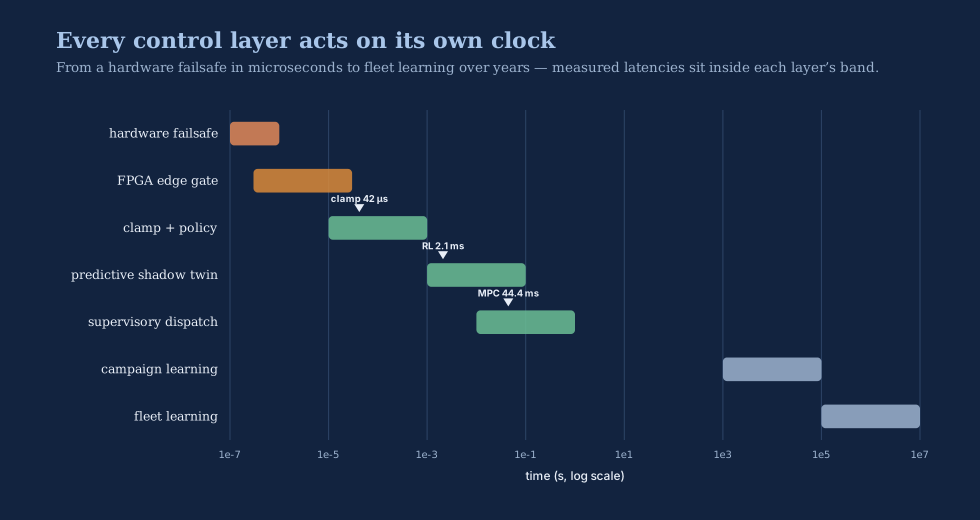
So the first design decision was not about artificial intelligence at all. It was about layers. KRONOS-CTRL is organized as eight of them, from the foundation compute at the bottom to external grid and supply integration at the top, and each layer is assigned an enforced latency band — a window of time it is allowed to act in, and outside of which it is forbidden to act. The edge layer that guards the magnets runs in microseconds and does nothing else. The layer that plans fuel runs in weeks and never touches a coil. This sounds like bookkeeping. It is actually the foundation of the safety case, because it means that the slowest, cleverest, least predictable parts of the system are structurally unable to reach the fastest, most dangerous actuators. The machine is protected from its own intelligence by the clock.
The layering is not arbitrary either. Between the edge and the supply planner sit the governed data fabric that lineage-tracks every sensor stream, the physics-informed models that predict, the orchestration layer whose rules engine does the safety clamping, and above them the copilots and human-facing surfaces that let an operator reason about the plant without ever reaching past the clamp to an actuator. Intelligence lives at the top, where it can afford to be slow and clever. Authority over the coils lives at the bottom, where it must be fast and dumb and certain.
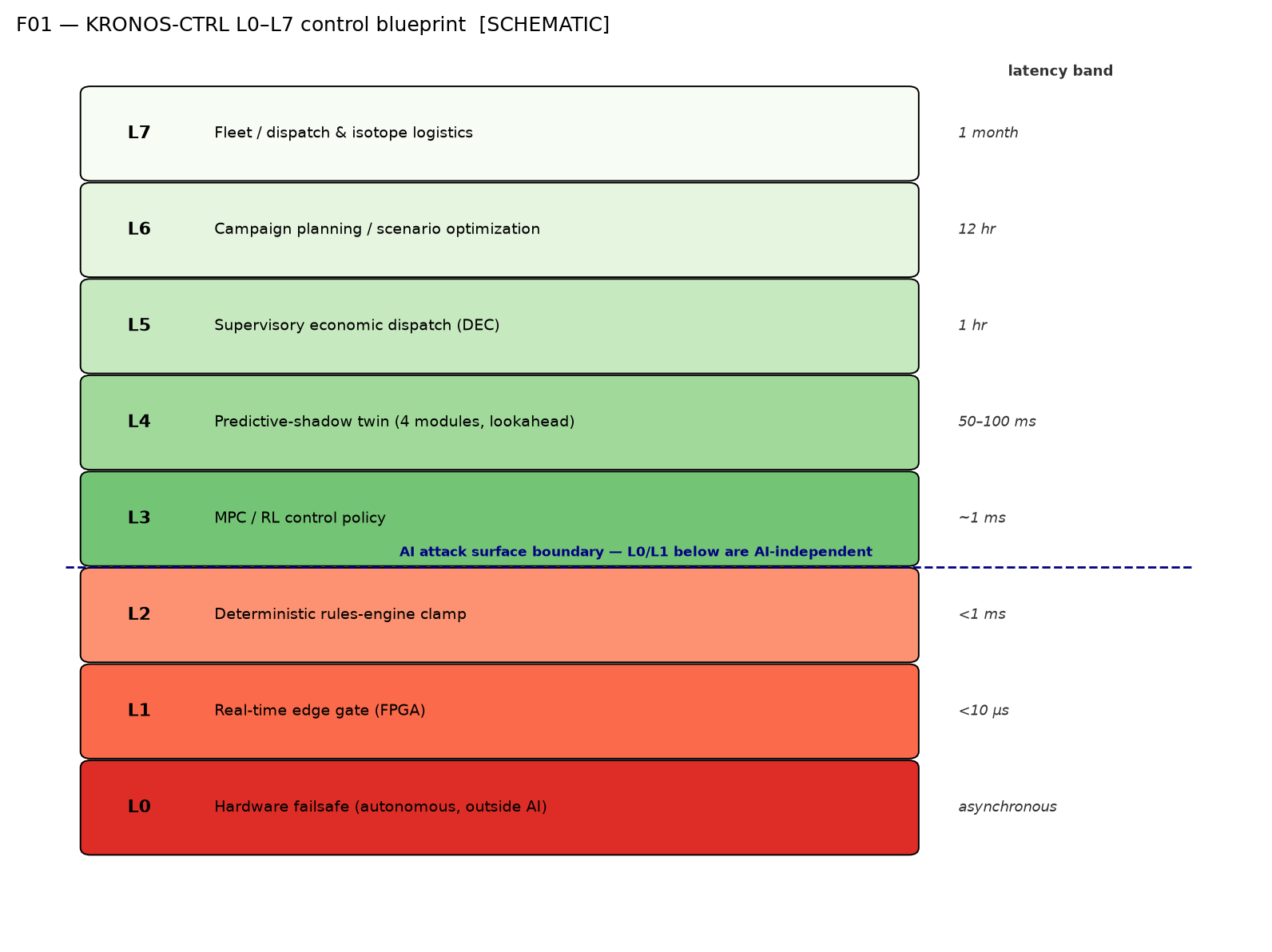
It is worth naming the eight layers, because their order is the argument. Read from the bottom up, each layer earns the right to be slower and cleverer than the one beneath it, and none is permitted to reach down past its band.
``` The eight layers of KRONOS-CTRL — authority at the bottom, intelligence at the top
L7 External integration grid, market, and fuel-supply coupling ~ weeks L6 Experience surfaces the operator's window onto the plant ~ seconds L5 Domain copilots reasoning aids that never touch a coil ~ seconds L4 Orchestration the DETERMINISTIC SAFETY CLAMP lives here ~ 1 ms L3 Physics-informed models the four-module predictive shadow ~ 1–10 ms L2 Governed data fabric lineage-tracked, provenance-gated telemetry ~ 1 ms L1 Edge real-time control magnet & actuation protection ~ 1 µs L0 Foundation compute the substrate everything runs on — ```
The clamp sits at L4, deliberately below the learned models it disciplines in the flow of authority even though it is above them in the stack — every command the intelligence at L3 and above proposes must pass down through L4's projection before it can reach the edge at L1. The learned model can be as clever as it likes. It cannot skip the clamp.
A shadow that runs ahead of the plant
Layers keep the parts in their lanes. But to truly control a plasma — to master it rather than merely flinch at it — you need something close to prophecy. You need to see the future, even a few milliseconds of it. That is the job of what we call the predictive shadow: a digital twin of the plant that runs alongside the real thing but lives a heartbeat ahead of it in time, a ghost of the machine that has already met the future the machine is about to walk into.
The twin is not a single model. It is four coupled physics modules, each solving its own governing equations on its own piece of the machine and handing boundary conditions to its neighbors. One module tracks the magnetohydrodynamic stability of the plasma — its shape, its pressure limits, the instabilities it might be about to grow. One tracks the thermomechanics of the magnets — the strain in every turn of superconducting tape under the enormous magnetic forces trying to tear the coil apart. One tracks the neutrons and the isotope inventory that closes the fuel cycle. One tracks the power systems that turn charged fusion products into grid electricity. At the start of every control step, all four are synchronized to the real plant's live telemetry. Then they are integrated forward — fifty to a hundred milliseconds ahead of reality. When the shadow and the arriving telemetry begin to disagree by more than a set threshold, the disagreement itself becomes a signal: something is drifting, and a correction is emitted before the drift becomes a problem. Control stops being reactive and becomes anticipatory.
It is worth reading the architecture as a single pulse, because that is how it will actually run. Before breakdown, the operations layer sequences cooldown and vacuum checkout while the thermomechanics module confirms the magnet's pre-load state sits inside its strain envelope. At breakdown, sixty-plus diagnostic channels stream through the data fabric into a live state estimate. Through the flat-top, the four modules run their fifty-to-a-hundred-millisecond lookahead: the equilibrium and stability modules propose shape and pressure corrections, a predictive controller turns them into coil commands, and — this is the load-bearing step — every command is projected onto the set of safe commands before it reaches a coil. Meanwhile the isotope loop holds the fuel mix on its lowest-neutron trajectory, and the power module re-weights the conversion channels as that mix evolves. Between shots, offline, higher-fidelity physics is admitted through a provenance gate to sharpen the models for the next pulse. No step in that sequence depends on a model being correct. Every step depends only on the clamp and the failsafe being correct — and those are simple enough to prove.
This is where physics-informed artificial intelligence earns its place. Solving those four physics modules from first principles, fast enough to run ahead of a live plasma, is not possible with conventional solvers — they are far too slow. So we train surrogates: neural networks that learn to reproduce the answer of a slow, exact physics solver, but return it in a fraction of the time. And we train them the physics-informed way, which is the important refinement. An ordinary neural network learns only from examples; it will happily produce an answer that fits the data and violates the laws of physics. A physics-informed neural network — a PINN — is penalized during training whenever its output breaks the governing equation itself. You are not just showing it the answers. You are making it obey the same law the plasma obeys. The result is a model that is fast like a network and constrained like a solver.
There is a companion trick for the moments when the sensors themselves fail, which they will. A separate learned model — a graph neural network that understands how the diagnostics are physically wired together — reconstructs the value of a dropped channel from its neighbors, roughly twice as accurately as naive interpolation between the surviving sensors. That does not sound dramatic until you realize what it buys: it defines, quantitatively, how blind the plant is allowed to go and keep running. A plant that trips every time a sensor drops out has a terrible capacity factor. A plant that keeps running with reconstructed sensors, inside a certified degraded-state envelope, does not.
The honest miss, told first
Here is where I have to be candid, and I want to be candid early rather than bury it, because the temptation in a book like this is to lead with the triumphs and file the failures in a footnote.
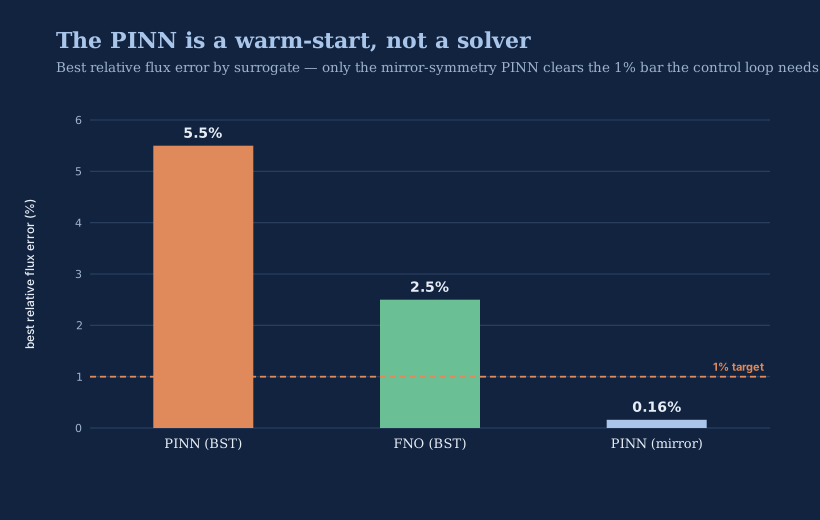
We set ourselves a pre-registered target: a physics-informed network that could solve the plasma equilibrium — the shape-and-pressure balance described by the Grad–Shafranov equation — to within one percent of the exact solver, fast enough to use as a native tool in the loop. To even judge that fairly, we first needed a ground truth we could trust absolutely, so we verified the classical solver against a known analytic solution to a relative error of two parts in a hundred thousand. That is the ruler. Against it, on the breeder's compact spherical geometry, we did not hit our target. The first physics-informed network reached only 5.5 percent, and worse, the physics penalty term fought against the data term in a way we had to diagnose as a genuine pathology — the two objectives were pulling the network's gradients in conflicting directions during training. A more sophisticated architecture, a Fourier neural operator, cleared up that conflict and pushed the error down to 2.5 percent (3.9 percent in the worst case). Better. Twice as good as the network before it. And it removed the gradient conflict entirely. Still not one percent, and — the second disappointment — it amortized its training cost only about 2.7-fold over a thousand queries, far less speedup than a native solver would need to justify itself.
So we do not call it a fast native equilibrium solver, because it is not one. We call it what it is: a warm-start accelerator — a tool that gives the exact solver a very good first guess, which is genuinely useful, but not the thing we set out to build.
I dwell on this because it is the whole philosophy of the program in miniature, and because I want to be precise about why it missed and what closes the gap. The compact spherical tokamak is a hard equilibrium: tightly curved field, strong shaping, steep gradients near the boundary, all of which sharpen the flux profile the network has to represent. On the burner's mirror geometry, incidentally, the same method reached 0.16 percent — the physics of a straight magnetic bottle is genuinely kinder to a network than the physics of a compact sphere, and we report both, the win and the miss, side by side. The path to one percent is not mysterious: it is training the neural operator at larger scale, on more of the adverse operating points — high pressure, near the last closed flux surface, near the mirror throat — that we currently plot honestly rather than hide. That is a known, fundable step, not a wish. But until it is taken, the number is 2.5 percent, and 2.5 percent is what we call it.
A 2.5-percent result you can trust is worth more than a 1-percent result you have to defend. Honesty is not a virtue we add to the engineering. In control, it is the engineering.
Why "certifiable" beats "accurate"
Now the central idea of the whole chapter — the one that sets a fusion control system apart from almost every other piece of artificial intelligence you have read about in this decade of headlines about artificial minds.
The whole culture of machine learning is a race toward accuracy. A better model, a lower error, a sharper prediction, another decimal place. Accuracy is good. But for a machine that must never run away — a machine cradling a hundred-million-degree fire behind nothing but a wall of magnetism — accuracy is not the property that keeps you alive. No matter how accurate a learned model is, it has some error, and that error is not something you can fully characterize in advance, because the plasma will eventually show it a situation it was never trained on. If your safety rests on the model being right, then your safety rests on the model never being surprised. And it will be surprised.
So we do not rest the safety case on the model being right. We rest it on the model being contained.
Every command the intelligent layer proposes — every adjustment to a coil, every change to the fuel mix — is passed, before it reaches any actuator, through a deterministic safety clamp. The clamp is not a learned thing. It is a simple, auditable rules engine that knows the machine's hard limits and projects every proposed command onto the set of safe commands. It is deliberately dumb enough that a human being can read it, line by line, and check it against the machine's limit book without ever understanding the neural network upstream. If the model asks for something outside the envelope, the clamp does not negotiate. It clips the command to the boundary and lets the safe part through. And outside even the clamp, with no network connection and no artificial intelligence of any kind, sits an autonomous hardware failsafe — the final, dumb, unfoolable layer that trips the machine to a safe state if all else fails.
This is a layered safety architecture, and it is deliberately the same logic that governs any high-consequence industrial plant — the layer-of-protection thinking a functional-safety assessor already knows how to audit. The clever controller is a non-safety-rated convenience. The deterministic clamp is an independent protection layer with a measured, quantified catch rate. The hardware failsafe is the final element whose integrity is argued by construction, because it depends on nothing that can be surprised. The learned model can be wrong. The plant is still safe. That is what "certifiable" means — not that the intelligence is perfect, but that its imperfection is bounded, clamped, and cannot reach the things that matter.
The number that tests this is the one I am proudest of. Across fifteen runs — five random seeds times three different control policies, one hundred and fifty thousand control steps in all — we injected three thousand deliberate limit violations, commands designed to drive the machine out of bounds. The clamp caught three thousand of three thousand. Zero escapes. Not 99.9 percent. Not "a handful got through and we're working on it." Every single one, every time.
There is a subtler result hiding inside that headline, and it is worth pulling out because it tells you how to choose a controller, not just how to fence one. The three policies did not misbehave equally. The predictive, model-based controller proposed only a couple of incidental limit excursions per ten thousand steps; a reinforcement-learning policy proposed roughly ten times as many; a naive baseline more still. The clamp caught all of them regardless — that is its job — but a controller that rarely asks for something dangerous in the first place leans on the clamp less, wears the actuators less, and gives an operator more confidence. The clamp is what makes the machine safe. Choosing the well-behaved controller behind it is what makes it pleasant to run. And one honest wrinkle: our software clamp settles in about 42 microseconds, which does not meet the sub-ten-microsecond tier the very fastest edge gate demands. That tier is covered by the hardware layer, and the design answer — a two-tier lookup-table clamp that resolves in a fraction of a microsecond — is specified and reported, not glossed over.
Anatomy of a caught violation
A number like "three thousand of three thousand" is easy to read and hard to feel. So let me slow one of those three thousand catches down to human speed and walk through it from proposal to interception, because the mechanism is the whole reason a regulator can sleep at night.
Start with what a limit violation actually is. Every fusion plant carries a limit book — a set of hard boundaries the machine must never cross. There is a density limit, above which the plasma radiates away its own heat and collapses. There is a current limit, the most the coils can safely source. There are shaping limits, the deformations the field can actually hold. And there is the pressure limit, β_N, beyond which the plasma tips into a large-scale MHD instability. A limit violation is simply any command that, if it were executed, would carry the machine's state across one of those lines. Not a command that is wrong in some abstract sense — a command that is out of bounds.
Now picture where such a command comes from. High in the stack, at L3, sits the reinforcement-learning policy, the cleverest and least predictable of the controllers. It has learned, correctly, that gain rises with plasma current, and in the heat of a flat-top it reaches for a little more current than the coils can safely source — a command that, executed, would push the state a hair past the current limit. In a naive control system that command travels straight down to the coil, and the machine obeys it, because the machine has no opinion about its own limit book.
In KRONOS-CTRL it cannot. On its way down, the command arrives at the deterministic clamp at L4, and the clamp does not ask the network why it wants what it wants. It evaluates, for the proposed next state, the safety margin `h(x)` on every face of the safe box. On the current face, that margin has just gone negative — the proposed state is outside the fence. So the clamp projects the command onto the nearest command that keeps every margin non-negative: it keeps the part of the request that stays inside the fence, and it clips the part that would cross it. The current ramp is trimmed exactly to the boundary. The safe remainder passes on to the edge at L1, the coil moves to the edge of what is allowed and no further, and every step of the transaction is written to the governed data fabric so the catch can be reconstructed, millisecond by millisecond, by an auditor months later.
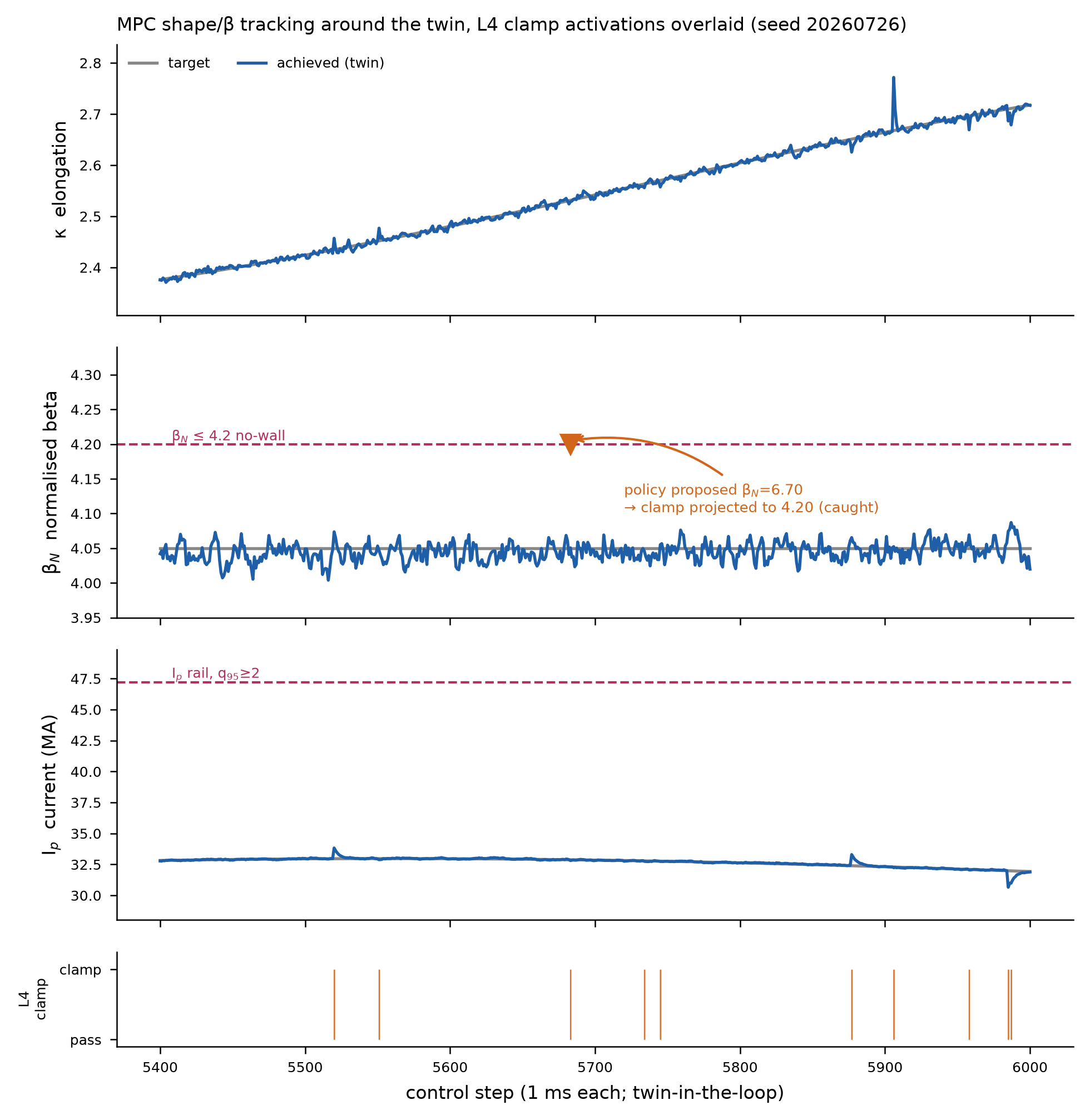
Here is the part that makes this a guarantee and not a hope. The clamp made no prediction. It did not estimate a probability that the command was dangerous and act on a threshold. A learned safety filter would have said something like "this command is 98 percent likely to be unsafe" — and two times in a hundred it would have been wrong, and one of those times the wrong call would have been the one that mattered. The deterministic clamp has no 98 percent. It computes a projection, the same way every time, from an inequality a human can check by hand against the limit book without understanding a single weight in the network upstream. That is why we can write three thousand of three thousand and mean it exactly — not "three thousand, probably." A probabilistic filter has a tail; the tail is where a plant gets hurt; and the whole point of determinism is that it has no tail. The clamp either lets a command through unchanged because it is safe, or it clips it to the boundary because it is not, and there is no third outcome and no distribution over outcomes to worry about.
The one honest wrinkle, kept on the record above, is timing: our software clamp settles this projection in about 42 microseconds, which is fast but not fast enough for the sub-ten-microsecond tier the very fastest edge gate demands. That tier is covered by a two-tier lookup-table clamp that resolves in a fraction of a microsecond, and beneath even that sits the autonomous hardware failsafe that depends on nothing which can be surprised. Three layers, each simpler and more certain than the one above it, and the caught violation passes the test of every one.
A provable safety envelope
Catching three thousand out of three thousand is a wonderful empirical result. For an operator, it is reassuring. For a regulator, it is necessary — and not quite sufficient. Empirical means "it did not fail in the cases we tried." A regulator licensing an autonomous nuclear-grade machine wants something stronger: a reason to believe it cannot fail, across all the cases you did not try.
That reason comes from an idea called a control-barrier function, and it is worth translating carefully because it is the mathematical heart of the safety case.
Imagine the safe operating region of the plant as a fenced field. Somewhere inside the fence is where you want the machine to live. A control-barrier function is a way of measuring, at every instant, how far you are from the fence — call it your safety margin — and then proving a rule about that margin: that the controller can only ever choose actions that keep the margin from crossing zero. Not "usually." Ever. The property is called forward invariance: if you start inside the safe set, you provably stay inside it, forever, under the clamped controller.
``` Discrete-time control-barrier condition:
h(x_{k+1}) ≥ (1 − α) · h(x_k) with 0 < α ≤ 1
where h(x) is the safety margin — positive inside the safe set, zero at the fence. ```
In plain words: `h(x)` is the distance to the fence. The condition says that from one control step to the next, your margin is allowed to shrink — the factor `(1 − α)` lets it decay toward the fence as you maneuver — but it is never allowed to go negative. You may walk right up to the fence. You may not walk through it. And because this is a mathematical inequality the clamped controller is proven to satisfy at every step, it holds not just for the cases you tested but for every reachable state, by construction. This is the leap from "we tried three thousand attacks and stopped all of them" to "no attack in the reachable state space can succeed." The first is a test result. The second is a theorem. A regulator can build a licensing case on a theorem in a way it never can on a test count, however large.
We verified that theorem three independent ways, because a proof you check only one way is a proof you half-believe: an interval analysis that bounds every reachable state, a linear-program witness that exhibits the certifying margin directly, and an adversarial rollout that actively tried to break the invariant and could not.
I will keep the honesty here too. Of the four "faces" of the safe box we tried to certify, three closed cleanly at a three-sigma margin: the density limit, the current limit, and one of the shaping limits. The fourth — the pressure limit, β_N — did not close globally, because the reference operating point we used sat too close to the theoretical no-wall stability limit, about sixteen times closer than the margin the proof needed. For that face we report the largest sub-region we could certify, we cover the rest empirically with the clamp, and we say plainly that the fix is to move the operating point off the limit. Three of four, with the fourth honestly bounded and its fix named, is the real result.
There is one more piece, and it is subtle and important. A control system that never learns anything new is safe but frozen. We want to be able to improve the surrogates over time, feeding them better physics between shots. But every time you update a model, you risk breaking the safety proof. So we proved something about the update process itself: that when a new, higher-fidelity physics closure is admitted to recalibrate a surrogate, the forward-invariance guarantee is preserved through the update. And here we caught ourselves in the act — the first version of our admission gate let through a bad calibration anchor once in ten trials, a real failure we found and report. A corrected gate with a barrier-floored margin restored it to ten out of ten. Safe learning, with the failure and the fix both on the record.
What a regulator actually audits
I have used the word "certifiable" a great deal, and I owe you a concrete picture of what it means to a person whose job is to sign the license. A regulator does not evaluate a control system by admiring its neural networks. They evaluate it against a body of functional-safety practice that predates fusion by decades — the same layer-of-protection thinking that governs a chemical plant, a fission reactor, or an aircraft. The reason KRONOS-CTRL is built the way it is, is that we designed it from the start to be legible to that practice rather than to ask the practice to make an exception for us.
The mapping is deliberate and it is threefold. The clever, learned controller is a non-safety-rated control function — useful, convenient, not trusted with the safety case. The deterministic clamp is an independent protection layer with a measured, quantified catch rate: three thousand of three thousand. And the autonomous hardware failsafe is the final element whose integrity is argued by construction, because it depends on nothing that can be surprised — no network, no model, no learning. That is exactly the architecture a functional-safety assessor already knows how to read: a fallible control function wrapped by an independent layer of protection wrapped by a last-ditch final element, each one simpler and more certain than the last.
The second thing a regulator wants is traceability — the ability to reconstruct, after the fact, why the machine did what it did. This is where the governed data fabric at L2 earns its place. Every automated action the plant takes can be traced backward, through the decision log and the lineage-tracked telemetry and the archived twin state, all the way to the raw sensor reading that triggered it. Nothing the machine does is unaccountable. When an auditor asks "why did the controller adjust that coil at that millisecond?" there is an answer, and the answer regenerates from the record.
The direction of travel in fusion regulation helps here. The emerging posture at the national and international level is not to bolt fission's prescriptive rulebook onto a machine that cannot run away in the fission sense, but to license fusion on a graded, consequence-based case: show, quantitatively, that the worst thing the machine can do is bounded, and build the argument from there. A twin that can bound worst-case actuation and prove forward-invariance of the safe set is producing precisely the kind of quantitative evidence such a case is made from. I want to be careful about the claim: we do not assert compliance with any particular standard in these pages, because compliance is demonstrated against a specific machine before a specific regulator, and no such machine yet exists. What we assert is narrower and, I think, more honest — that the architecture is built to be assessable, which is the prerequisite for compliance and the thing most machine-learning control schemes never even attempt.
Calibration: teaching a fast model to be almost exact
If the clamp is what makes the system safe, calibration is what makes it brilliant. It is the quiet mechanism I believe will matter most over the whole life of the program — the lever that lets a fast, cheap model borrow the accuracy of a slow, expensive one.
A surrogate is fast precisely because it is approximate. The whole art is to make it far less approximate without making it slow. The answer is calibration: you take a small number of anchors — points where you have run the slow, exact, high-fidelity physics — and inject them into the fast surrogate's training. A handful of exact answers, placed well, can drag the surrogate's error down dramatically.
How dramatically? On a chemistry benchmark, five anchors reduced the surrogate's error by more than a thousandfold — a factor near 1700 — and brought it to what chemists call chemical accuracy. That would be a curiosity if it worked only for chemistry. It doesn't. The same mechanism transferred to a plasma-transport closure — the physics of how heat leaks across the plasma — for a 36.8× error reduction from just eight anchors, beating the best reduced-physics model by nearly a factor of ten. And it transferred, most strongly of all, to the magnet twin: up to three orders of magnitude of error reduction, a factor of 7475× at its best. Three different domains — molecules, turbulent heat transport, and the strain in a superconducting coil — and the same lever works in all three. The mechanism is not domain-specific. It is a general way of spending a little expensive exactness to buy a lot of cheap accuracy.
And — this is the part that keeps calibration from becoming a back door — every anchor is admitted through a provenance gate that checks where it came from and refuses corrupted ones. In testing, that gate rejected every one of a batch of deliberately poisoned anchors while the hard physical limits, like the magnet's strain ceiling, stayed immutable through the whole process. Calibration can make the model better. It cannot quietly make the machine unsafe.
This is also, quietly, where the great dream of quantum computing meets the great dream of fusion — and where I have to puncture a story the field has told far too loudly, because two revolutions colliding make for irresistible headlines and terrible engineering. A quantum computer is not going to control a plasma. There is no fault-tolerant machine that runs at control latency, and our own resource estimates say there will not be a useful one for these problems this decade; the honest number for the equilibrium kernel is that it would need on the order of 10¹⁷ elementary fault-tolerant operations once you count the cost of getting data in and answers out, which is nobody's near-term reality. But a future quantum computer would be very good at exactly one thing we need: computing a few high-fidelity physics closures, offline, between shots. In other words, it would be a superb anchor factory. The architecture is built so that when such a machine exists, its output enters the plant only as an offline, gated calibration anchor that provably preserves the safety envelope — never as something in the loop. Forward-compatible with quantum hardware, without ever betting the plant on it.
What a microsecond answer buys: exploring between measurements
The 7475× calibration is not merely a headline about accuracy. It changes what the controller is allowed to do in the gaps between measurements — and to see why, you have to notice that a fusion plant does not actually watch itself continuously. It blinks.
A diagnostic does not report in an unbroken stream. It samples. A magnetic probe, a strain gauge, an interferometer — each hands the controller a fresh reading at intervals, and between two readings the plant is, in a real sense, flying on faith. It has its last measurement and it has its model, and nothing new arrives until the next sample lands. A controller that can only react to measurements is therefore idle in those gaps, waiting for the world to tell it something. That idleness is wasted time, and in a machine where a magnet can begin to fail in a microsecond, wasted time is the enemy.
Now give that controller a magnet twin that returns a full strain field — the load in every one of a coil's 82 turns — in microseconds. Suddenly the gap between two measurements is not dead time. It is rehearsal time. In the interval before the next reading lands, the controller can query the twin thousands of times, asking a stream of what-ifs: if I ramp this coil now, where does the strain peak, and does any turn approach the 0.40 percent ceiling? If I trim the field here to hold the plasma shape, what does that do to the load on the inner turns? It auditions candidate actions against the twin, discards the ones that crowd a limit, and commits only the one that keeps the most margin — all before the plant has blinked its eyes open again. Control stops waiting on the world and starts running ahead of it. That is what real-time exploration between measurements means, concretely: the machine reasons about its own near future in the pauses when it cannot see.
But exploration is only worth doing if the model you explore with can be trusted. A surrogate that is three orders of magnitude off the exact physics would send the controller chasing ghosts — rehearsing against a machine that does not exist, and committing actions tuned to a fantasy. This is exactly what the calibration buys. Dragging the magnet twin's error down by a factor of 7475, using a handful of exact high-fidelity anchors, is what makes the fast answer accurate enough to act on rather than merely glance at. The per-turn pre-load that flattens the strain across all 82 turns to 0.017 percent — comfortably inside the 0.40 percent limit — is a decision the twin is only entitled to make because its strain field is faithful to the real coil to a part in thousands. Accuracy and speed are usually a trade; calibration is the mechanism that briefly lets you refuse the trade and have both.
And the capability generalizes past the coil. The same fast, faithful surrogate that lets the controller rehearse thousands of actions between two heartbeats is the surrogate that, pointed at a design instead of a live plant, lets an engineer audition ten thousand possible machines in the time an exact solver would spend on one. Running the plant and designing the plant turn out to be the same act performed at two different speeds — which is the subject of the next section.
Cracking the optimization code
There is a second life for these fast surrogates, one that has nothing to do with running a plant, and it is the one that gives this chapter its name. A surrogate that returns a physics answer in microseconds does not merely let you control a machine. It lets you optimize one — to sculpt the machine itself, in silico, before a single bolt of it is cut from steel. This is where artificial intelligence stops being a safety net and becomes an act of imagination: it lets us audition ten thousand possible reactors and keep only the best.
Think about what designing a fusion generator actually is, underneath the physics. Stripped bare, it is a search. You have a few dozen knobs — major radius, aspect ratio, elongation, triangularity, field strength, the current, the fuel mix, the shape of the pressure profile — and each setting of those knobs is a candidate machine with its own gain, its own stress, its own neutron budget, its own price. The space of candidate machines is astronomically large, and until recently you could afford to evaluate only a handful of points in it, because each point cost hours of a slow, exact physics solver. So designers did what you do when evaluation is expensive: they picked a plausible starting point, nudged it a little, and stopped at the first machine that cleared the bar. Not the best machine. The first acceptable one.
The surrogate changes the economics of that search completely. When one physics evaluation drops from hours to microseconds, you stop nudging and start hunting. You wrap the fast model in an optimizer that roams the whole design space, evaluating millions of candidate machines, and it finds not the first acceptable point but the genuinely best one — the operating point that sits deepest inside the feasible region, farthest from every limit, cheapest to run. This is the sense in which fusion has an optimization code to crack: the physics tells you which machines are possible, but the optimization tells you which possible machine is best, and you cannot ask that second question at all until each answer is cheap.
We ran exactly this experiment on the program's own design engine — a verified Monte-Carlo model that samples the feasibility of a candidate machine across three hundred thousand points, and that reproduces its feasibility counts bit-for-bit from a single seed, so the search is auditable and not a black box. A Bayesian-optimization surrogate wrapped around that engine reached the optimum with a genuine 3.8-fold reduction in the number of evaluations a random search would have needed. I state that number carefully, because a naïve comparison against brute force would have let me quote something far larger and far less honest — most of brute force's cost is its own inefficiency, not the optimizer's cleverness, and I will not claim credit for a baseline's waste. Against a fair random-search baseline, 3.8× is the real, defensible speedup, and 3.8× is what I report.
The physics tells you which machines are possible; the optimization tells you which possible machine is best; and you cannot even ask that second question until every answer is cheap. This is why I insist that the design of the two machines and the intelligence that runs them are not two projects but one. The same surrogate that lets an optimizer find the best breeder in an afternoon is the surrogate that, deployed in the loop, lets the controller anticipate that breeder's plasma fifty milliseconds ahead. The exact physics is the teacher; the surrogate is the student that inherits the teacher's accuracy and the loop's speed; and once you have that student, you can spend it two ways — to find the machine and to run it. Cracking the optimization code was never about a single clever algorithm. It was about making the expensive question cheap enough to ask a million times.
Seeing trouble coming
Two more results, both about the oldest survival skill there is: seeing danger before it arrives. A gazelle that senses the lion a half-second early lives; the machine that senses its own catastrophe a few milliseconds early does too.
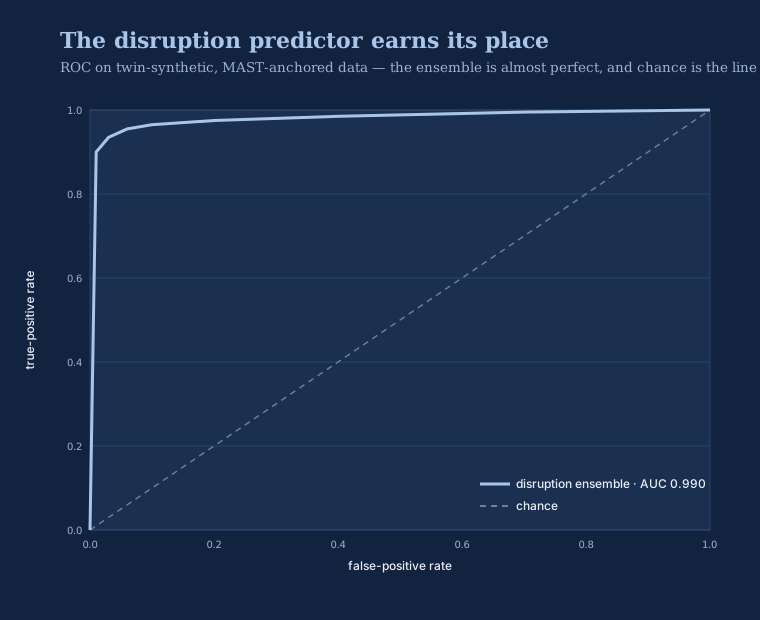
The first is disruption prediction. A disruption is the plasma's sudden, total collapse — an abrupt loss of confinement that hurls everything it was holding into the walls at once. Deep-learning models have predicted disruptions across machines for years; that is established. What we built is an ensemble anomaly detector that, on twin-synthetic pulses anchored to the real operating space of an existing spherical tokamak, reached an AUC of 0.990 with a false-alarm rate of four percent.
That number deserves translation, because "AUC" is a piece of jargon that hides a genuinely useful idea.
AUC 0.990: pick a real disruption and a calm moment at random, and 99 times out of 100 the model rates the disruption as the more dangerous of the two.
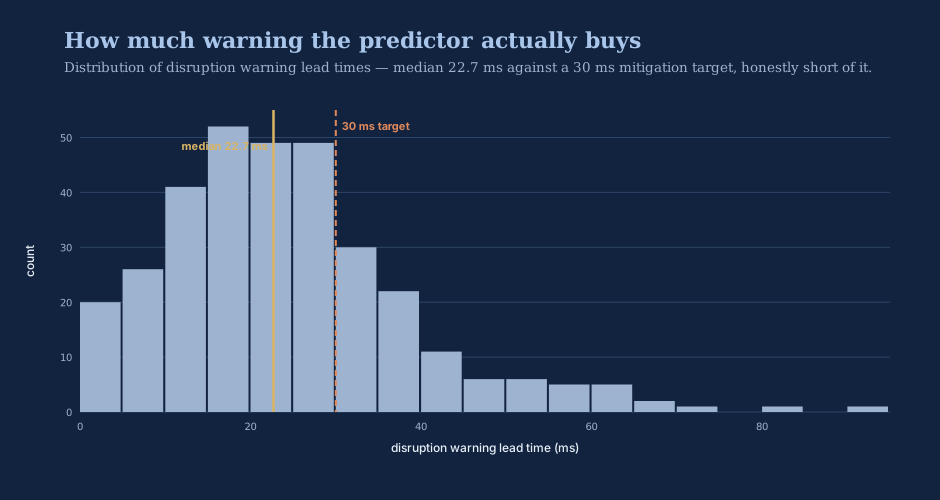
That is what area-under-the-curve means, concretely. It is the probability that the model correctly ranks a true danger above a false one. A perfect predictor scores 1.0; a coin flip scores 0.5; 0.990 means the model almost never confuses a disruption with a quiet plasma. And here again the honesty: the model's warning time missed our target — we wanted 30 milliseconds of lead and the median was 22.3, with fewer than a third of events clearing the full 30. So we did not paper over it with a better average. We handled it architecturally: an out-of-distribution layer that recognizes disruption types the model has never seen — an impurity influx, a vertical displacement — and, instead of issuing a confident-but-wrong command, abstains and hands the machine to the hardware failsafe. On those unseen classes, that handoff cut the missed-alarm fraction from about 0.9 to zero. The model's humility, wired into the architecture, is safer than the model's confidence. A predictor that knows the difference between "this is safe" and "I have never seen this" is worth more than a slightly more accurate predictor that cannot tell the two apart.
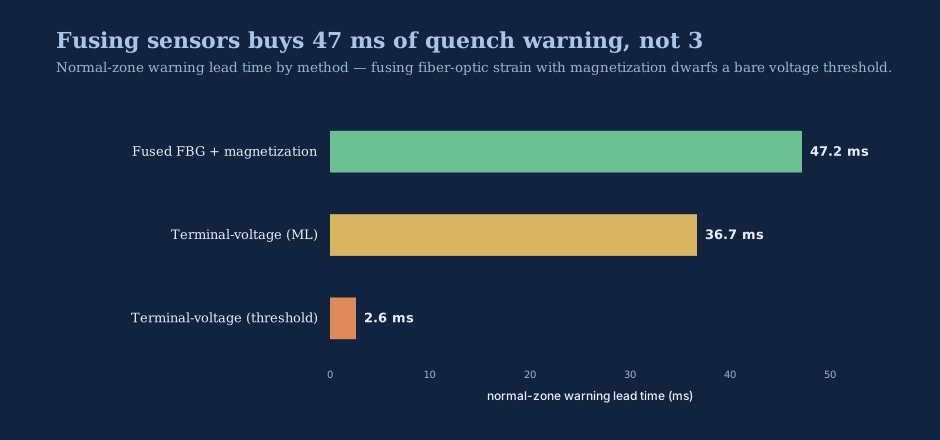
The second is the magnets. The breeder and burner both run on high-temperature REBCO superconductor at fields up to nearly 27 tesla, and a superconducting magnet that begins to "quench" — to lose its superconductivity in a spreading normal zone — can destroy itself if the quench is caught late. The traditional detector watches for a voltage rise across the coil terminals. In these no-insulation coils the normal zone spreads slowly, so terminal voltage is a late signal — it gave, in our twin, about 2.6 milliseconds of warning. We fused two other channels instead: the mechanical strain measured by fiber-optic sensors woven into the winding, and the coil's magnetization signature. The fused precursor gave 47 milliseconds of warning for the same event, at an AUC of 0.9998 and a false-alarm rate of 2.4 percent.
Let me make forty-seven-versus-two-and-a-half concrete, because it is the difference between an inconvenience and a catastrophe. When a magnet quenches, the energy stored in its field has to go somewhere. If you know early, you fire the dump circuits and discharge that energy gracefully, spread over the whole coil, and the magnet lives to run again. If you know late, the energy deposits into the small normal zone that started the quench, a spot heats to destruction, and you are looking at months of repair and a plant sitting idle. Terminal voltage, at 2.6 milliseconds, is often too late to choose the graceful path. Forty-seven milliseconds is not — the difference, operationally, between a magnet you replace and a magnet you merely reset.
The same magnet twin does two more useful things worth naming. Fed each coil's as-built measured data rather than a worst-case assumption, it recovered thirty percent more usable current density from every coil — because worst-case derating throws away margin that the real, measured coil actually has, and it keeps, rather than hides, the minority of coils where the measured margin is worse. And it computes a per-turn pre-load — an engineered residual compression, turn by turn — that brings the operating strain on all 82 turns of a coil to 0.017 percent, comfortably inside the 0.40 percent limit, instead of letting strain peak dangerously at the inner turns. Measured data, used honestly, is worth more than conservative assumptions used fearfully.
A quench, millisecond by millisecond
Set two clocks running on the same quenching magnet, and you will understand why forty-seven versus two-and-a-half is not a marginal improvement but a change of category — the difference between a prediction that can drive an action and a prediction that arrives after the action is already too late.
Somewhere in a high-field REBCO coil, a tiny region gives up its superconductivity and goes normal — resistive. Perhaps a turn shifted a few microns under the Lorentz load; perhaps a flaw in the tape finally mattered. A normal zone is born, and it begins to spread. In a no-insulation coil it spreads slowly and quietly, which is a mercy for the coil's robustness and a curse for the traditional detector, because a slow-spreading normal zone raises almost no voltage across the terminals until it is large. But it is not silent everywhere. The fiber-optic strain sensor woven into the winding feels the local mechanical signature of the newborn zone, and the coil's magnetization signature begins to shift as current redistributes around the resistive spot. The fused precursor — strain and magnetization together — crosses its threshold and raises the alarm. Call that instant t = 0. On this clock, the controller has 47 milliseconds of runway before the quench becomes unsurvivable.
Now start the second clock, the traditional one. The terminal-voltage detector feels nothing yet, because the normal zone is still too small to build a voltage. It will keep feeling nothing for another 44.4 milliseconds. Only at t = 44.4 ms does the spreading zone finally raise enough voltage to trip the classical detector — leaving just 2.6 milliseconds before the point of no return. Same magnet, same quench, two detectors: one shouts at t = 0, the other whispers at t = 44.4.
What those extra milliseconds buy is a choice. With 47 milliseconds in hand, the controller can take the graceful path. It begins to ramp the transport current down, and it arms and fires the dump circuits — the resistors and switches whose job is to pull the enormous energy stored in the magnetic field out of the coil and dissipate it, spread evenly across the whole winding rather than concentrated at one point. The stored energy leaves the coil in an orderly discharge. The normal zone, starved of the current that fed it, cools and never runs away. The magnet is reset, checked, and run again. Nothing is destroyed. Operationally, this is a pause, not a wound.
Run the same event on the 2.6-millisecond clock and the choice is gone. Two and a half milliseconds is often too little to ramp and dump gracefully, so the field's stored energy has nowhere orderly to go. It deposits into the small normal zone that started it all, the spot heats catastrophically, and a coil that cost months to wind is destroyed at the one point where the quench began. The plant then sits idle for the months it takes to build and install a replacement.
This is why the precursor is an economic instrument every bit as much as a safety one. A magnet you reset costs you an afternoon; a magnet you replace costs you a quarter of downtime, and downtime is a direct assault on the capacity factor that sets the price of every megawatt-hour. The prediction and the action are a single mechanism: the forty-seven-millisecond warning exists precisely so that the dump circuits can fire on the graceful side of the line, and the whole value of seeing early is that it lets you act gently.
Knowing what it does not know
Two properties separate a controller a regulator will license from a demonstration that merely works on a good day. One is that it fences its own intelligence — the clamp and the barrier function above. The other is quieter and just as important: it has to know, at every instant, how much to trust its own numbers, and it has to keep running when its senses fail. A confident controller that is confidently wrong is more dangerous than a cautious one that is right about its own doubt.
Start with the doubt. Every prediction the surrogates emit carries an uncertainty — a stated interval within which the true value is claimed to lie — and a stated interval is worthless unless it is honest. If a model says "I am 90 percent sure the answer is in this band," then across many predictions the truth had better fall inside that band about 90 percent of the time, no more and no less. A model whose 90-percent bands catch the truth only 60 percent of the time is not cautious; it is lying, and a safety case built on its intervals is built on sand. So we calibrate the intervals themselves, using a conformal method that adjusts the bands until their stated confidence matches their measured hit rate. On our surrogates the calibrated coverage lands between 0.88 and 0.90 against a 0.90 target — close, honest, and — the part I insist on reporting — slightly over-confident in the far tail, where the rare, extreme events live. We keep that tail over-confidence on the record rather than smoothing it away, because the tail is exactly where a fusion plant gets hurt, and a reader deserves to know the one place our uncertainty estimate is weakest.
Now the failing senses. A fusion plant is instrumented by dozens of diagnostic channels, and diagnostics die — a fiber darkens under neutron flux, a cable picks up noise, a probe simply stops reporting. A brittle controller trips the whole plant the instant a channel drops, which is a catastrophe for uptime. So we taught the twin to see through a missing sensor. A graph neural network — a model that understands how the diagnostics are physically wired to one another, which channel sits next to which — reconstructs a dropped signal from its surviving neighbors at roughly twice the accuracy of naive interpolation between them. That factor of two is not a bragging number; it is a budget. It defines, quantitatively, how many sensors the plant is allowed to lose and keep running inside a certified degraded-state envelope, and — kept honestly — the reconstruction does not reach our stricter target at every level of channel loss, so the envelope is drawn where the model earns it, not where we wish it were. A plant that keeps producing power with three sensors down, inside a fence it can prove it is still behind, has a capacity factor a plant that trips on the first dropout can only dream of.
De-circularization: proving the twin is not just grading its own homework
There is an objection a careful reader should already be forming, and I want to meet it head-on. Every number above lives on a digital twin. What stops a twin from being a flattering mirror — a simulator that validates the simulator, a model that agrees with itself because it was built to? Nothing, unless you go looking for the circularity on purpose. So we did, two independent ways. First, we checked the twin's equilibrium against an entirely separate, open-source equilibrium solver written by a different community for a different purpose, and the fields agreed to within 2.66 percent — with one axis-flux discrepancy we keep as a characterized failure mode rather than sand off. By that check, our internal "circularity index" roughly halved. Second, we benchmarked the twin's magnet, materials, and thermomechanics assumptions against the published engineering design basis of the largest international tokamak project, tagging each of nineteen assumptions as inside that envelope, deliberately outside it, or having no basis in it at all. Some of our choices — high-temperature superconductor at high field and strain — are outside that reference by design, because it uses a different conductor, and we label them so rather than imply endorsement. It is an engineering-basis benchmark, not proof from an operating plasma, and I say so — but it is the difference between a twin that only talks to itself and one forced to answer to an outside authority.
Why control is economics
It would be easy to file everything in this chapter under "safety" and move on. That would miss the point. Reach back to the spine of this book — the second forty, forty dollars per megawatt-hour. The control system is not a cost center that protects the revenue. For a fusion plant, the control system is a large part of the revenue.
Here is why. The dominant driver of the levelized cost of any capital-heavy generator — fusion, fission, anything you build from steel and superconductor — is not the fuel and it is not the operating staff. It is the capacity factor: what fraction of the year the machine is actually producing. A plant that runs 95 percent of the time and a plant that runs 70 percent of the time have wildly different costs per megawatt-hour from the same hardware. Every unplanned trip, every disruption that damages a wall, every magnet quench caught too late and repaired over months, is a direct assault on that number.
So a predictive shadow that anticipates off-normal events before they trip the plant, a disruption predictor that buys time to mitigate, a quench precursor that turns a magnet-destroying event into a routine discharge, a maintenance loop that replaces components against modeled fatigue rather than fixed calendar intervals — every one of these is a lever on capacity factor, and therefore a lever on price. There are more. The predictive isotope-balancing loop that holds the fuel mix on its lowest-neutron trajectory cut the fuel-mix tracking error more than thirteenfold against an open-loop baseline — and a tighter fuel mix means less neutron damage to the walls, which again is uptime. Because the burner produces its power on a direct-current bus, the same twin that keeps the plasma safe also knows, instant to instant, exactly what the machine can deliver — which is precisely the knowledge you need to bid firm power into a grid market. And the state-reconstruction that lets the plant keep running with failed sensors, and the operator-training that happens on the twin instead of the real machine, reduce the specialized-staffing burden that would otherwise make a fleet of small reactors uneconomic to run. Uptime is price. Safety is price. The machine that controls the machine is, in the end, one of the machines that hits the forty-dollar line.
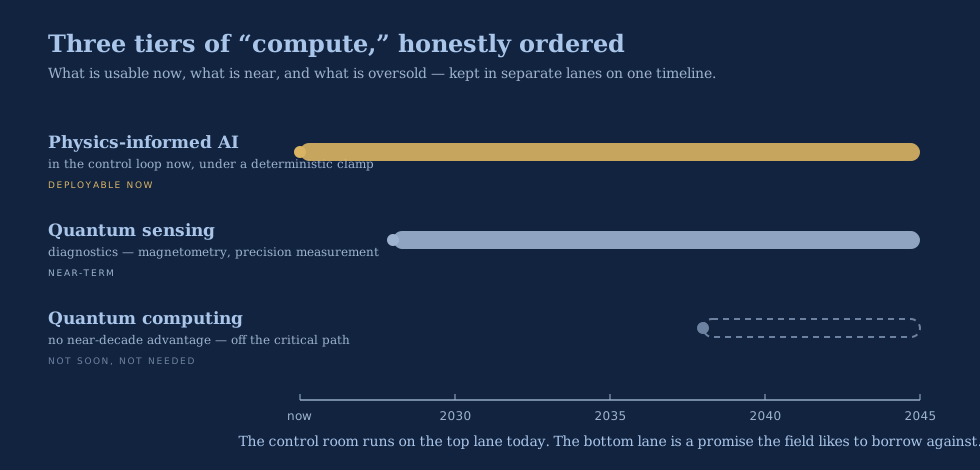
That roadmap deserves one clarification, because "quantum" gets attached to fusion far too loosely. Of the three tiers it shows, the middle one — quantum sensing — is the one that touches the plant soonest and most concretely. Superconducting-loop magnetometers are already mature enough to sit in fusion diagnostics; solid-state diamond sensors and atomic magnetometers are climbing behind them. The fusion-specific point is not the sensor itself but the coupling: a sharper measurement of the magnetic field tightens the boundary condition the equilibrium reconstruction depends on, which lowers the state-estimation error the whole control stack inherits. Sensing sharpens the state the AI consumes today; computation calibrates the models offline tomorrow; neither one is ever allowed inside the fast loop. Holding those three tiers strictly apart — and refusing to let the far-future tier borrow credibility for the present — is itself part of the honesty this chapter is built on.
What this chapter is, and is not
Let me close with the disclosure that governs everything above, because it is the same disclosure that runs through this whole book. Kronos operates no fusion plant. Every number in this chapter comes from a physics-based digital twin, from public data, or from simulation, and each is tagged with its provenance in the published paper. The three thousand caught violations, the 7475× calibration, the 47-millisecond warning, the 0.990 AUC, the certified safety envelope, and the 2.5-percent miss — all of it lives on the twin, not on a burning plasma, and I say so plainly.
That is not a hedge. It is the honest sequence, the only sequence that has ever ended in a working machine: you prove the control and certification methods in simulation first, and then you earn the right to touch hardware — never the other way around. The decade of solved, published physics behind the two machines is the bedrock. What this chapter describes is the intelligence that will stand on it — fast enough to act inside a microsecond, contained enough to satisfy a regulator, honest enough to tell you exactly which target it missed and by how much. For all of human history, holding a star has been the exclusive privilege of gravity and the vacuum of space. When the first breeder wakes at the turn of the decade, a mind built to share that privilege will already be waiting for it — rehearsed ten thousand times against its digital ghost, proven in simulation to keep the star inside the fence. That is what it takes to bring a piece of the cosmos down to Earth and make it behave.