🎧 Prefer to listen? Open the audiobook
Gain, Solved and Published
For seventy years, fusion has been the most seductive sentence in science: we have achieved a breakthrough, and net energy is now within reach. It is a sentence with the pull of a horizon — and, like a horizon, it has stayed exactly the same distance away no matter how far the field walked toward it. The reach has always remained just past the fingertips. So I want to be careful, in this chapter, about the sentence I am actually making, because it is a different sentence, and the difference is the whole reason this book exists. I am not telling you that a machine in a laboratory has produced the gain we need. It has not. What I am telling you is narrower, harder, and much more useful: the gain is solved on paper, published in the open, and deposited so that any physicist on Earth can rerun the calculation and try to break it. This is the "show the work" chapter. Everything in it is a number you can check — and I invite you to try.
The distinction matters because "solved" and "demonstrated" are two different claims, and the whole credibility of this book rests on never confusing them. A solved design is a closed set of equations with a self-consistent operating point — a place in the vast space of temperature, density, current, field, and geometry where the machine does what you asked, without violating a wall limit or a stress limit or the laws of thermodynamics. A demonstrated result is hardware, on a test stand, with an ammeter. We have the first. We do not yet have the second, and I will tell you exactly when we expect it. But do not undersell the first. For most of fusion's history, no one could even write down a self-consistent breeder that closed at a sane size. The blank page won every time. That is the thing that changed — and once you have seen a solved design, you cannot unsee that the road ahead is now made of steel and schedule rather than of unknown physics.
What Q actually measures
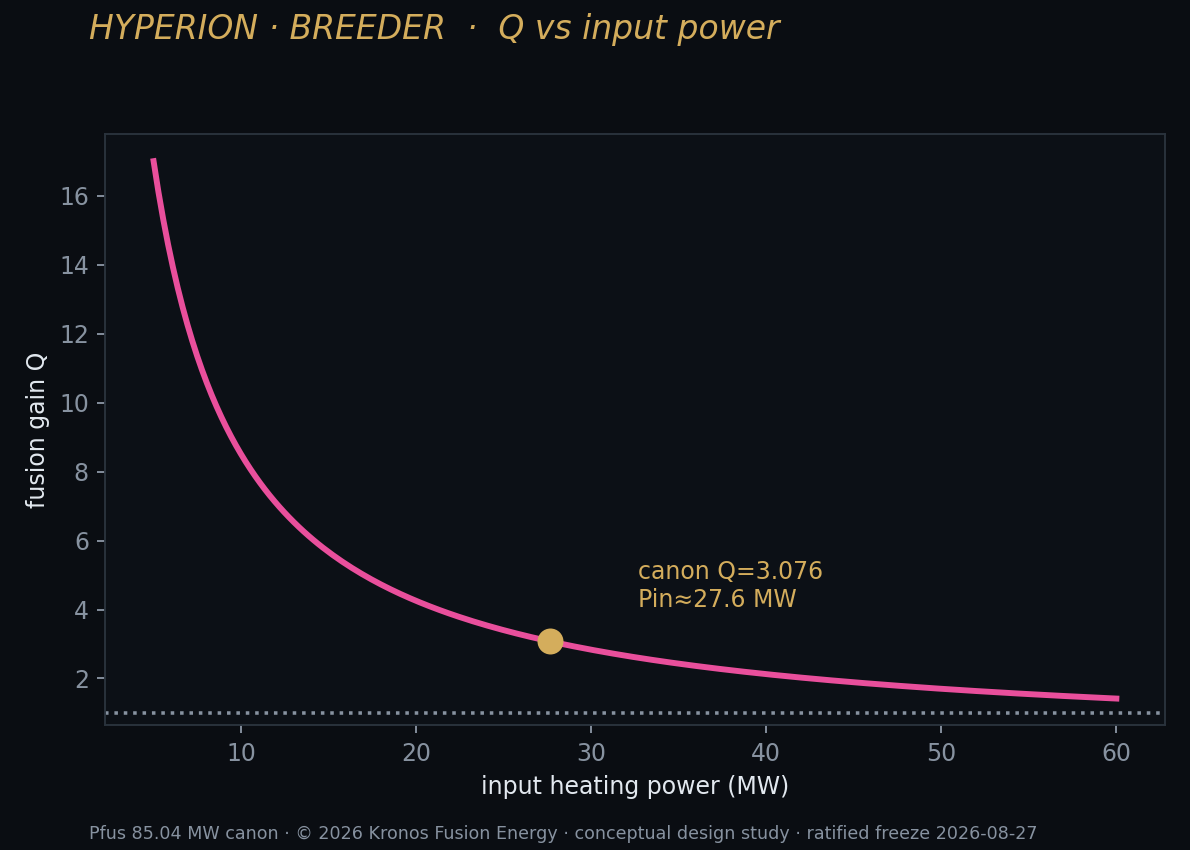
Start with the word everyone uses and almost no one defines the same way twice: gain. Its symbol is Q, and in its cleanest form it is a ratio of two powers.
**Q = P_fusion / P_heating**
That is it. The fusion power the plasma produces, divided by the heating power you have to pour in to keep it hot. When Q = 1, the plasma is giving back exactly as much energy as you are spending to sustain it. That point has a name — break-even — and it is one of the most oversold milestones in all of science, a ribbon-cutting mistaken for a finish line.
Here is why. Break-even is a statement about the plasma, not about the plant. The plasma does not run itself. It sits inside a machine full of magnets that must be cooled, pumps that must move fuel and exhaust, cryogenics, control electronics, and a conversion system that turns heat into electricity at some efficiency well below one hundred percent. Every one of those systems draws power, and that recirculating draw is subtracted before a single electron reaches the grid. So the number a customer actually cares about is not the plasma gain but the engineering gain:
Break-even is a laboratory result. It changes the physics conversation and nothing about the price of your electricity.
To distinguish them, physicists write Q_sci for the scientific, plasma-only gain in the equation above, and Q_eng for the engineering gain — net electricity out over total electricity in, across the whole plant. The gap between the two is not a rounding error; it is a chasm, and it opens up in stages. First, the heating systems themselves are inefficient: to deposit one megawatt of power in the plasma you may draw two or three from the wall. Then the thermal cycle claws back only a third to a half of the fusion heat as electricity. Then the magnets, pumps, and cryoplant take their cut off the top, running whether the plasma is burning or not. Stack those factors and a plasma sitting exactly at Q_sci = 1 corresponds to a plant at Q_eng far below 1 — a machine that consumes several times more grid power than it returns. Break-even, in other words, is a plant that is deeply in the red.
This is the trap the field's press releases keep falling into. "We reached break-even" sounds like the finish line. It is closer to the starting gun. And it is why the honest target has to be so much larger than one. Recall the first of this book's three forties: Q40, a fortyfold return. That number is large precisely because it has to swallow every one of those recirculating losses — the inefficient heating, the mediocre thermal cycle, the parasitic house load — and still leave a plant that sells power for less than it costs to make. Somewhere around a fortyfold plasma gain, the arithmetic of a plant finally closes. Q_sci is the physics quantity you solve for on paper; Q_eng is the one the grid pays for; and Q40 is the specific value of the first that finally drags the second across zero and into profit. Three different numbers, three different jobs. Confusing them is how the field has oversold itself for two generations.
Now hold two facts next to each other, because their tension is the drama of this entire chapter. The highest gain any fusion device has been driven to, in the design's careful accounting, remains modest — of order Q ≈ 0.7. The field has walked right up to break-even and never once stepped across it. And yet the design I am about to show you closes at Q_sci ≈ 3.076 — comfortably past break-even, several times over. How can a paper claim more than three when the best hardware on the planet still sits below one? Because the paper is not hardware. It is a solved operating point, carried openly as a design-point target, with every assumption named. That gap between 0.7 demonstrated and 3.076 solved is exactly the gap between this chapter and the day, later in the timeline, when a real centrepost carries real current. I will not paper over it. I will point straight at it, and keep pointing.
The reaction, and how its energy is split
Before we get to the bar the plasma has to clear, it is worth being precise about the reaction itself, because the way its energy divides is the hinge on which the entire two-machine strategy turns. Everything in this book — which machine breeds fuel and which one sells power, why one runs a ferocious magnet and the other a gentler one — follows from the accounting of a few million electron-volts. Get the bookkeeping of a single fusion event right and the whole architecture of the enterprise falls out of it.
The near-term breeder burns deuterium and tritium, and the reaction is the most generous in the accessible range:
D + T → ⁴He (3.52 MeV) + n (14.06 MeV)
Seventeen and a half million electron-volts per event, and — this is the part that matters — it does not come out as one lump. Roughly a fifth of it, 3.52 MeV, rides on the helium nucleus, which carries electric charge and is therefore held by the magnetic field, depositing its energy back into the plasma and helping to keep it hot. The other four-fifths, 14.06 MeV, rides on the neutron, which carries no charge, ignores the magnetic field entirely, and streams straight out of the plasma into whatever you have placed around it. For a power plant that neutron is a problem — it damages materials and its energy must be caught as heat. For a breeder it is the entire point: those 14 MeV neutrons are the tool that transmutes lithium into tritium and the industrial flux you sell for materials qualification. The breeder is built to harvest exactly the part of the reaction a power plant wishes it could avoid. One machine's waste is the other machine's product — the same insight, monetized.
Deuterium also fuses with itself, and here the split is more intricate, because the deuterium–deuterium reaction runs down two branches of almost equal probability:
D + D → ³He (0.82 MeV) + n (2.45 MeV) D + D → T (1.01 MeV) + p (3.02 MeV)
The first branch throws off a 2.45 MeV neutron and leaves a helium-3 nucleus recoiling with 0.82 MeV; the second stays entirely charged, sharing 4.03 MeV between a tritium nucleus and a proton. In the design's careful accounting the neutron branch takes a profile-weighted fraction of 0.5306 — not the round one-half that circulated in the older literature, a small correction with real consequences for how much of the reaction's energy stays behind to heat the plasma. This D–D side reaction is not a nuisance to be suppressed; in the breeder it is a second, independent source of helium-3, produced inside the plasma itself rather than in the blanket. I will return to that when we count the machine's three products.
The rate at which any of this happens, per unit volume, is the reactivity law from earlier in this chapter made specific:
**P_fusion = n₁ · n₂ · ⟨σv⟩ · E_fusion**
The fusion power density is the product of the two reactant densities, the reactivity ⟨σv⟩ at the operating temperature, and the energy per reaction. Read it and the design pressure becomes obvious: power scales with the square of density (through n₁·n₂), which is why the machine is driven so hard toward high density and therefore high pressure — and why, as the next sections show, the whole design turns on how much pressure a magnetic field can be made to hold. Squeeze harder, and the reward grows as the square of the squeeze. That single fact will pull the entire design toward the strongest magnet it can honestly build.
The triple product: the bar that has to be cleared
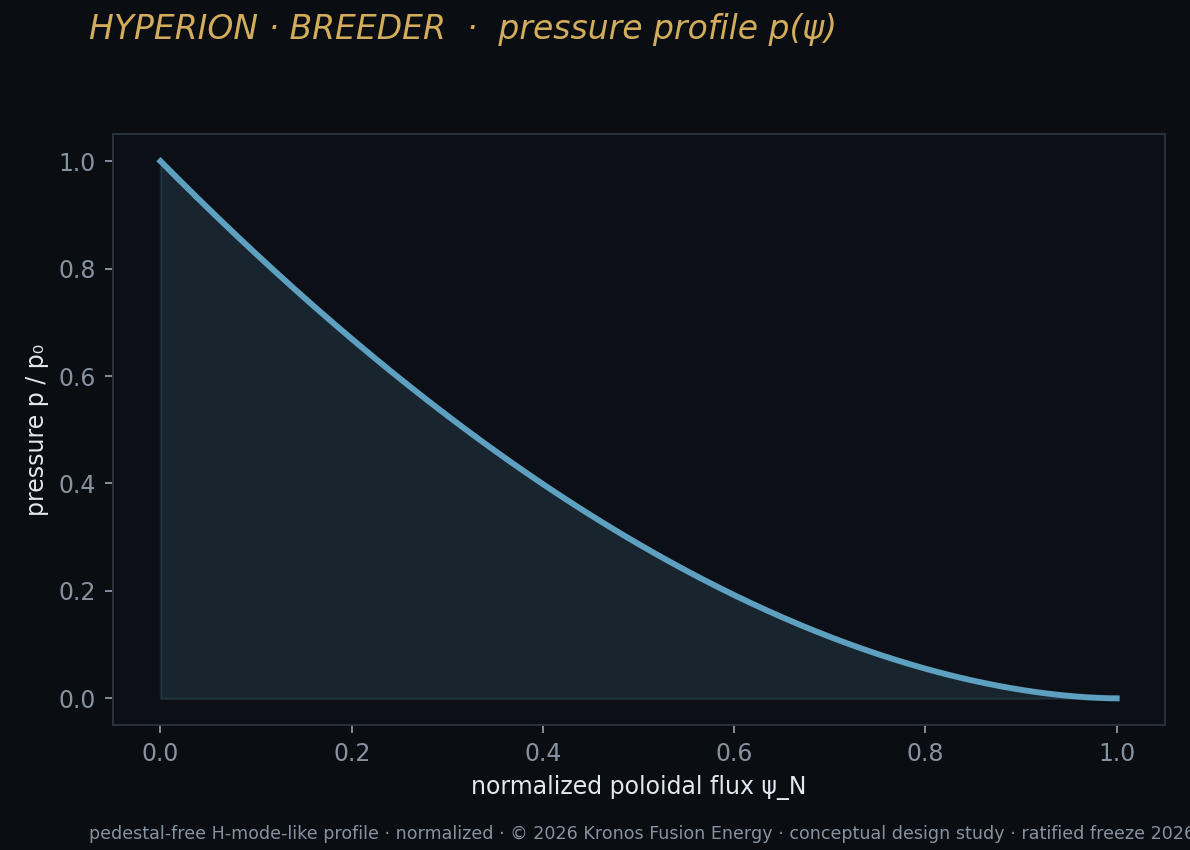
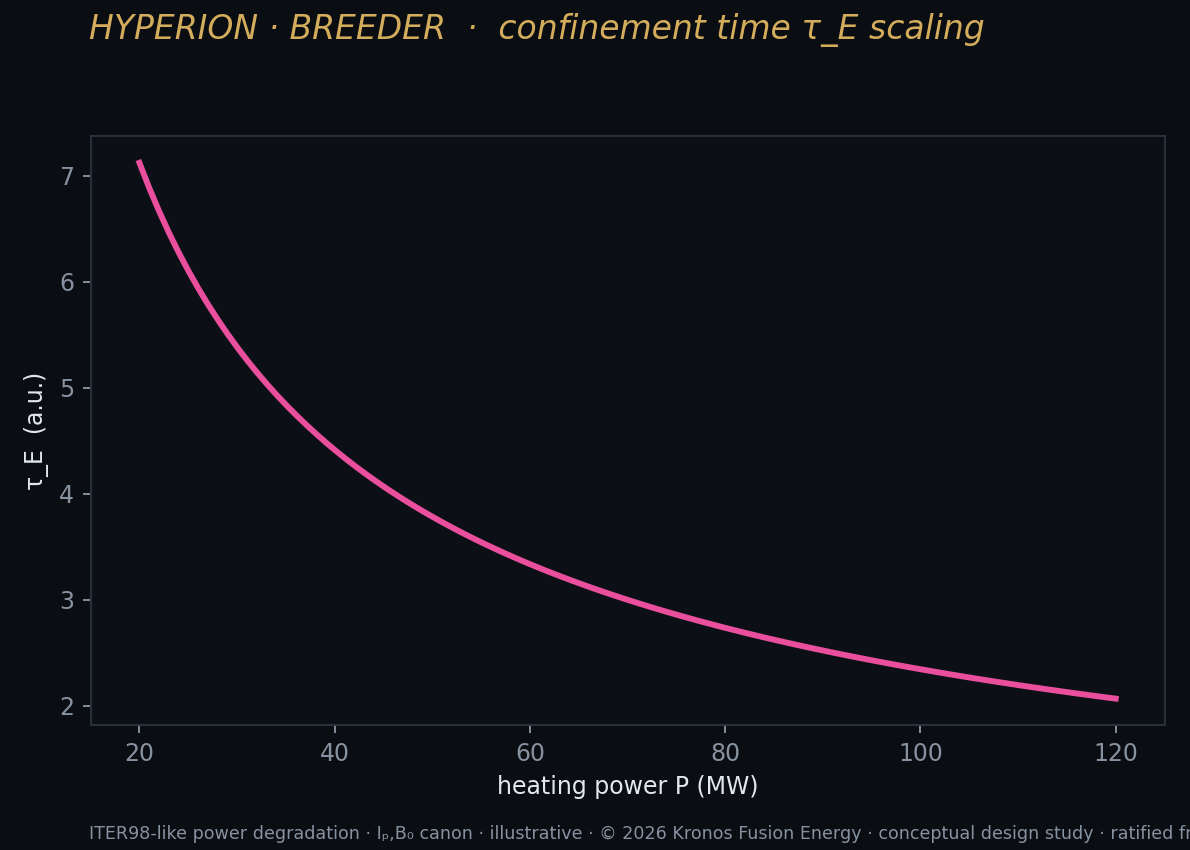
Why is gain so hard to get? Because you cannot buy it with any single quantity, and the universe is uncommonly strict about this. You cannot simply make the plasma hotter, or denser, or hold it longer, and expect fusion to follow. You need all three at once, and the physics multiplies them together into one merciless figure of merit — the fusion triple product, the modern form of a criterion first written down in the 1950s, the Lawson criterion.
n · T · τ_E ≳ 3 × 10²¹ keV · s · m⁻³ (for a D–T burn)
Read it slowly, because every symbol is a different kind of difficulty, and each one is a separate lever the designer has to pull — while the other two fight back.
The first lever is n, the density — how many fuel nuclei you have packed into each cubic metre. More nuclei means more collisions means more fusion, and the reaction rate climbs with the square of density, so this lever is powerful. But you cannot simply crank it. A magnetically confined plasma pushes outward with a pressure set by its density and temperature together, and the magnetic field can only push back so hard before the plasma squirms free. Density is not free; it is rationed by pressure, and pressure is rationed by field. Hold that thought — it is the whole reason this machine runs such a strong magnet.
The second lever is T, the temperature — how fast the nuclei are moving. For fusion this means tens of thousands of times hotter than the core of the Sun, because we cannot cheat with the Sun's crushing gravity and must make up for it with sheer speed. The design point runs the ion temperature up into the hundred-kilo-electron-volt range, past a hundred million degrees. And here is the first hint of a trap that the rest of this chapter is built around: temperature is not a lever you can lean on without limit. Past a certain point, pushing the plasma hotter makes it radiate its own energy away faster than the extra reactions can replace it. There is a ceiling on this lever, and I will come back to exactly where it sits.
The third lever is τ_E, the energy confinement time, and it is the one that has broken more careers than the other two combined: it is how long the plasma holds onto its heat before that heat leaks away. Not how long the machine runs — how long a given packet of energy stays put before escaping into the wall. For decades the entire game was τ_E: build a bigger, better magnetic bottle, hold the heat longer, watch the triple product climb. That instinct is deep in the field, almost tribal, and — as I will show near the end of this chapter — it is precisely the instinct that fails you once radiation enters the picture. Confinement holds particles. It does not hold light.
The cruelty of the triple product is that it is a product. Winning on temperature does you no good if your confinement is poor; the energy you added just leaks out faster. Doubling your density is wasted if it forces you to run cooler to stay under the pressure limit. You must clear the whole bar, in all three variables simultaneously, and the bar sits at roughly three followed by twenty-one zeros in the right units. That single inequality is why fusion took seventy years and not seven.
But the product is also, usefully, a menu — and this is where the story turns from tragedy to strategy. Because the three quantities multiply, you are allowed to trade among them. A machine that runs at very high density and field can clear the bar at a smaller size than one that must rely on brute confinement time — it substitutes pressure for scale. That trade — buy the triple product with field and geometry rather than with sheer size — is the entire design philosophy of the machine in this chapter. It is why the flagship international devices are the size of buildings and the machine I am about to describe is barely more than a metre across. They chose to win on τ_E through scale. This one chooses to win on n·T through field, and to fix the geometry so that confinement survives at a size no one thought was possible. Same bar, radically different route up the cliff.
The number, and the machine that reaches it
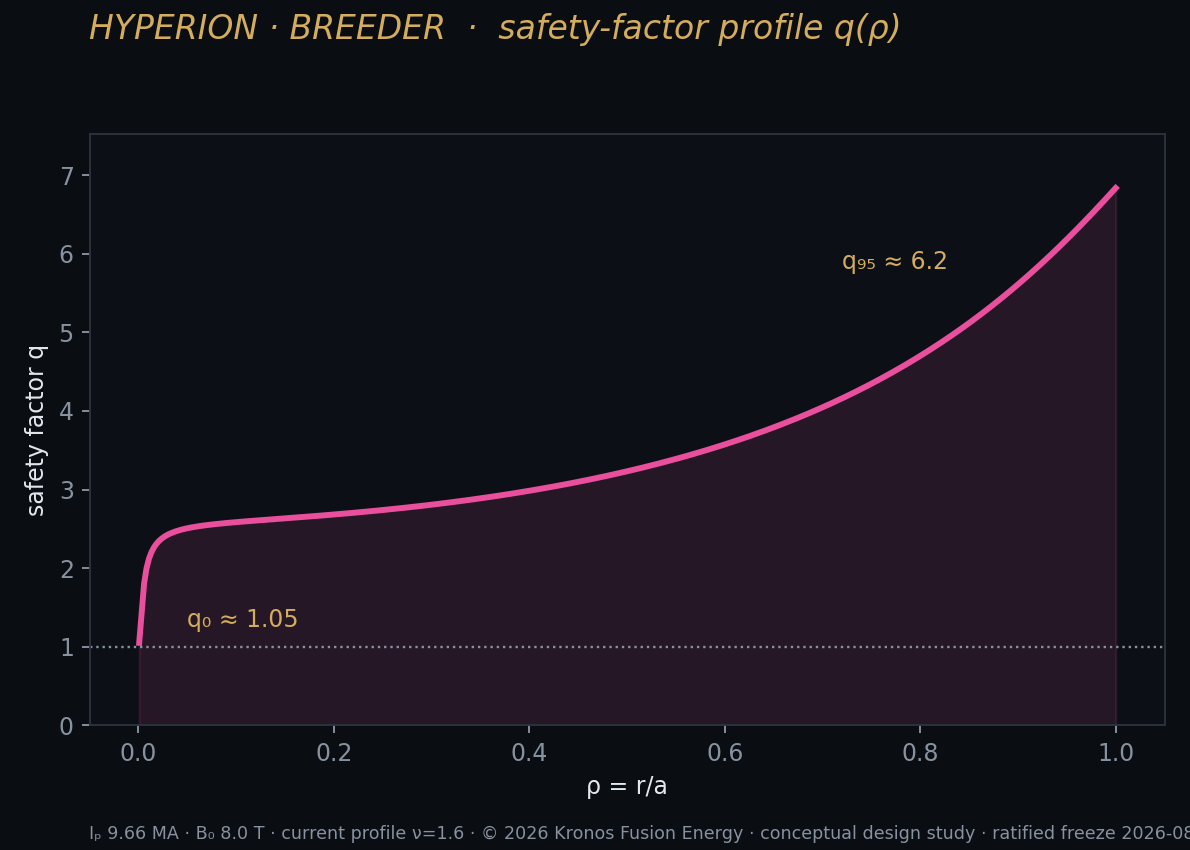
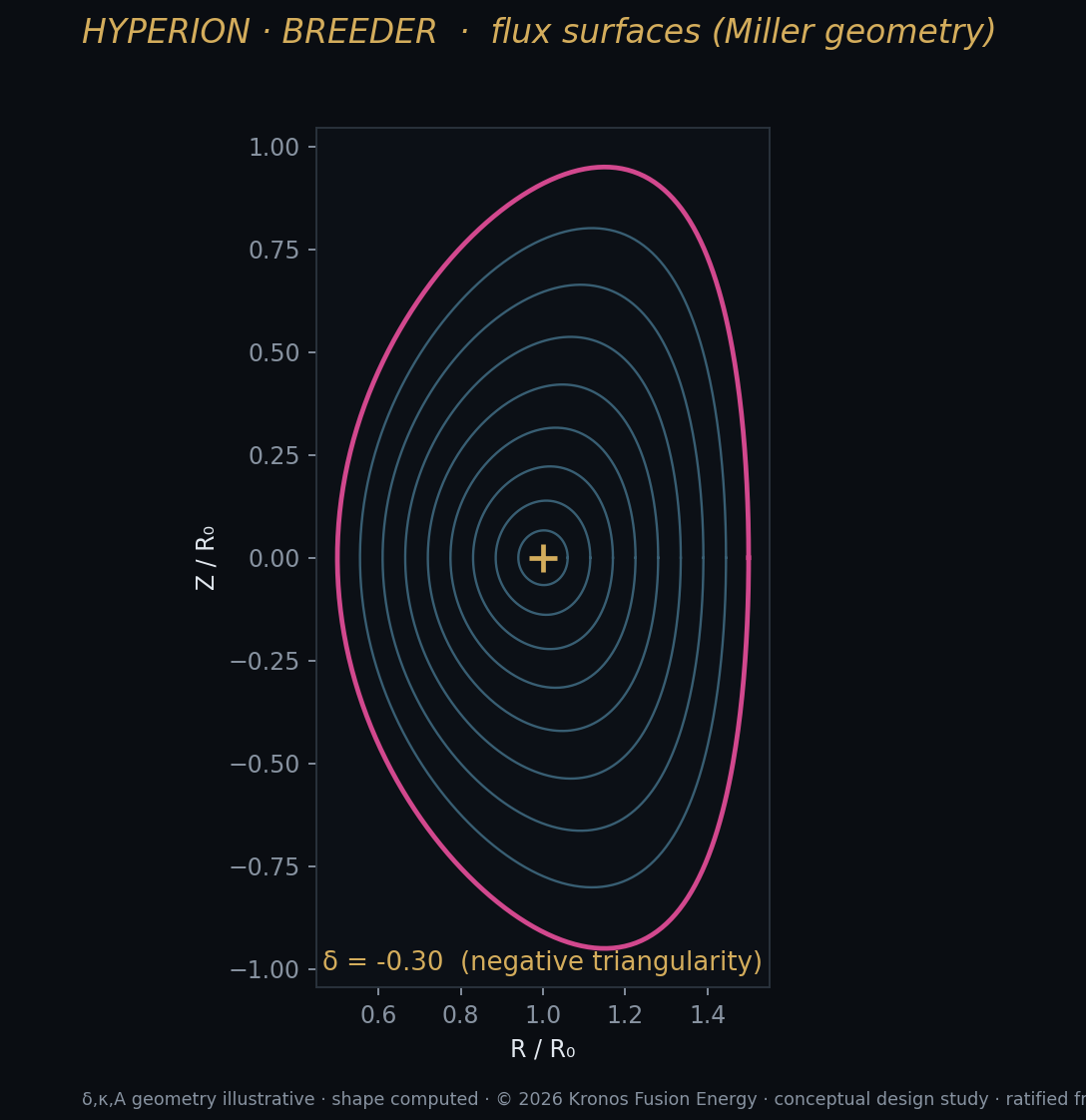
Here is the design basis, in public, in full — the receipts behind the wonder. The breeder — Hyperion, a compact spherical tokamak — closes at a frozen operating point (the engineers call it config 22021) with these values:
| Quantity | Value | What it is |
|---|---|---|
| Q_sci | ≈ 3.076 | plasma gain (solved, not demonstrated) |
| P_fusion | 85.04 MW | fusion power at the design point |
| I_p | 9.66 MA | plasma current in the design configuration |
| B₀ | 8.0 T | on-axis field on the REBCO magnets |
| δ | −0.30 | triangularity — negative, deliberately |
| TBR (lever) | 1.03–1.20 | breeding lever: literal recipe → solid-Be layer; tritium-marginal by design |
| R₀ | ≈ 1.2 m | major radius — a genuinely small machine |
That operating point did not come from a single lucky guess, and this is the part I most want you to feel. Picture the search as a great winnowing. Twenty-five thousand two hundred candidate machines go in at the top — every plausible combination of size, field, aspect ratio, elongation, temperature, and density — and each is put to a single merciless question: does it meet the national fuel duty without breaking a wall limit or a current-drive limit? Watch the field thin. Most fail on the first cut, unable to breed enough. More fail on the second, asking for a field no conductor survives. By the time the sieve stops shaking, the tens of thousands have collapsed to a few hundred, and then to 213 machines that close on deuterium–tritium and 71 on pure deuterium. One point in that surviving population — config 22021 — is the machine this book is about, chosen not because it dazzled anyone but because it was the smallest thing left standing when every easy answer had been disqualified.
When I say the design is "frozen," I mean exactly that: the inputs are written down in a declared-parameter table, the scan is reproducible, and the winning configuration is fixed so that anyone can find it in the same haystack. This is the opposite of a hero shot. It is a census — the machine chosen not because it dazzled a reviewer but because it survived twenty-five thousand attempts to disqualify it.
Three point zero seven six. That is the load-bearing number of the whole breeder program, and I want to be precise about what it does and does not claim. It is well past break-even, which means the physics of gain — the hard part, the part that defeated the field for seventy years — is solved for this machine at this point. It is emphatically not Q40, and it is not trying to be. The breeder is not a power plant. It is a foundry: it burns deuterium and tritium not to sell electricity but to make materials — tritium to fuel the next machines, helium-3 as a strategic commodity, and a flux of 14-MeV neutrons for advanced materials and isotopes. I said it plainly in the last chapter and I will say it again here, because it is the kind of fact the field has trained itself to hide: the breeder — for all the 85.04 megawatts of fusion power it makes at the design point — is net-negative on electricity, roughly minus seventy-nine megawatts electrical. That is not a flaw in the design. It is the design. A breeder needs fusion gain, not net electricity — and gain of 3.076 is more than its mission requires. The fortyfold return lives with the burner, later, and is a different machine's story.
There is a second choice buried in that table worth dwelling on, because it shows how disciplined the design is about its own goals. On paper, pure deuterium fuel would make more tritium per unit of fusion energy — nearly twelve times more of the raw product. So why does the machine burn deuterium–tritium instead? Because the binding constraint here is not tritium-per-joule; it is plasma current.
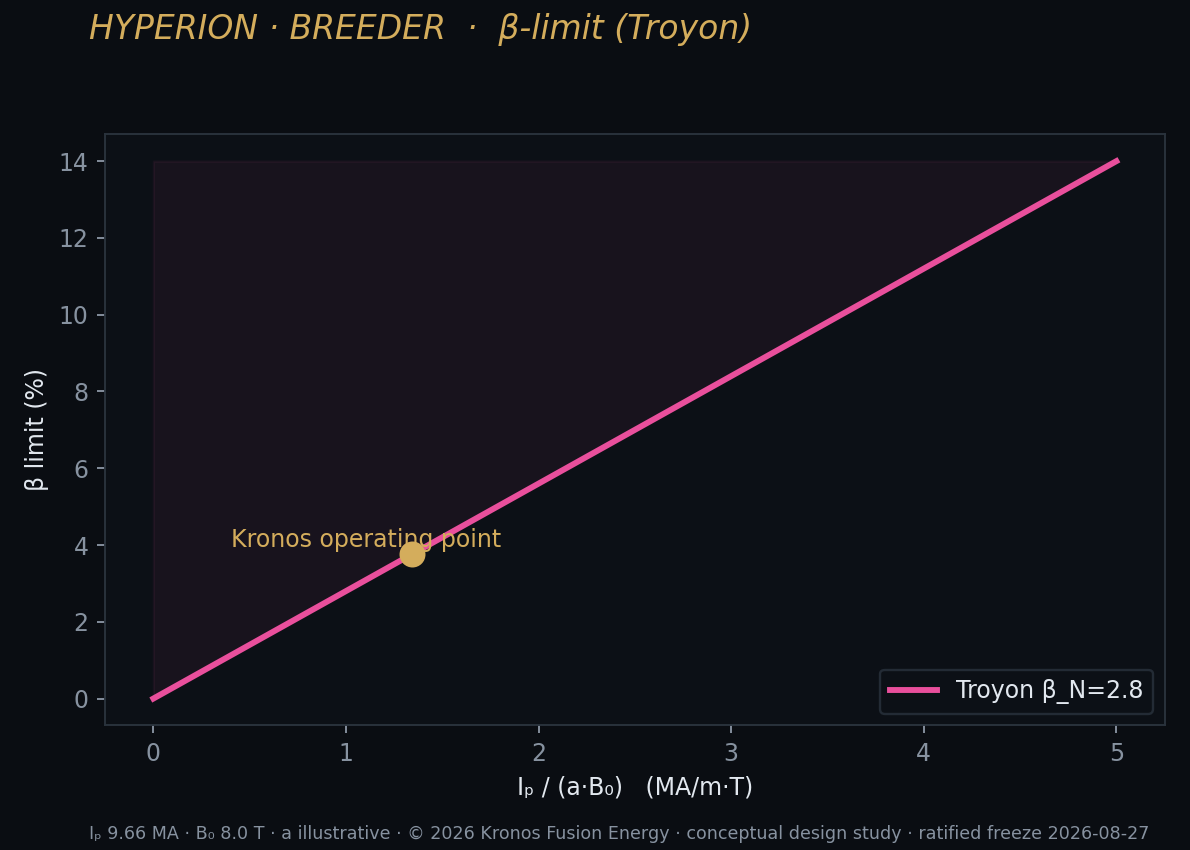
The reason is structural, and it is worth stating as a chain, because each link is forced. A tokamak run at a fixed normalised pressure — the ratio physicists call β, plasma pressure over magnetic pressure — is pressure-limited: there is a hard cap on the n·T it can hold. To hit a given fusion rate under that cap, you need a certain plasma current, and the fuel's reactivity sets how much:
**required I_p ∝ 1 / ⟨σv⟩ → I_p(D–T) ≈ I_p(D–D) / 19**
Deuterium–tritium reacts roughly nineteen times more readily than deuterium alone at these temperatures, and that higher reactivity lets the machine meet its fuel duty at 9.66 MA at the frozen design point — a current a third the size of the international flagship's — where the closest pure-deuterium configuration in the scan demands 15.5 MA, a current larger than the flagship's. That is the whole game: the current a tokamak's centrepost can carry is a wall the designer cannot move, so the design picks the fuel that lets it stay well below the wall. It does not pretend one fuel is universally better. It picks the fuel that eases the constraint that actually binds. That is the texture of an honest design point: not "we chose the best fuel," but "we chose the fuel that fits the one wall we could not move."
What makes 3.076 reachable in a machine barely more than a metre across, when the international flagships are the size of buildings? Two choices, both of which look strange until you see the physics they are fighting. One is the shape of the plasma. The other is the strength of the field. Take them in turn.
Three products from one machine
I keep calling the breeder a foundry rather than a power plant, and it is worth slowing down on what, exactly, it forges — because this is where the design stops being an abstract exercise in gain and becomes an answer to a specific national vulnerability. This machine does not wait for the last, hardest problem to be solved before it earns its keep. It has products the day it lights.
The machine makes three things at once, and none of them is electricity. The first is tritium, the heavy hydrogen that fuels the next machines. Tritium is scarce and getting scarcer: it does not occur in nature in useful quantities, it decays at about 5.5 percent every year — a stockpile left alone loses a twentieth of itself annually — and the national supply has been sustained from a single ageing source rather than by adding new capacity. A machine that can manufacture tritium from lithium, on the ground, on demand, is therefore of strategic value entirely apart from whether it ever sells a watt. It turns a dwindling stockpile into a renewable one.
The second product is helium-3, the isotope the burner in the later chapters is built to consume, and a strategic commodity in its own right — prized for neutron detection, for reaching temperatures a whisker above absolute zero, and for a form of medical lung imaging. A national reserve of it stopped being auctioned back in 2009, and demand has outrun supply ever since. Here the breeder does something quietly elegant: it produces helium-3 independently of the blanket, partly as the direct product of that deuterium–deuterium side branch inside the plasma, and partly as the daughter of tritium's own decay, banked over time. In the design's accounting the machine yields on the order of two kilograms of helium-3 a year as a co-product it was going to make anyway — the same reaction that heats the plasma quietly mints a substance the modern world cannot buy at any reasonable price.
The third product is the one a power plant spends fortunes trying to avoid: a flux of 14 MeV neutrons. Nowhere on Earth is there enough of this exact neutron spectrum to properly test the materials that future fusion plants will be built from, and so the breeder's neutron flux is itself a service — a materials-qualification facility that happens to also make fuel. The very radiation that other designs armor themselves against becomes, here, a product line.
This is the strategic logic of building the foundry first, and it is worth making explicit, because it is the hinge of the whole staged plan. A machine that must sell electricity has to clear the fortyfold engineering bar before it earns a cent — it has no product until the very last, hardest problem is solved. A machine that sells materials has a product the moment it runs, at a gain its physics already reaches, because tritium, helium-3, and a 14 MeV neutron flux are valuable whether or not the plant ever closes its electrical loop. The breeder is therefore the near-term business precisely because it is net-negative on power. It asks the physics for the part that is already solved — gain — and asks nothing of the part that is not yet: net electricity. The burner, and the fortyfold return, come later, standing on fuel this machine will already have made. We do not bet the enterprise on the hardest problem first. We solve the solvable one, sell its output, and let it pay for the climb.
Making tritium, though, is not free, and the honesty of the design shows in how it accounts for the balance. The relevant figure of merit is the tritium breeding ratio:
**TBR = (tritium bred in the blanket) / (tritium burned in the plasma)**
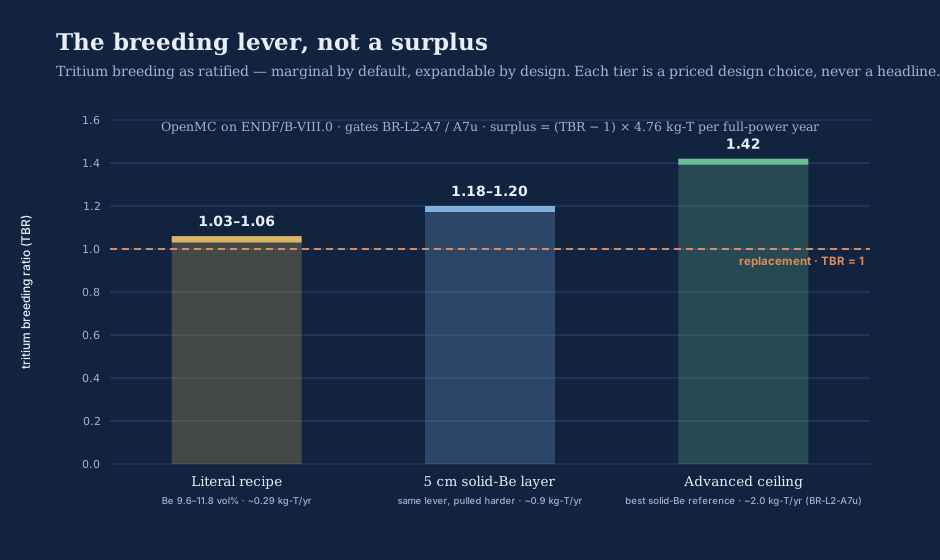
For the machine to replace the fuel it burns, the TBR must exceed one — and here I owe you the frozen truth rather than the hopeful one, because this is the number a hopeful engineer most wants to round up. Bred tritium is not a surplus headline in this design; it is a lever. On the frozen recipe — the literal blanket, with beryllium packed at 9.6 to 11.8 percent by volume — the Monte-Carlo neutron transport on evaluated nuclear data (OpenMC on ENDF/B-VIII.0, gate BR-L2-A7) yields a breeding ratio of 1.03 to 1.06: above one, and deliberately not far above it. Pull the same lever harder — a dedicated five-centimetre solid-beryllium layer — and the identical calculation reaches 1.18 to 1.20. And the lever has a ceiling worth naming: the advanced blanket — the best solid-beryllium reference the same code family supports — reaches 1.42 (gate BR-L2-A7u). The surplus arithmetic is plain: at 85 MW the plasma burns about 4.76 kilograms of tritium per full-power year, so the surplus is (TBR − 1) × 4.76 — roughly 0.29 kilograms a year on the literal recipe, 0.9 at the solid-beryllium tier, and ~2.0 at the advanced ceiling. That ladder, 1.03 to 1.42, is the honest shape of the blanket: a machine that is tritium-marginal by design, holding its fuel loop just above replacement and treating every point of breeding beyond that as a design choice with a cost, not a boast. The old habit of quoting a single triumphant breeding number is exactly the habit this program exists to break.
There is one more piece of accounting the paper insists on, and it is the kind of detail that separates a design from a brochure. Helium-3 is fragile in a neutron flux — a neutron can strike it and destroy it, turning it back into tritium and a proton. If that loss were large it would quietly gut the helium-3 yield. The design tracks it explicitly and finds that, on the staged-extraction path, the destructive channel removes only about 0.18 parts per million of the helium-3. And the equilibrium tritium inventory the machine must hold at any one time — the number that governs whether it can be licensed at all — comes to about 6.2 kilograms, comfortably inside existing civil precedent for handling the isotope. These are not glamorous numbers. They are the numbers a regulator and a safety case actually turn on, and the design carries them in the open, because a machine that cannot be licensed is a machine that cannot be built, no matter how beautiful its physics.
Why the plasma is dented inward: negative triangularity
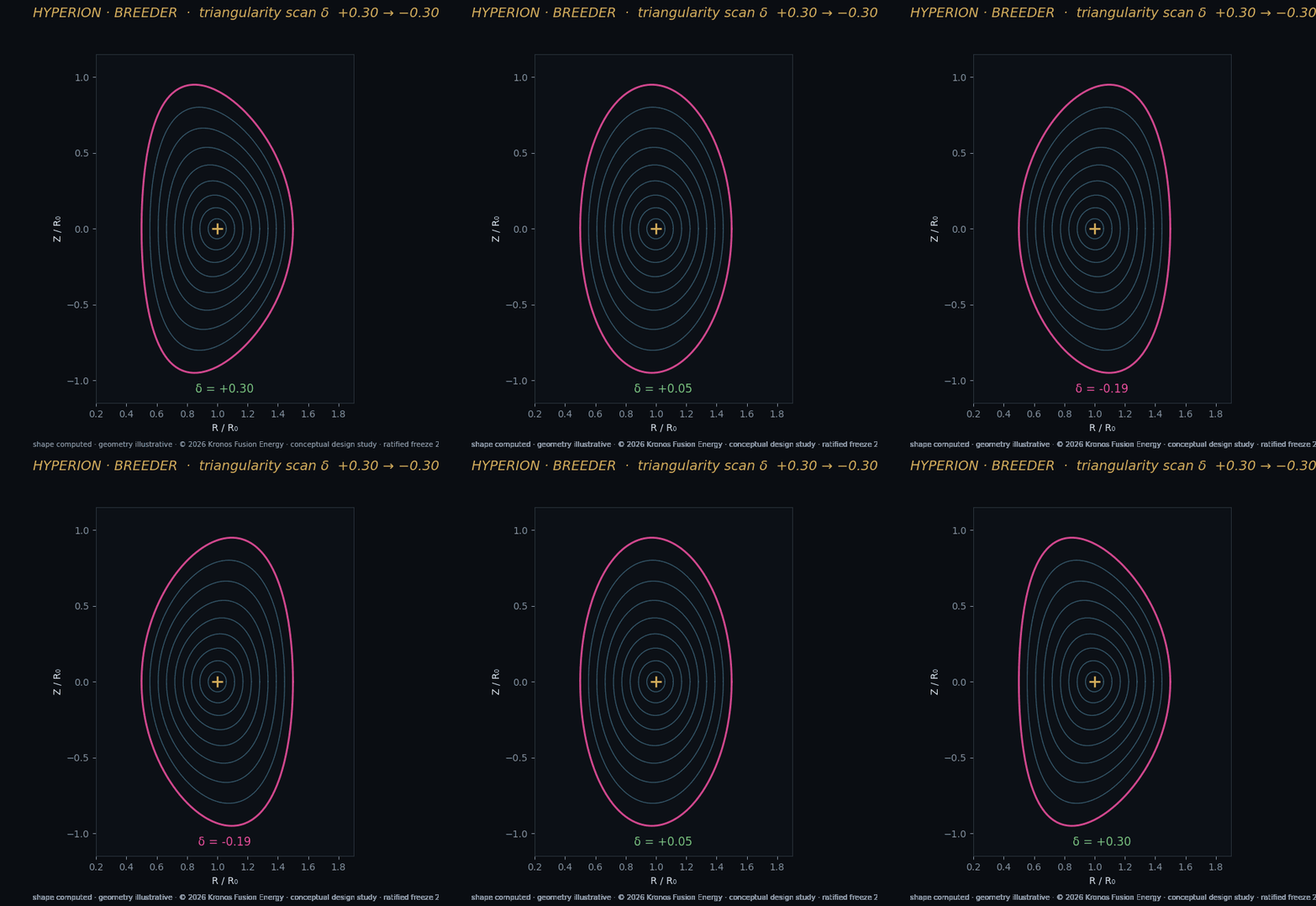
Look at a cross-section of a conventional tokamak plasma and you see a shape like a capital D — the straight back against the machine's central column, the bulge facing out. The "triangularity" measures which way that D leans. Positive triangularity, the field's default for decades, points the plasma's corners one way; negative triangularity points them the other, so the plasma looks like a backward D, dented inward on the outboard side. Hyperion runs at δ = −0.30. That minus sign is the configuration's defining geometric choice, and it is there to kill a specific monster — one that has haunted high-performance tokamaks since they first learned to confine well.
The monster is the edge-localised mode, or ELM. A high-performance tokamak edge builds up a steep pressure pedestal — a cliff of pressure right at the plasma's boundary that is the price of good confinement — and that pedestal periodically relaxes in a violent burst. An ELM flings five to twenty percent of the pedestal's energy at the wall in under a millisecond. Put a number on it: a single uncontrolled Type-I ELM can dump more heat onto a tungsten surface, per event, than the material can survive — the transient load blows past the roughly twenty megawatts per square metre that tungsten can take. And it does this over and over, every discharge, thousands of times in a campaign. It is a controlled explosion the machine is forced to endure again and again. Machines spend enormous ingenuity mitigating ELMs: pacing them with pellets, shrinking them with magnetic perturbations, spreading them out in time. It is a whole subfield devoted to managing a recurring detonation inside the machine.
Negative triangularity does something better, and this is the kind of move that makes an engineer smile. It does not manage the detonation; it removes the phenomenon. The dented-inward shape suppresses the edge instability that builds the dangerous pedestal in the first place, so the pedestal never steepens to the point of collapse. This is not a hope — it is demonstrated. Experiments on a major national tokamak sustained a completely ELM-free edge at strong negative triangularity across an entire campaign — no ELM in any discharge, at an average triangularity even more strongly negative than Hyperion's design value. You do not have to schedule, pace, or survive a monster you have arranged never to be born. The best defense against an explosion is a geometry in which it cannot form.
Nothing in fusion is free, and I will name the price precisely, because the paper does. Negative triangularity trades a violent, transient problem — the ELM spike — for a steady one: a harder, continuous heat load on the divertor, the component at the bottom of the machine that catches the plasma's exhaust. Here the numbers get demanding. The exhaust arrives in a startlingly thin layer — a scrape-off width of about two-tenths of a millimetre in the design's baseline estimate — and that concentrates the parallel heat flux to something like fourteen gigawatts per square metre, roughly fourteen times the international flagship's. To hold the actual target surface below what tungsten tolerates, you have to radiate away the great majority of that power before it lands — a radiated fraction near ninety percent at the thinnest width estimate.
I want to be honest about the shape of that ninety-percent figure, because it is exactly the kind of number a press release would hide behind a decimal point. It rests on extrapolating a heat-flux-width scaling a factor of two-and-a-half beyond the range in which it was actually fitted. If the real scrape-off layer is broader than the pessimistic estimate — half a millimetre to a millimetre, still narrow — the required radiated fraction falls to somewhere between fifty and seventy-five percent, and that is squarely inside detached-divertor operation that has already been demonstrated on existing machines. So the exhaust is open at this field, not adverse: a hard engineering requirement contingent on a width, not a physics verdict against the design. The difference between those two things is the difference between a problem and a wall, and this is a problem.
And there is a subtle sting in the tail that ties this section back to the last, and forward to the next. Sustaining a high radiated fraction means seeding the plasma edge with impurities — injecting a trace of nitrogen, neon, or argon whose job is to glow the power away before it reaches the target. But impurities are not free either. They raise the plasma's effective charge, they dilute the fuel, and they nudge the machine toward the radiation ceiling I am about to describe. Seeding for argon can push the effective charge from around 1.16 toward 1.66, and that dilution shaves the tritium duty down measurably. The divertor's price, in other words, is not paid only in cooling hardware; part of it is paid in the plasma's own radiation budget. This is the pattern you will see everywhere in this work: not "we solved everything," but "here is precisely which problem we chose to have instead, and exactly what it costs us elsewhere." An honest design is a ledger, not a highlight reel.
Why the field is so strong: high-temperature superconductors
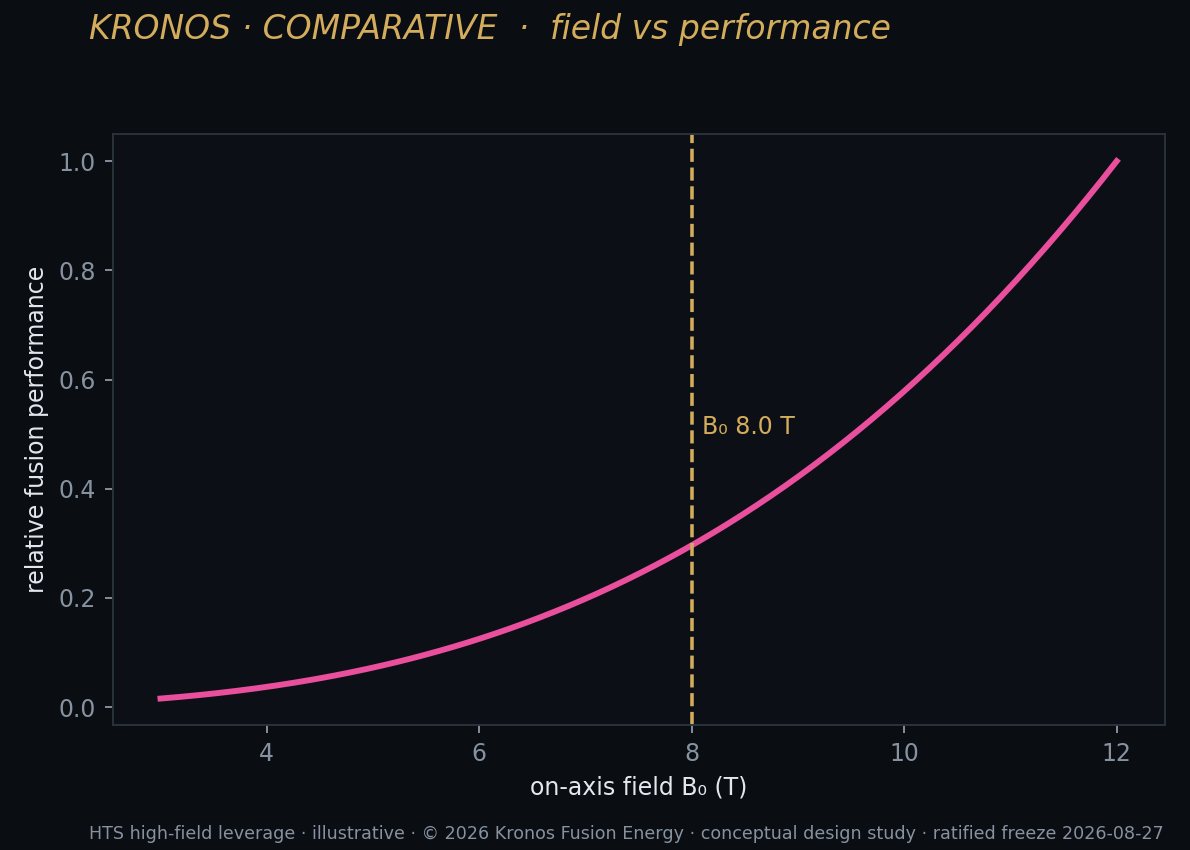
The second choice is field. Hyperion's magnets are wound from REBCO — a rare-earth barium copper oxide high-temperature superconductor — and they give 8 tesla on the plasma axis, with a substantially higher working field at the conductor. To feel how strong that is: it is hundreds of thousands of times Earth's magnetic field, held perfectly steady, in a coil you could stand next to. This is a material that did not exist in usable form when I was a student, and it is the quiet reason a compact machine is now possible at all.
Field is the lever that lets a small machine clear the triple product, and the reason is a single, unforgiving, gorgeous scaling. A tokamak at a fixed pressure ratio — the physicists call the ratio beta, plasma pressure divided by magnetic pressure — is pressure-limited. And magnetic pressure grows with the square of the field. So the plasma pressure you are allowed to hold scales the same way:
**p_max ∝ β · B²**
Read what that little equation is telling you, because it is the whole reason this machine can be small. Double the magnetic field and, all else equal, you can hold four times the plasma pressure — four times the n·T you were rationing back at the triple product. More pressure in the same volume means more fusion reactions in the same volume. High field is how you buy the n·T part of the triple product without building something the size of a stadium. This is the same insight that has powered the recent wave of compact-tokamak efforts, and it rests entirely on REBCO tape having matured, in the last decade, from a laboratory curiosity into a conductor you can actually wind into a magnet and run at these fields. A materials breakthrough became a machine-scale one: shrink the magnet's demand and you shrink the whole reactor around it.
Crucially, the conductor’s working point sits inside the demonstrated REBCO envelope. This is where the design's discipline shows again. The breeder's centrepost is, in the engineers' phrase, "stress-comfortable" — the field it must produce is well within what the conductor and its structure can bear, so its binding limit is not the magnetic force but the neutron lifetime of the coil behind its shield. That is a scheduled-replacement question — how often you swap a consumable centrepost — not a fundamental wall you cannot climb. The far more demanding magnet, the one that pushes the technology to its genuine edge at more than 26 tesla, belongs to the burner and is a later chapter's problem. The breeder deliberately does not ask its magnet to do anything heroic. It asks it only to be strong, and steady, and replaceable — and it saves the heroics for the machine that has to earn them.
So: dent the plasma inward to kill the ELMs, crank the field to buy the pressure, and you get a machine that closes the triple product at Q_sci = 3.076 while remaining small enough to license and site. The radial build tells the whole story in one slice — a thin superconducting centrepost, then shield, then the breeding blanket and the plasma, then blanket and shield and vessel again on the way out.
But there is a third constraint, subtler than either shape or field, and it is the one the design threads most carefully. It is a ceiling you cannot spend your way through — no magnet, no matter how strong, can buy your way past it. It is written into the plasma itself.
The radiation ceiling: the knife-edge the design threads
Here is a fact that surprises almost everyone the first time they meet it, and it is one of the most beautiful and most punishing facts in all of fusion. In a hot plasma, you cannot simply push harder and harder and expect fusion to keep climbing, because the plasma is also a lamp. Every time an electron swerves past an ion it radiates — a loss called bremsstrahlung, German for "braking radiation" — and that radiation streams out of the plasma at the speed of light. The hotter and denser you run, the more the plasma glows away its own energy. Fusion power and radiation loss are locked in a race, and the terms of that race set a hard ceiling on what any deuterium-burning device can do. This is the ceiling I foreshadowed on the temperature lever: it is the reason you cannot just run hotter forever. The furnace fights the lamp, and past a point the lamp wins.
The Kronos papers establish this with a result that is almost unnervingly sharp. Compute the ratio of fusion power to bremsstrahlung power for a pure deuterium plasma, and it peaks at just 1.589, at a temperature around 108 keV — and even that peak assumes a perfectly clean plasma. Not a factor of ten of headroom. Not a factor of two. About sixty percent more fusion than radiation, at the single best temperature, in the best case. Everything real you add to the plasma eats into that thin margin. The dream of a pure, easy, self-igniting burn runs headlong into a number that leaves almost no room to stand.
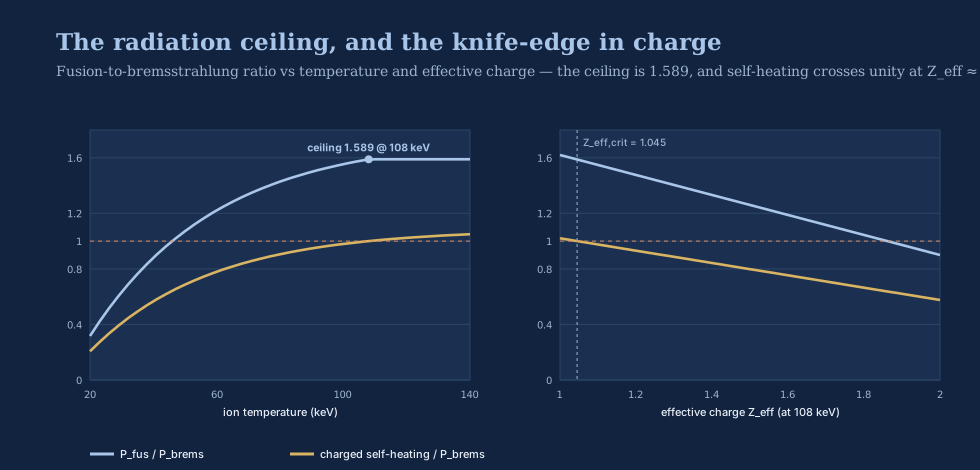
Where does the margin go? Into contamination. The balance depends on the plasma's effective charge — how many heavier ions have crept into the fuel — and it depends on that quantity in a way worth stating exactly:
**P_fusion / P_bremsstrahlung ∝ 1 / (Z_eff + c_ee · t), t = T / mₑc²**
Translated: the ratio falls off with the effective charge Z_eff in a way that is affine — a straight-line-with-offset — not a simple inverse. That distinction is not pedantry; it means two plasmas quoted at the same "impurity level" can radiate quite differently depending on which impurity and at what temperature, so any tolerance stated as a bare number is not reproducible unless the species and the temperature come with it. And there is a critical value: an effective charge of about 1.045 at 108 keV, above which the plasma radiates more than its own reactions can heat it, and gain falls apart. That is a knife-edge measured in the second decimal place. Push the impurity level a few percent past 1.045 — exactly the kind of nudge that edge seeding for the divertor threatens to deliver — and the machine crosses from a plasma that ignites to one that merely glows. The margin between triumph and a very expensive light bulb is that thin.
The sharpness gets sharper still when you look at how the number was pinned down, and here is a detail I find genuinely thrilling in the way a good detective story is thrilling. It turns on a single misplaced symbol. Somewhere in the radiation calculation a number refused to reconcile — two supposedly authoritative sources for the same physical quantity, disagreeing by a whisker, in a place where a whisker decides whether a fuel works. Chase that whisker down, term by term, and it resolves to something almost too tidy to believe: one factor of the square root of two, dropped a generation ago and copied forward ever since. There is a coefficient in that bremsstrahlung formula — the electron–electron term, c_ee — whose exact analytic value is a specific combination of π and √2 that works out to 2.120022. A version that has circulated widely in the literature for years quietly dropped a √2 and used 1.499 instead. The two differ by exactly √2, to nine significant figures. When you correct it, the radiation balance moves — and it moves the wrong way, tightening the margin, not loosening it. And when four independent evaluations of the pure-deuterium self-heating-to-radiation balance were run, they landed between 0.984 and 1.121 — straddling unity — and every physical effect the calculation neglected (cyclotron radiation, transport, residual impurities) pushes the number strictly down. Pure deuterium, in other words, sits exactly on the edge, and every honest correction nudges it toward the wrong side. The universe, it turns out, does not want the easy fuel to be easy.
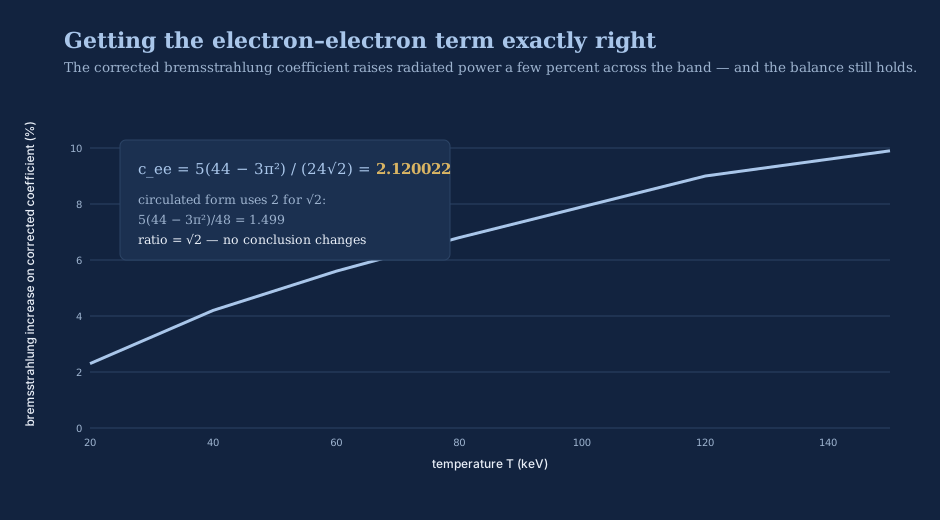
There is a deeper consequence, and it is the most counter-intuitive result in the whole breeder paper, so let me spell it out carefully, because it overturns an instinct the field has carried for fifty years. It falls straight out of writing the plasma's power balance honestly. In steady state, the external heating you must supply is whatever it takes to replace everything leaking out, minus whatever the reaction gives back for free:
**P_aux = W / τ_E + P_radiation − f_dep · P_charged**
Read the terms one at a time. W / τ_E is the transport loss — the plasma's stored energy W draining away over the confinement time τ_E, the term the whole field spent fifty years trying to shrink. P_radiation is the light the plasma throws away as bremsstrahlung. And f_dep · P_charged is the gift: the fraction f_dep of the charged fusion products' power that stays trapped and reheats the plasma. External heating only has to make up the difference.
Now push confinement to perfection — let τ_E grow without bound. In fusion we have always been taught that this is pure profit: hold the heat longer, get more gain. That was the whole logic of the τ_E lever, the mountain the field has been climbing since the 1950s. That intuition is wrong once radiation matters, and the power balance shows exactly why. As τ_E → ∞ the transport term W/τ_E vanishes — but the radiation term does not, because photons leave at the speed of light regardless of how good your magnetic bottle is. Confinement holds particles and heat. It does not hold light. So the gain does not run away to infinity. It saturates, and the asymptote is set by what remains when transport is gone:
**Q_∞ = P_fusion / (P_radiation − f_dep · P_charged)**
That equation says the gain approaches a finite asymptote set entirely by the radiation balance — finite whenever radiation exceeds charged-particle self-heating, and infinite (true ignition) only when it does not. Read the denominator: it is the radiation loss minus the fraction of the plasma's own charged-particle power that stays and reheats it. If radiation wins that subtraction, no amount of confinement can close the gap, and the gain tops out at a number you can compute. Improving confinement in a radiating plasma buys you diminishing returns toward a ceiling, not a runaway to ignition. The dream of "just build a better bottle" hits a wall made of light.
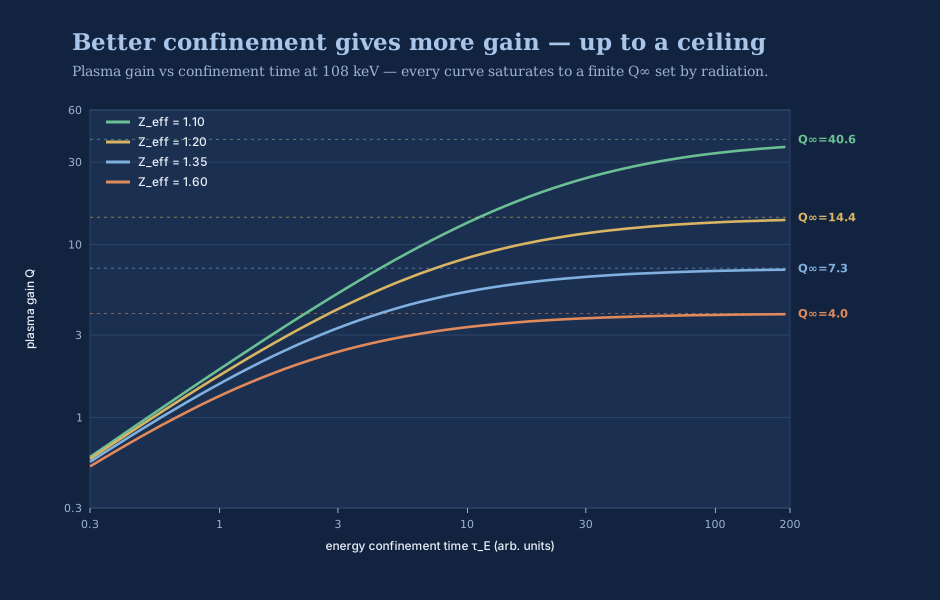
Confinement holds heat, not light. Push the bottle to perfection and the gain does not run away — it saturates.
This is why "we just need better confinement" has failed as a slogan for the pure aneutronic dreams, and it is why the breeder is designed as a driven, sub-ignition machine rather than a self-igniting one. A driven plasma at demonstrated confinement — one you keep hot with external heating, rather than one you hope will light itself — is a materially easier target than ignition. And, as the last chapter argued, a driven sub-breakeven plasma is exactly what a breeder needs, because a breeder is measured in kilograms of fuel produced, not megawatts sold. The design does not try to leap the radiation ceiling. It threads underneath it, on purpose, and asks its confinement only for what has already been shown to be achievable. That is not a retreat. It is knowing precisely where the ceiling is, and building tall enough to be useful without ever pretending it is not there.
I dwell on the ceiling because it is the honest counterweight to every number in this chapter. The reason I can tell you 3.076 is real is that it was computed inside these constraints, not in spite of them. The knife-edge is not a footnote the design survived; it is the wall the design was drawn against. Any number that ignored it would be worthless, and would deserve to be.
A caution the later chapters depend on: directed power is not charged power
There is one more general result in the breeder paper that belongs here, even though its full weight lands later, on the burner. It is a distinction that sounds pedantic and is in fact the difference between an honest efficiency and a dishonest one — and it is the trap that has swallowed more than one celebrated "clean fuel."
When you read that a fusion fuel is "aneutronic" — that its energy comes out on charged particles rather than neutrons — the implication is usually that you can therefore convert that energy directly to electricity at high efficiency, catching the charged particles the way a battery catches current, skipping the wasteful boil-water-spin-a-turbine cycle. That is true only under a condition almost no one states out loud: the charged particles have to come out in discrete energy lines, not a smeared continuum.
Here is why, and it comes down to the shape of the reaction's final state — a piece of pure conservation-law bookkeeping. A two-body reaction — one that ends in exactly two products, as deuterium and helium-3 do — must, by conservation of energy and momentum, hand each product a single sharp energy. Two clean lines, which a direct-conversion machine can be tuned to catch efficiently. But a reaction that ends in three products shares its energy among them continuously, producing a broad smear of energies with no sharp lines at all. The most-hyped "clean" fuel of all, proton–boron, ends in three helium nuclei sharing 8.7 MeV as a continuum:
p + ¹¹B → 3 ⁴He (8.7 MeV, shared as a continuum)
Its charged fraction is 1.000 — every scrap of its energy is charged, which sounds ideal — but its directable fraction, the part you can actually match to an efficient electrostatic converter, is effectively zero, because you cannot tune a converter to a smear. Any efficiency figure quoted across two fuels of different final-state multiplicity, as though "charged" and "convertible" were the same word, is wrong on its face. This is exactly the trap the burner chapter has to walk around, and it is why that machine is built on a two-body fuel with two clean lines rather than on the fuel with the best press. The prettiest slogan and the workable physics are, once again, not the same thing.
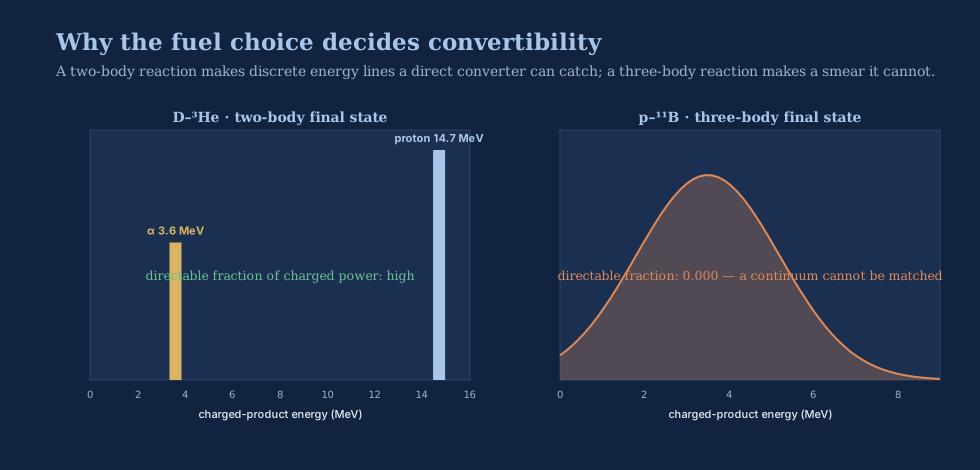
Solved, published, reproducible
Now the part that separates this book from a press release, and separates this century of fusion from the last. It is not enough to have a number. Anyone can have a number. The field is littered with them. The claim I am making is that the number is checkable — and I have arranged for you, or more precisely for any physicist you trust, to check it. I did not ask you to believe me. I built the machine that lets you refuse to.
The full design is published open-access as part of a five-paper Kronos 2026 design series. The breeder paper's headline quantities are not asserted; they are regenerable by named scripts that read their inputs from a single declared-parameter table, so that changing an assumption changes the answer in front of you. This is what "frozen operating point" buys the reader: the 25,200-configuration scan that produced config 22021 can be rerun; the 213 deuterium–tritium closings and 71 pure-deuterium closings can be recounted; the blanket-breeding numbers can be regenerated from the deposited neutronics data on both the demonstrated and the target blanket. Nothing central is a figure you have to take on faith.
And the methods behind those numbers are the field's own, not house inventions dressed up to flatter the result. The confinement and current-drive estimates rest on the standard international confinement scaling the whole field uses as its baseline, with a standard bootstrap-current model layered on top; the driven fraction is then reported at the operating point rather than assumed. The blanket transport is not an assumed spectral shape but a Monte-Carlo neutron-transport calculation run on retrieved, evaluated nuclear-data tapes — the same data libraries the reactor community relies on. The minimum plasma current is not adopted from a summary table; it is read straight off the raw scan and then reproduced by an entirely independent aspect-ratio sweep of more than two million evaluations, which agrees to fourteen decimal places. When a number in this design can be reached by two independent roads, the paper walks both of them and reports where they meet. That is the texture of a result built to be attacked — and a result built to be attacked is the only kind worth trusting.
The simulation code and the physics validation data are archived on Zenodo — the CERN-hosted open repository that mints a permanent digital object identifier for a dataset — under doi:10.5281/zenodo.21746157, with companion deposits for the burner, the magnet, the direct-energy-conversion system, and the AI control layer, so the whole five-paper record has a permanent, citable home. The reduced-order physics engines can even be run in a browser, no installation required, so that "check the work" does not require a supercomputer or a compiler — it requires a web page. This is what "reproducible" means concretely: not "trust me," but "here is the code, here is the data, here is the DOI, rerun it and try to break it." When I wrote in the first chapter that we stopped arguing and started closing, this is the closing. The argument is now a repository.
We stopped promising gain. We deposited it, with a DOI, and invited the world to try to break it.
And now the gate — stated as plainly as I know how, because the temptation to blur it is exactly the temptation this book exists to resist. No hardware has been built. The gain is solved and published and deposited; it is a design-point target, not a demonstrated result. The best any device has reached remains around Q ≈ 0.7, and the honest path from there to 3.076 runs through steel, not equations. The load-bearing quantity — the gain itself — is a target, and so are the confinement multiplier, the current-drive fraction, and the plasma's ash fraction; each is stated with its evidence class rather than dressed up as a measurement. Hardware validation comes with the first machine's operation — first tritium targeted around 2030. And I am retiring, explicitly and permanently, a claim from when I first wrote this that no longer belongs in this book: there is no "net gain in 2027." That date was wrong, or rather it was a different date wearing the wrong label. 2027 is when construction begins — the second quarter, first shovel — not when a plasma produces net gain. I would rather correct my own record in print than let an old, optimistic milestone ride on the credibility of a new, honest one.
That is the whole shape of the claim, and I will stand on it. The physics of gain — the part that humbled the field for seventy years, that made "thirty years away" a punchline — is closed on model for this machine, at a stated operating point, inside the radiation ceiling, and published so completely that its central numbers can be regenerated from open code. What remains is not physics. It is engineering, and steel, and time. In the language the paper itself uses: the hard part, the power balance, is solved; what remains is to build it. That is a sentence fusion has never honestly been able to say before. The chapters that follow are about the building — about turning a solved star on paper into a fire that lights a grid.
This chapter's forty. Q40 — the physics. The gain is solved on paper and deposited in the open; the fortyfold return the whole book is built to reach begins as a number you can check, right here.