🎧 Prefer to listen? Open the audiobook
Aegis: Firm Power Where It Cannot Fail
There is a question that sits underneath every map of the modern world, and most of the time we are polite enough not to ask it out loud: what happens when the power stops? Not for an afternoon, not for the length of a summer storm, but on the day someone has decided, deliberately, that it should stop. Peel back the skin of any advanced society and you find, underneath the sensors and the surgeons and the supercomputers, a single dependency running like a nerve through all of it — electricity, and the promise that it will be there in the next instant. A hospital runs on it. A water-treatment plant runs on it. A radar array watching an approach corridor runs on it, and so does the cooling for the servers that hold a nation's records, and so does the base at the far end of a supply line that is measured in weeks and defended by convoy. Strip the electricity away from any of these and the rest of the apparatus — the sensors, the pumps, the people — becomes a collection of expensive, inert objects. Energy is the substrate. Everything else is written on top of it, and writing on top of something means you are only ever as safe as the layer beneath.
Aegis is the burner configured for exactly that problem: firm, clean electrical power sited where it cannot be allowed to fail. It is not a new machine, and that is the point — it is the same D–³He tandem-mirror generator described earlier in this book, the same physics, the same low-neutron burn, the same direct-conversion train that turns a stream of charged particles into current without a boiler. What changes is the housing and the mission. Aegis is that generator hardened, sized, and shielded for a fixed installation whose defining requirement is not cheapness and not scale but survivability — power that is there in the morning because it was made on the site, from fuel held on the site, independent of any grid or pipeline that an adversary might reach before they reach you. Picture a small, patient star sealed inside a bunker, making current out of seawater's cousin and the ash of its own fuel cycle, owing nothing to any road. That is the ambition. Now let me earn it.
Let me be clear at the outset about one thing, because this book earns its keep on candour: Aegis is a later product. It is gated on the same physics gate the burner carries — the end-plug density requirement I will not stop naming — and its economics, at fleet scale, wait on cheap helium-3 the way all burner economics do. I am not going to tell you Aegis is around the corner. I am going to tell you why it is worth building when its corner comes, and what makes it a genuinely different proposition from anything the grid can offer a site that cannot afford to go dark.
Energy security is national security
The phrase has become a slogan, which is a shame, because it is literally true and the literal version is more interesting than the slogan. A nation's capacity to act — to defend itself, to keep its people fed and warm, to compute, to communicate — is downstream of its capacity to make and move energy. Every empire that ever rose ran on its ability to command power, whether that power was grain, coal, or oil; the story of geopolitics is in large part the story of who could feed the fire. For most of the last century that meant fuel: coal in the hold, oil in the tanker, diesel in the generator behind the building. Fuel is stored energy you can stockpile, which is a strength, and fuel is stored energy you have to deliver, which is the weakness that has decided more campaigns than most battles have.
A forward installation running on diesel is only as secure as the road, the sea lane, or the airstrip that resupplies it. The generator in the yard is not the vulnerability; the tail behind it is. Every litre burned is a litre that a truck carried, and the truck needed a road, and the road needed to be held, and the people holding it are themselves a cost measured in more than money. Analysts of military logistics have a grim, well-worn figure for how much of a force's effort goes simply into moving fuel to the things that burn it, and how many of the casualties along a supply line are paid not for territory but for the tanker. I will not put a number on it here, because the exact number is contested and beside the point. The point is structural: the fuel convoy is a supply line, and a supply line is a target.
A generator you must feed by convoy is only as reliable as the most dangerous kilometre between it and its fuel.
It is worth sitting with the structure of that tail for a moment, because it is not an accident of one campaign but a law of the whole enterprise. Fuel is heavy, it is consumed continuously, and it cannot be manufactured at the point of use — so it must be delivered, and delivered again, in an unbroken stream for as long as the installation is to keep functioning. That turns a single generator into a system with a very long reach: the tank at the site, the depot behind it, the transport that connects them, the route that transport travels, the force that keeps the route open, and the fuel that that force in turn consumes doing so. The tail feeds on itself, an ouroboros of logistics. A meaningful fraction of what a forward force moves is fuel for the vehicles that are moving the fuel. Every link is a place where an adversary can apply pressure without ever engaging the installation directly — because you do not have to destroy a generator that you can simply starve. The most effective attack on a diesel outpost is often not aimed at the outpost at all. It is aimed at the road.
And the road is the vulnerable part precisely because it is exposed by geometry. A defended perimeter can be made very hard. A supply route measured in tens or hundreds of kilometres cannot; it passes through terrain the defender does not own, past populations the defender does not control, along a line that is by definition predictable because the fuel has to arrive on a schedule. This is the oldest asymmetry in warfare, and modern precision has only sharpened it: the cost of interdicting a convoy has fallen far faster than the cost of protecting one. A generator that must be fed by that convoy inherits every one of its weaknesses. It is not, in any honest accounting, an independent source of power. It is the visible end of a fragile, expensive, defended line.
The civilian version of the same problem is quieter but no less real. Critical infrastructure — the water plants, the data centres, the hospitals, the communications hubs — is tied to a grid that was built for a gentler world. The grid is a marvel of shared efficiency and a masterpiece of shared vulnerability: a single, continent-spanning machine, arguably the largest object humanity has ever built, in which a fault in one place can cascade into darkness a thousand miles away, and in which the physical substations and control systems that hold it together are exposed, mapped, and — increasingly — attacked, by weather, by accident, and by design. A facility that "has power" because it is connected to the grid does not, in the sense that matters, control its own power at all. It is a tenant. Aegis is about ownership.
The grid's exposure has grown a new dimension in my lifetime, and it deserves naming because it changes the threat model entirely. A grid is no longer only a physical machine of wires and transformers; it is a controlled machine, run by software, coordinated across networks, dependent on communications that can themselves be reached from a keyboard on the other side of the world. The battlefield has quietly moved inside the control room. The attack surface is no longer only the substation you can drive to. It is the control system you can reach remotely, the supply of a single hard-to-replace transformer, the timing signal the whole synchronised machine depends on. Defenders have become very good at this, but the essential asymmetry holds: the grid is large, shared, and mapped, and a critical load that depends on it depends on the security of the entire thing. A generator that makes its own power on its own site, disconnected from that vast shared surface, does not have to be more secure than the grid. It simply has to not be the grid. Islanding — the ability to run cut off from everything, indefinitely, on fuel already on hand — is not a feature of Aegis. It is the entire premise.
Why firm, and why that word matters
"Firm power" is one of those pieces of engineering vocabulary that sounds like jargon and is actually a precise, load-bearing distinction. Firm power is power you can count on being there at the instant you need it, regardless of the weather, the time of day, or the season. It is the opposite of intermittent power, which is available when the sun shines or the wind blows and absent otherwise, however abundant it may be on average.
The distinction matters because a critical load does not consume averages. It consumes instants. A radar does not need a year's worth of energy to have arrived by December; it needs power in the millisecond it is tracking. A hospital does not benefit from a windy Tuesday if the surgery is on a still Thursday night. For loads like these, the relevant question is never "how much energy over the year?" but "what is the probability the power is there in the worst hour I will ever face?" — and for the worst hour, intermittent sources answer honestly that they cannot promise.
I want to be fair to the intermittent sources, because this book is not in the business of tearing down clean energy to sell a different clean energy. Wind and solar are extraordinary — humanity learning, at last, to drink directly from the sky — and for the bulk energy of a decarbonised civilisation they are indispensable. But they buy their low cost by handing the timing problem to someone else — to storage, to a backup plant, to the grid's collective ability to shuffle power across space and time. That handoff works, and works well, right up until the site in question cannot rely on the grid to catch it: the island base, the isolated facility, the installation whose entire reason for existing is that it must keep functioning when the surrounding system is under attack. There, the timing problem cannot be handed off. It has to be solved on site. That is the firm-power niche, and it is precisely the niche a compact fusion generator was born to fill.
The clean way to think about it is availability, not capacity. A source's worth to a critical load is roughly its power multiplied by the fraction of the worst-case interval it can be relied upon to deliver that power:
Value to a critical load ≈ (power delivered) × (probability it is available in the worst hour)
An intermittent source can have an enormous first term and a punishing second one. A firm source — a fusion generator that, once lit, runs continuously through weather and darkness and season — is built to keep that second term as close to one as engineering allows. The whole design philosophy of Aegis is the pursuit of that second factor: not the cheapest electron, not even, at first, the cleanest, but the surest.
The reason that second term is so unforgiving is that reliability compounds the wrong way. A power system for a critical load is a chain, and a chain's availability is the product of its links, not their average. A source available 99 percent of the time, backed by storage available 99 percent of the time, fed by a resupply route available 99 percent of the time, does not give you 99 percent overall — it gives you the three multiplied together, and every additional link you depend on drags the product down. This is the tyranny of the series chain, and it is why the intermittent-plus-storage-plus-backup architecture, which works so well for a grid that can borrow from its neighbours, becomes treacherous for an isolated site: each link you add to cover the last one's gap is itself a new link that can fail, and on the worst night the failures like to arrive together. The engineering answer to a chain that multiplies against you is to make the chain short. A self-fuelled firm generator is the shortest chain there is: one machine, one on-site fuel store, no route, no borrowing, no neighbour to lean on. There is less to multiply, so there is less to fail.
I should be candid that "firm" does not mean "never off." Any real machine needs maintenance, and a fusion plant needs it too; the honest claim is not that Aegis never stops but that when it stops is a scheduled decision made by its operators, not an accident imposed by weather or an adversary. That distinction is the whole game for a critical site. Downtime you choose, in a window you control, with the load transferred in advance, is not a vulnerability. Downtime that arrives on a still, dark night — or on the night the convoy was ambushed — is the only kind that kills. The value of firmness is not the elimination of the off state. It is the transfer of the off state from chance and the enemy to the operator's own hand.
Why the burner is the right machine for this
Not every clean, firm generator is a good candidate for a hardened installation. A conventional fission plant is firm and clean in the carbon sense, but it is large, it is a licensing and public-acceptance project measured in decades, and its fuel and waste carry a security burden all their own. A gas plant is firm only as long as the pipeline is. What makes the burner — and Aegis specifically — interesting for this mission is a stack of properties that happen to line up unusually well with what a critical site needs, as if the machine had been drawn for the job before anyone wrote the job description.
The first is the low-neutron fuel, and it is the one that changes the character of the whole plant. The burner runs on deuterium and helium-3, whose primary reaction throws off its energy as charged particles — a fast proton and a helium nucleus — and, in that primary channel, no neutron at all. The unavoidable side reactions leave a residual neutron fraction of about 5.44 percent of the fusion power, which is not zero, and I insist on the honest word "low-neutron" rather than the seductive "aneutronic." But 5.44 percent against the roughly 80 percent that a deuterium–tritium plant sends out as fast neutrons is not a marginal improvement; it is a change in kind, the difference between a spray and a flood. It means shielding sized to a gentle source rather than a torrent. It means a machine people can work near at a defensible standoff, on a site where every extra metre of concrete and every extra tonne of hardware is a real constraint. It means a plant whose structure is not being steadily embrittled and made radioactive from the inside, so that its maintenance is a cadence rather than a countdown. For a fixed installation that must be lived beside and worked inside, the neutron ledger is not an environmental footnote. It is a habitability requirement, and the fuel meets it by physics rather than by shielding alone.
The second property is compactness of the energy source relative to what it replaces, in the sense that matters for a site: no fuel farm. A diesel installation's true footprint is not the generator; it is the tank field, the storage, the resupply apparatus, and the standing inventory that a long siege demands. A fusion generator's fuel is measured in kilograms per year, not tankers per week. The energy density of the fuel is so far beyond hydrocarbons that a working store of it is a cabinet, not a compound. That collapses the logistical tail — the exact tail that, in the diesel world, is the target — down to something a site can hold internally for a very long time.
I want to make that comparison concrete, because "energy density" is one of those phrases that slides past the reader without landing, and it deserves to land, because it is the hinge on which the whole mission turns. The chemical energy in a fuel is stored in the bonds between atoms; the nuclear energy in a fusion fuel is stored in the bonds between the particles inside the nucleus, which are stronger by a factor that runs into the millions. That is not a marketing figure. It is the reason a gram of fusion fuel carries the energy of tons of the hydrocarbon it replaces — the same jump in scale that separates a struck match from the Sun. For a site, the practical translation is stark: the standing fuel inventory that a diesel installation must guard, refrigerate, and constantly replenish — the tank field that is often the single largest and most flammable object on the base — shrinks to a shielded store you could walk past without noticing. A year of full-power operation does not arrive by convoy on a weekly schedule; it arrives, in effect, once, and sits in a room. The siege math inverts. Where a diesel site's endurance is measured by how long the tanks last against how fast the convoys can be cut, a fusion site's endurance is measured in the same units as the machine's own maintenance cadence — seasons and years, not days. An adversary cannot starve what does not need to be fed on a schedule.
There is a strategic subtlety here that goes beyond convenience. A logistical tail is not only a vulnerability; it is a signal. The pattern of resupply — how often the convoys run, how large they are, which routes they favour — is itself intelligence, readable by anyone watching, and it ties an installation's tempo of operations to a rhythm an adversary can observe and predict. A site that makes its own power emits no such signal. Its endurance is not legible from the outside, and its operations are not paced by a delivery schedule that can be interdicted or even merely watched. To remove the convoy is not only to remove a target. It is to remove a tell.
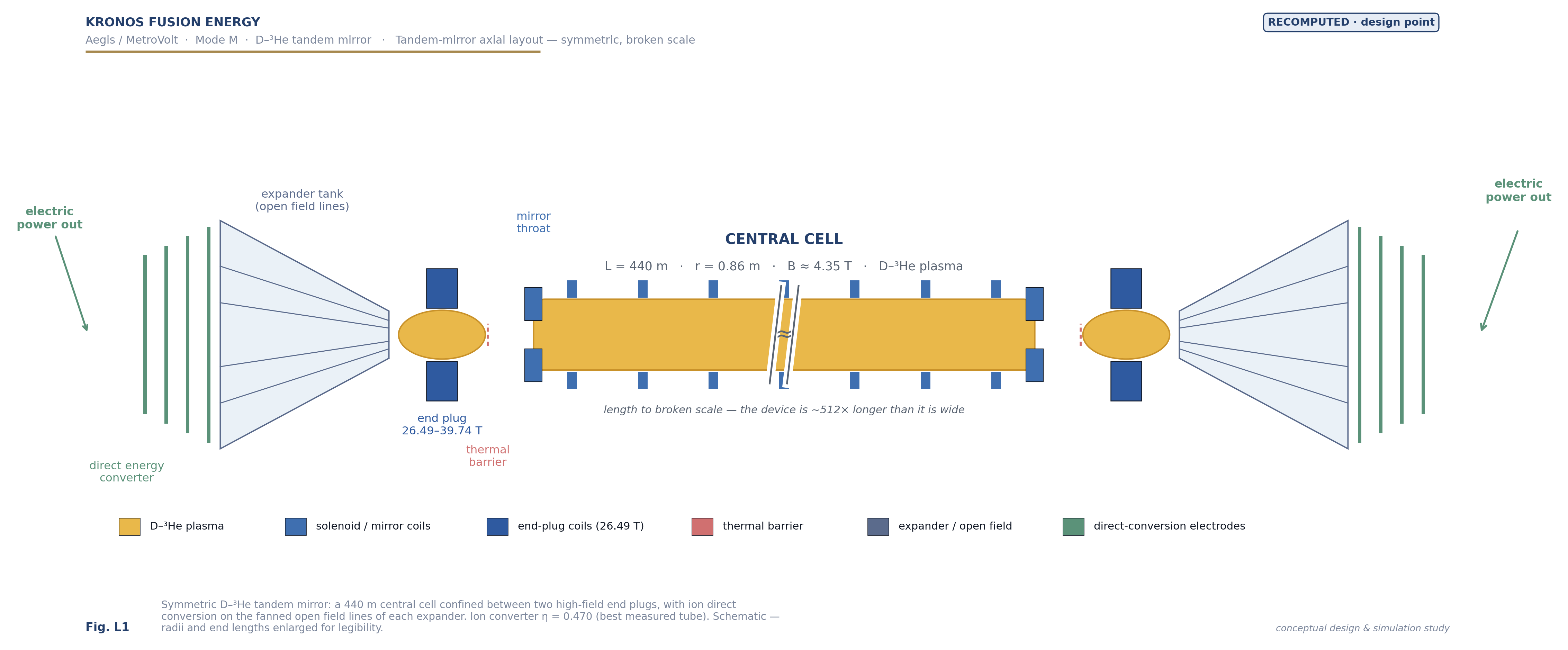
The third is the direct-energy-conversion architecture, which I dwelt on in the burner chapter and will only touch here. Because the burned fuel leaves the machine as a directed beam of charged particles, the plant catches that beam on collector electrodes and turns its kinetic energy into current more or less directly — no steam cycle, no boiler, no cooling towers of the kind that make a plant visible from orbit and dependent on a river. It is electricity harvested from motion itself, one step removed from the reaction, rather than laundered through nineteenth-century heat. A machine that makes electricity without a large thermal plant behind it is a machine you can site in places, and harden in ways, that a boiler would forbid. For a survivable installation, every subsystem you can delete is a subsystem that cannot be broken.
And the fourth, quietly, is firmness itself — the property this whole chapter is about. Once the burner is lit and fuelled, it runs. It does not wait on weather. It does not draw down a battery that must then be recharged from a source that may not come. Its availability is the availability of a well-run machine, not the availability of the sky.
Survivability is designed, not added
A word about the name, and about what "hardened" actually means, because it is easy to say and expensive to mean. Aegis is not a standard burner with a thicker fence around it. Survivability, done properly, is a property of the whole architecture, decided at the drawing board, because almost everything that makes a plant cheap at scale makes it fragile under attack, and the two design goals genuinely pull against each other. The commercial burner housing — the data-centre configuration described elsewhere in this book — optimises for cost per megawatt-hour. Aegis optimises for the probability of still delivering power on the worst day it will ever see. Those are different machines wearing the same physics, tuned to two different definitions of victory.
Consider what the direct-conversion architecture buys a hardened site, beyond the efficiency I described in the burner chapter. A conventional thermal plant is a system of large, exposed, interdependent objects: a boiler, a turbine hall, condensers, and — above all — a cooling system that must reject waste heat to a river, a lake, or a bank of towers visible for miles and dependent on a water source that can itself be cut. Every one of those is a soft target, and several of them are single points of failure. A machine that turns charged particles into current on collector electrodes deletes most of that apparatus. No turbine hall, no boiler, a far smaller heat-rejection burden, no dependence on a major external water source to make electricity. Each subsystem removed is a subsystem that cannot be broken, cannot be flooded, cannot be targeted, and does not have to be defended. The most survivable component is the one that was designed out — the part of the plant that isn't there is the part no enemy can find.
The compactness of the source compounds this. A power plant that fits in a hardened structure can be buried, bermed, or sited underground in ways a sprawling thermal station with its cooling towers and switchyard never could. It presents a small signature. It can be built to shrug off the kinds of physical and electromagnetic insult that a critical installation must assume it will one day face. None of this is exotic; it is the ordinary logic of fortification, applied to a generator that is finally small enough and self-contained enough to fortify. You cannot harden a coal plant. You can harden Aegis, because Aegis was drawn to be hardened.
And redundancy, at a site like this, means something more demanding than a second diesel behind the first. Two diesels that draw from the same tank field and the same convoy are not redundant against the threat that matters; they share the single point of failure that is the fuel supply. Genuine redundancy for a critical load means independence all the way down to the fuel — and that is exactly what a self-fuelled generator provides. Its backup is not another machine waiting on the same vulnerable supply. Its backup is the fact that its supply cannot be reached in the first place.
Fuel sovereignty: the deepest layer of the argument
Here is the part of the Aegis case that goes furthest, and it is the part I care about most, because it is where "energy security" stops being a slogan and becomes a supply chain you can actually draw.
A generator is only as sovereign as its fuel. You can build the most survivable plant in the world, but if its fuel must be bought each year from a source you do not control, on a market that can be embargoed or cornered, then you have not achieved independence — you have relocated the dependency and dressed it in better clothes. The diesel base depends on the convoy. A naïvely-fuelled fusion base would depend on whoever sells the helium-3, and helium-3 is the rarest link in this entire enterprise. It barely exists on Earth in useful quantity. The terrestrial supply is a by-product of processes measured in a few kilograms a year for the entire planet, and a fleet of power plants would want far more than that. If Aegis had to buy its fuel on the open terrestrial market, it would be neither sovereign nor economic.
This is where the two-machine strategy of the whole book pays off in a way that is specific to Aegis, and it is one of the more elegant things I know in the design. The breeder — Hyperion — is a fuel foundry. Its business is not, in the near term, electricity; it is materials: tritium, neutrons, and, as the tritium it makes decays, helium-3. The helium-3 that runs an early Aegis unit is helium-3 that the enterprise made itself, from its own breeders, on its own soil — a fuel with no foreign passport and no market price set by a rival. The first burners, including the first Aegis installations, run on that internally-produced trickle. That is a small supply — deliberately so, because the breeder foundry is built few and built carefully — but it is sovereign supply. The fuel and the machine come from the same programme. There is no convoy and no foreign seller in the loop.
Sovereignty is not just making your own power. It is making your own fuel, from your own supply, on ground you hold.
And then there is the long horizon, which is the subject of a later chapter and which I will only point at here. The trickle of helium-3 that decays out of stored tritium is enough to demonstrate Aegis and to run a first few units. It is nowhere near enough to fuel a fleet. The scale story of the burner — dozens of units, real gigawatts of clean firm power — waits on helium-3 in quantity, and the only place that quantity exists within reach is the surface of the Moon, where billions of years of solar wind have laid it down in the regolith, a fuel bank filled by our own star while the continents were still forming. Lunar helium-3, arriving around 2040 in the plan this book keeps returning to, is what turns the burner from a demonstrated machine running on a trickle into a fleet running on an abundance. For Aegis that arrival means something with a particular strategic flavour: a fuel that is not on anyone else's territory, cannot be blockaded by a navy, and is not for sale by a rival. A supply chain that runs from the Moon to a hardened base, entirely inside the enterprise, is about as close to fuel sovereignty as the physical world allows — a supply the ordinary instruments of terrestrial coercion simply cannot reach.
I want to hold the honesty line firmly right here, because this is exactly the kind of vision that invites overreach, and vision without receipts is how good arguments go bad. The lunar supply is a later chapter's promise, not a present fact. Nothing about Aegis at fleet scale is available today, and I would be doing the reader a disservice to imply otherwise. What is true today is the shape of the argument: sovereign fuel from the breeder now, in small quantity, sufficient to prove the case; abundant sovereign fuel from the Moon later, sufficient to scale it. The two halves of that sentence live in two very different time zones, and I will not let the second one borrow credibility it has not yet earned.
The honest staging — where Aegis sits in the plan
Let me place Aegis precisely on the timeline, because vagueness here would be a form of dishonesty, and the whole point of this book is to have stopped being vague.
Aegis is not the first product. The first product is the breeder, whose construction begins in 2027 and whose first fuel comes around the start of the 2030s. The breeder is buildable on gain that is already in hand — its near-term business is materials, not electricity — and it is what funds everything downstream. The burner comes after: a first roughly 100-megawatt test unit around 2032, built to prove the physics of the machine, and a commercial fleet beginning around 2036. Aegis, as a hardened, fielded, fixed-installation product, lives in that later window and after it. A credible first Aegis-class build is a compact, self-fuelled demonstrator — a modest unit on the order of ten megawatts, fed by helium-3 that decays out of the breeder's own stored tritium — that proves grid-independent fusion power on a real site before the larger units follow. The full-scale Aegis unit, at the burner's several-hundred-megawatt output, comes as the fleet matures.
And it carries the gate. I have named it in every chapter that touches the burner and I will name it here, because a vision this large has no right to hide its hardest step: the burner's power balance closes on measured efficiencies, on paper, reproducibly — provided the end plugs reach a plasma density ratio, relative to the central cell, of about sixteen. That is roughly two orders of magnitude above what any tandem mirror has ever actually sustained, and it is the single largest open physics requirement in the whole design. It is not the magnetic field strength — the field the plug needs sits inside the record that superconducting magnets have already reached. It is the density. I owe you one more distinction here, because the magnet chapter is blunt about a second item and I will not round it away: building that field at the plug's small required bore is a genuine structural problem — a naive winding over-stresses the conductor, "infeasible as drawn," recovered only by a stress-managed architecture that the analysis shows closes on paper and flags as feasible-pending-detailed-finite-element-work. That is an engineering gate with a named path out, not a physics unknown. The physics unknown — the one no clever structure resolves — is the density. Until that gate is demonstrated, Aegis is a design with a superb mission fit, one unproven physics requirement, and one engineering problem with a drawn solution standing between it and a working plant. I would rather write that sentence plainly than sell around it. The wonder is real, and so is the wall we still have to climb.
So the honest staging is this. The mission is real and, I think, unusually well-matched to the machine: firm, clean, low-neutron, logistically-light, sovereign-fuelled power for installations that cannot depend on a grid or a convoy. The machine that serves it is the same burner the physics of this book has spent chapters defending. And the two conditions on which it all rests are stated, not hidden: the plug-density gate must be cleared, and the fleet-scale economics wait on cheap helium-3 that — for now — means the breeder's trickle, and — later — means the Moon.
This is where the book's second forty finally touches national security. Forty dollars a megawatt-hour is the burner's promise, and it is a promise that lives or dies on cheap fuel at fleet scale. But for a critical installation, the value of firm power was never really captured by a price per megawatt-hour in the first place. The value of Aegis is the value of not going dark on the worst night — of a radar that stays up, a hospital that stays lit, a data centre that keeps its promise, a base that does not run out of the one thing every other capability is written on top of. That value is not measured in dollars per megawatt-hour. It is measured in what a nation can still do when the grid and the convoy have both failed. A generator that keeps working then is not a commodity. It is a shield held over everything that matters when the lights go out everywhere else, which is the whole reason it carries the name it does.