Abstract
This register documents an independent physics de-risking campaign that re-ran 164 design gates across Kronos Fusion Energy's two machines — the Hyperion negative-triangularity spherical-tokamak breeder and the Aegis / MetroVolt D–³He tandem-mirror burner — at their frozen design points on established first-principles codes. Nonlinear CGYRO simulations confirm the core confinement bet: negative triangularity suppresses turbulent transport by ~40% at the ion scale (converged at real electron mass) and ~80% at the electron scale, robust to collisionality and across the linear spectrum. Both machines close on the frozen physics; the distance to demonstrated closure is a set of named experiments, not open physics questions. The breeder makes no net-electricity claim: its product is tritium, helium-3, and 14-MeV neutrons.
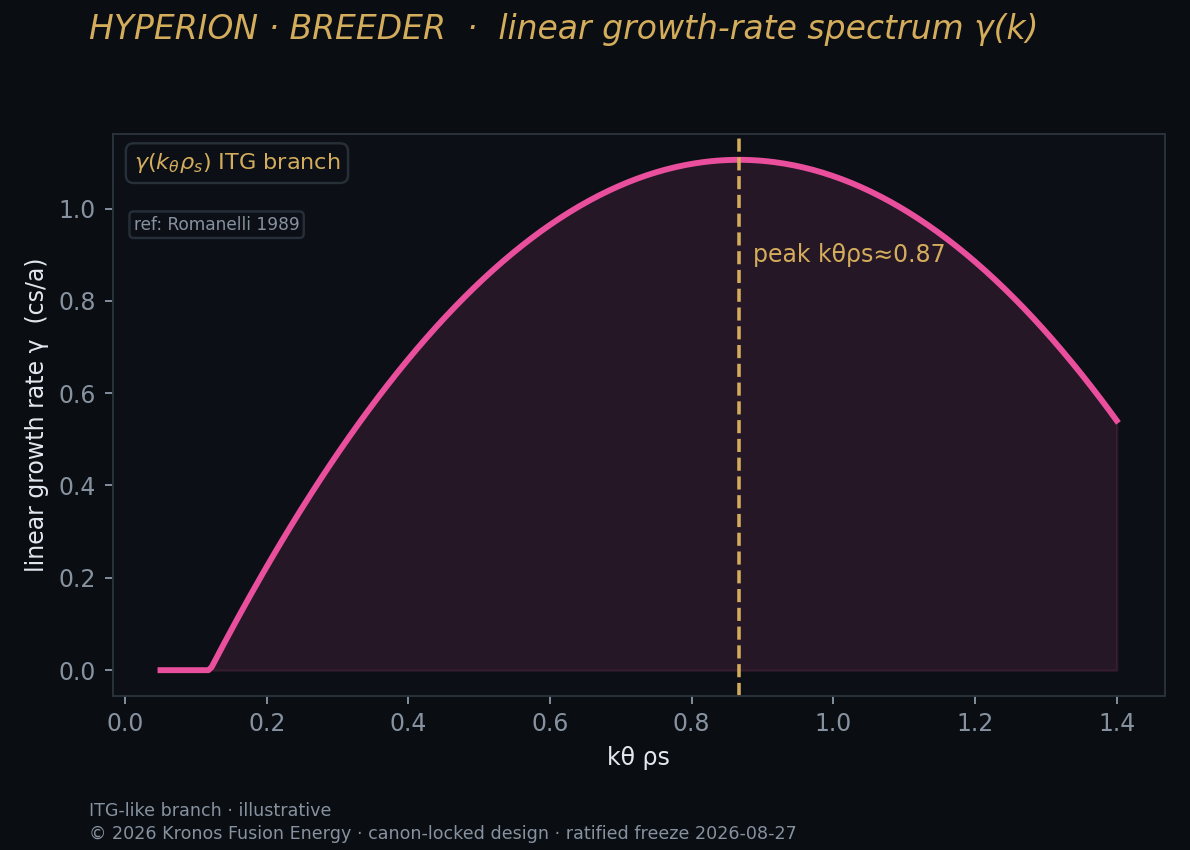
Nonlinear CGYRO confirms the central bet. Negative triangularity suppresses the turbulence that bleeds heat from the core — ~40% at the ion scale (converged and saturated at real electron mass, μ=3672) and ~80% at the electron scale — robust to collisionality and holding across the full linear spectrum. Four independent, mutually consistent gyrokinetic calculations. Dataset: 10.5281/zenodo.22136279
Key facts
The mission, and why a breeder comes first
Kronos exists to build the neutron economy — a future powered by fusion and the isotopes fusion makes. Fourteen-MeV neutrons qualify the structural materials every future reactor will need; they make medical isotopes such as molybdenum-99 and targeted-alpha emitters; they make helium-3 for quantum sensing and neutron detection; and, in the aneutronic burner, they make clean firm power.
None of that arrives without four things: tritium to fuel any deuterium–tritium system, helium-3 to fuel the aneutronic burner, low-activation materials proven to survive a fusion neutron spectrum, and high-field magnets proven at reactor scale. The breeder makes all four. That is why Hyperion comes first — it is the on-ramp, not the destination.

The three products
Hyperion — the breeder
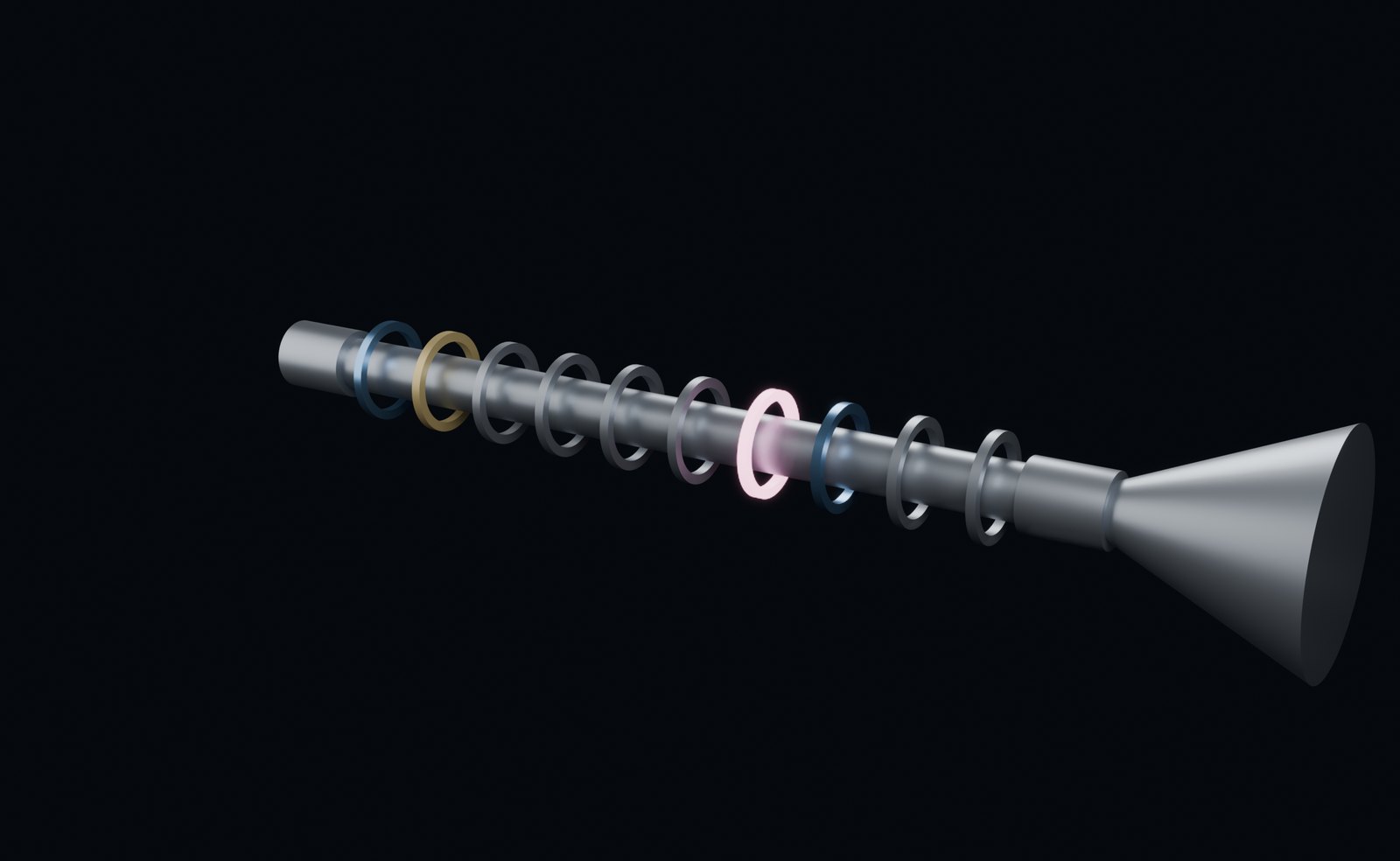
A compact spherical tokamak at strong negative triangularity (δ = −0.30) that breeds its own tritium, co-produces helium-3, and floods a test volume with 14-MeV neutrons. Q = 3.076 at 85 MW; 9.66 MA held without a central solenoid; 99.98% alpha confinement. Its product is tritium, helium-3, and neutrons — not net electricity. Honest gate tritium self-sufficiency.
Aegis / MetroVolt — the burner
One D–³He tandem-mirror burner in two housings — a hardened defense build (Aegis) and a data-center build (MetroVolt). Only 5.4% of its power leaves as neutrons; the rest a direct converter catches. QE = 1.318, net +850 MWe at 440 m, with every one of 40,000 Monte-Carlo samples above break-even. Honest gate the WHAM-scale plug experiment.

What “closing” means
The register makes one claim, repeated at every gate: the design closes. That word is used precisely. Closes on model means every governing equation, re-run from first principles at the frozen design point, gives a self-consistent, physically admissible answer. Demonstrated closure is the remaining distance to hardware — spanned by named, funded-scale experiments, not open physics questions. A stated hard requirement is a strength, not a gap: a design that hides its one hard number is unfalsifiable; one that states it — “we need a plug 16× the central-cell density, and here is the experiment that shows it” — is engineering.
Frequently asked
Does the Hyperion breeder make net electricity?
No. It is a strategic-isotope, tritium, and 14-MeV neutron-source platform; net electricity is a category error for it. Success is measured in breeding ratio and isotope yield. The Aegis / MetroVolt burner carries the power story.
What is the breeder's fusion gain?
Q = 3.076 at 85.04 MW fusion power (config-22021 design point), reproduced from first principles with 99.98% alpha confinement (ASCOT5).
How much tritium and helium-3 does it produce?
Up to ~2.0 kg of tritium per unit per year at the advanced blanket (breeding ratio 1.42); 3.6–4.5 kg/yr at fleet scale. Helium-3 follows from tritium decay plus lunar supply.
Is the burner net-energy-positive?
On the frozen model, yes: engineering gain Q_E = 1.318 with net +850 MWe at 440 m, and every one of a 40,000-sample Monte-Carlo lands above break-even. Demonstrated closure requires the WHAM-scale plug-potential experiment.
What is the one open physics gate?
The burner plug-potential requirement (n_plug/n_c = 16, 347× the demonstrated gas-dynamic-trap value) — a requirement-class result retired by a named WHAM-scale experiment, not open physics.
How was it validated?
By re-running 164 gate analyses on ~69 established, community-maintained codes (OpenMC, CGYRO, ASCOT5, NIMROD, SOLPS-ITER, Quantum ESPRESSO, WarpX …) under a deterministic seed, cross-checked against 19 frozen anchors.
When could this be built?
Construction Q2 2027; FOAK first tritium ~2030–31; a ~100 MW test burner in 2032; commercial fleets ~2036. Fleet scale is gated on lunar helium-3 (~2038–40), not a calendar.
The Kronos 2026 series — companion papers
This register is Paper 1.0, the hub of a 44-paper series. Each companion is archived on Zenodo under the community kronos_fusion_energy, with the DOI shown (resolving at doi.org on publication), and each draws on the same frozen gates re-run in this document.
Foundations — the five product volumes
- 1.1 Hyperion — compact ST tritium/He-3 breeder — the compact-ST strategic-materials platform — gain, breeding, He-3, 14-MeV neutrons · DOI 22132235
- 1.2 Aegis / MetroVolt — D–3He tandem-mirror burner — the low-neutron D–³He burner — engineering gain, the plug requirement, mirror confinement · DOI 22132474
- 1.3 High-field REBCO magnets & tape — the high-field REBCO superconductor basis · DOI 22132475
- 1.4 Direct energy conversion — quasineutral expander — recovering charged-particle power directly · DOI 22132480
- 1.5 AI, ML & quantum control — the computational-methods layer — ML surrogates, control, quantum · DOI 22132484
Breeder physics
- 2.11 Negative-triangularity confinement — negative triangularity suppresses turbulence 40–45% (TCV/DIII-D corroborated) · DOI 22132098
- 2.12 Disruptions & runaway electrons — disruptions, runaway electrons and SPI mitigation as a requirement · DOI 22132102
- 2.13 Alpha / fast-product confinement — 99.98% alpha confinement (ASCOT5) · DOI 22132106
- 2.15 Ideal-MHD stability — ideal-MHD stability, Troyon margin, Mercier/ballooning · DOI 22132110
- 2.23 Current drive & bootstrap — holding 9.66 MA without a solenoid · DOI 22132145
- 2.24 Solenoid-free startup — solenoid-free startup and ramp · DOI 22132147
- 2.39 Admissible operating-window synthesis — the admissible operating window · DOI 22132231
Burner physics
- 2.5 RF alpha-channeling — RF alpha-channeling — the efficiency lever · DOI 22132168
- 2.6 DCLC loss-cone microstability — the DCLC warm-fill knee, stated honestly · DOI 22132170
- 2.9 Red-team of the binding gates — red-team of the binding gates · DOI 22132187
- 2.29 Synchrotron radiation transport — synchrotron transport and the max-gain temperature · DOI 22132195
- 2.33 ECH thermal-barrier decoupling — the ECH thermal-barrier plug mechanism · DOI 22132209
- 2.34 MetroVolt HVDC-native power interface — the HVDC-native power-electronics interface · DOI 22132211
Materials, magnets & structures
- 2.1 Centrepost & magnet integrity — consumable-cartridge centrepost & magnet integrity · DOI 22132096
- 2.3 Centrepost fluence & shielding — centrepost fluence & shielding · DOI 22132162
- 2.17 Low-activation alloys — near-neutral low-activation refractory alloys · DOI 22132119
- 2.19 Flowing-lithium vapor-box divertor — the flowing-lithium vapor-box divertor · DOI 22132127
- 2.20 Quench detection & NV sensing — in-winding NV-diamond quench sensing · DOI 22132131
- 2.30 First-wall neutron-damage lifetime — first-wall neutron-damage lifetime · DOI 22132198
- 2.32 REBCO conductor materials under irradiation — REBCO conductor under irradiation · DOI 22132203
- 2.38 ML-potential materials-discovery pipeline — the ML-potential materials-discovery pipeline · DOI 22132229
- 2.16 Divertor portfolio — the divertor detachment portfolio · DOI 22132115
Fuel cycle, isotopes, safety & supply
- 2.2 Blanket tritium-breeding lever — the blanket tritium-breeding lever · DOI 22132129
- 2.14 Helium-3 fuel cycle — the He-3 fuel cycle (lunar-gated closure) · DOI 22132108
- 2.18 Tritium fuel cycle & breeding ladder — the tritium breeding ladder 0.29 → 0.9 → ~2.0 kg-T/yr · DOI 22132123
- 2.31 Nuclear-data UQ for the TBR — the credible error bar on the TBR — nuclear-data uncertainty · DOI 22132200
- 2.25 Isotopes & 14 MeV applications — 14-MeV isotope & applications platform · DOI 22132152
- 2.21 Inherent-safety & environmental case — the inherent-safety & environmental case · DOI 22132133
- 2.22 Licensing (byproduct material, Part 30) — byproduct-material (Part 30) licensing · DOI 22132139
- 2.35 Supply chain & fleet buildability — supply chain & fleet buildability · DOI 22132221
Methods, verification & the platform
- 2.4 Verification & validation (47-code provenance) — verification & validation — 47-code provenance · DOI 22132164
- 2.7 Control-barrier safety clamp — the certified control-barrier safety clamp · DOI 22132176
- 2.8 Quantum computing for fusion — quantum computing for fusion, honestly · DOI 22132180
- 2.28 Tensor-network kinetic solver — the tensor-network kinetic solver · DOI 22132192
- 2.26 Integrated platform overview — the integrated three-product platform overview · DOI 22132156
- 2.27 Advanced-fuel scorecard — the advanced-fuel scorecard · DOI 22132158
- 2.36 Centrepost prognostics & RUL control — centrepost prognostics & remaining-useful-life control · DOI 22132223
- 2.37 Maturity-gated actuation authority — maturity-gated actuation authority · DOI 22132227
Data & reproduction
The public edition is deposited on Zenodo at 10.5281/zenodo.22133057. Each analysis re-runs on established, community-maintained codes with a deterministic seed and is cross-checked against 19 frozen anchors; the companion papers above carry the per-domain data and code. Economics are held in a separate internal edition and appear in no public deposit — this record carries physics only.
Explore the platform
- Complete Volume — the full combined edition of the series
- Publications index — all 44 papers in one place
- Interactive 3D model — the machine, component by component
- Live physics validator — reproduce the frozen anchors in-browser
- Kronos toolkit — the open-source physics engine
- Zenodo community — every deposit in the series