KRONOS-CTRL: Neutronics Module
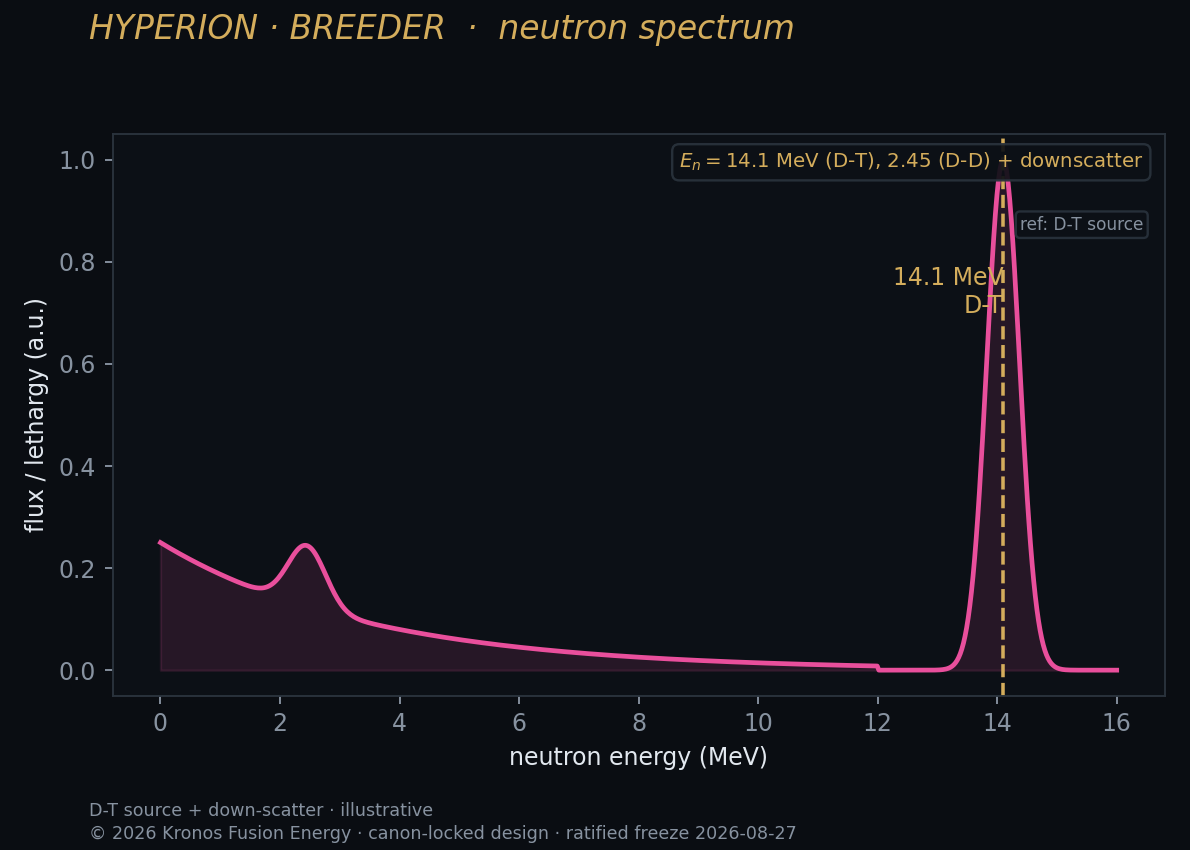
The Neutronics module tracks neutron flux and spectrum, tritium breeding balance, and the residual D-D output for both machines.
Scope
The Neutronics module models where neutrons are born, how they transport, and what they do to materials and the fuel cycle. For the breeder it integrates the 14 MeV D-T neutron source over the equilibrium the MHD module provides and tracks the tritium breeding ratio; for the burner it tracks the low but nonzero neutron output, neutron fraction 5.44%, and the residual D-D reactions that make the D-3He burn low-neutron rather than aneutronic.
Breeding balance for the breeder
The tritium breeding ratio (TBR) is treated as a design lever across 1.1 / 1.5 / 1.8, so the module tracks the running tritium balance, production in the blanket versus consumption in the plasma, as a live quantity feeding the fuel-cycle controller. The breeder is designed to net-produce tritium (roughly 4 kg/yr class) and helium-3 (roughly 1.97 kg/yr), so the Neutronics module's breeding accounting is central to the machine's purpose, not incidental.
- Source: 14 MeV neutron birth profile from the current equilibrium (breeder)
- Transport: flux and spectrum to blanket, vessel, magnets
- Breeding: live TBR estimate against the 1.1/1.5/1.8 lever
- Residual D-D: burner neutron fraction 5.44% and its material/activation load
Neutron output also drives the Thermomechanics module (volumetric heating and displacement damage) and long-term activation of the CrMoNbV vessel. The Neutronics module supplies those source terms each twin step and accumulates a lifetime fluence record used for structural-health and component-life tracking.
Because the machines are validation studies pre-FOAK, the neutronics is grounded in offline Monte Carlo transport at L0, distilled into a fast surrogate for the runtime module and periodically re-validated against full Monte Carlo. Once FOAK operates ~2030, real neutron-flux diagnostics recalibrate the surrogate against measured flux.