Tritium Plant Interface
The tritium plant interface governs breeding, extraction, isotope separation, and storage; it is a slow, accountancy-grade loop with strict containment interlocks.
What the plant does
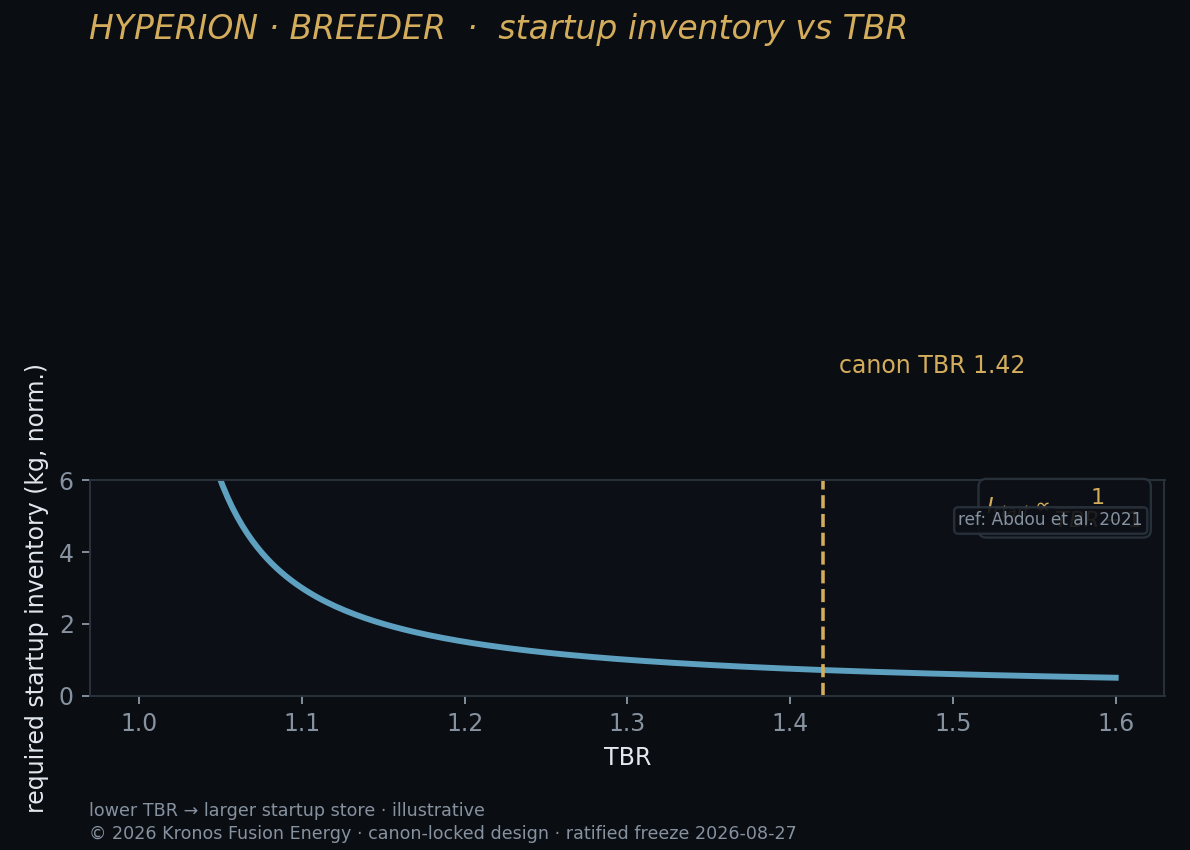
The breeder is a tritium source: from D–T fusion and the lithium blanket it targets a ~4 kg/yr tritium class product, with tritium breeding ratio treated as a design lever across 1.1 / 1.5 / 1.8. The plant interface controls the loops that recover unburned fuel, extract bred tritium from the blanket, separate isotopes, and store product safely.
Interface segments
- Blanket extraction: purge-gas flow, getter-bed cycling, tritium partial-pressure sensing.
- Isotopics: cryogenic distillation column setpoints and stream composition (see helium-3 handling).
- Storage: getter-bed loading, inventory, and glovebox/containment status.
- Accountancy: mass balance feeding the byproduct accountancy interface.
# blanket tritium mass balance (L4, slow loop)
dT_inv = (breed_rate*TBR - burn_consume - decay - losses) * dt
T_inventory += dT_inv
if T_inventory > storage_limit or containment_alarm:
    hold_campaign(); seal_glovebox()      # fail-safe containment
Owner and cadence
| Function | Owner | Cadence |
|---|---|---|
| containment trip | L1 | fast |
| column setpoints | L3 | s-min |
| campaign balance | L4 | min-hr |
| accountancy | L7 | hr-day |
Owner: L4 for campaign-level control, L3 for column regulation, L1 only for the fast containment trips. TBR is a lever in the design study, not a measured plant value, and no product flow is claimed before FOAK first tritium (~2030). Calibration is accountancy-grade: every stream measurement is traceable and reconciled against the mass balance. Design and Validation specification with regulatory containment framing.