Shape Control: Negative Triangularity
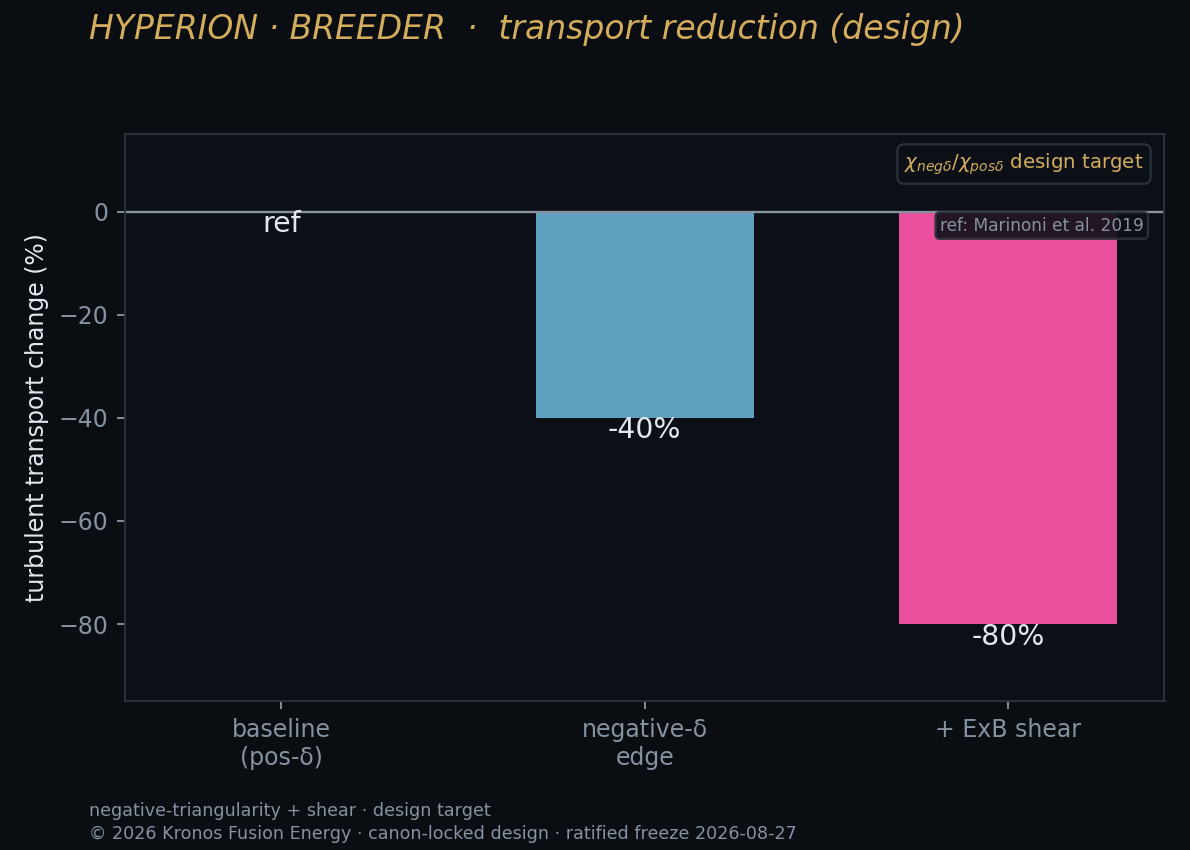
Maintaining the breeder's delta -0.30 boundary is a continuous feedback task; L1 tracks shape moments and corrects the plasma-facing profile in real time.
The shape target
The breeder's confinement and edge strategy rest on a specific boundary: negative triangularity δ = −0.30. Triangularity measures how the plasma cross-section is 'pushed in' at top and bottom relative to the midplane; a negative value bends the boundary the opposite way from a conventional D-shape. Holding it steady is the shape controller's continuous job.
Representing the shape
L1 does not track the boundary point-by-point; it tracks a small set of geometric moments — elongation κ, triangularity δ, X-point position, and gaps to the wall. These moments are computed from magnetics each cycle. The controller regulates the moment vector to its reference, which is more robust and lower-latency than reconstructing the full boundary contour in the fast loop.
Disturbances the loop rejects
- Plasma's tendency to relax toward positive triangularity.
- Current-profile evolution changing the internal inductance.
- Pressure changes from heating and fueling transients.
- Coil and supply nonidealities corrected by the inner current loops.
Each disturbance perturbs the moment vector; the feedback law returns PF-coil currents to restore it. Because the favorable ELM-free behavior is tied to the shape, tight moment regulation is not cosmetic — letting δ drift toward zero would forfeit the regime the machine was designed around.
Interaction with the edge
Shape control and edge control are linked. The negative-triangularity boundary is what enables the ELM-free edge; sustaining that edge in turn depends on holding the shape. L1 runs both objectives on the shared clock, with shape as the slower geometric regulator and the edge state monitored for any sign the regime is being lost. The physical actuators are the PF shaping coils.