REBCO Strain Gauges
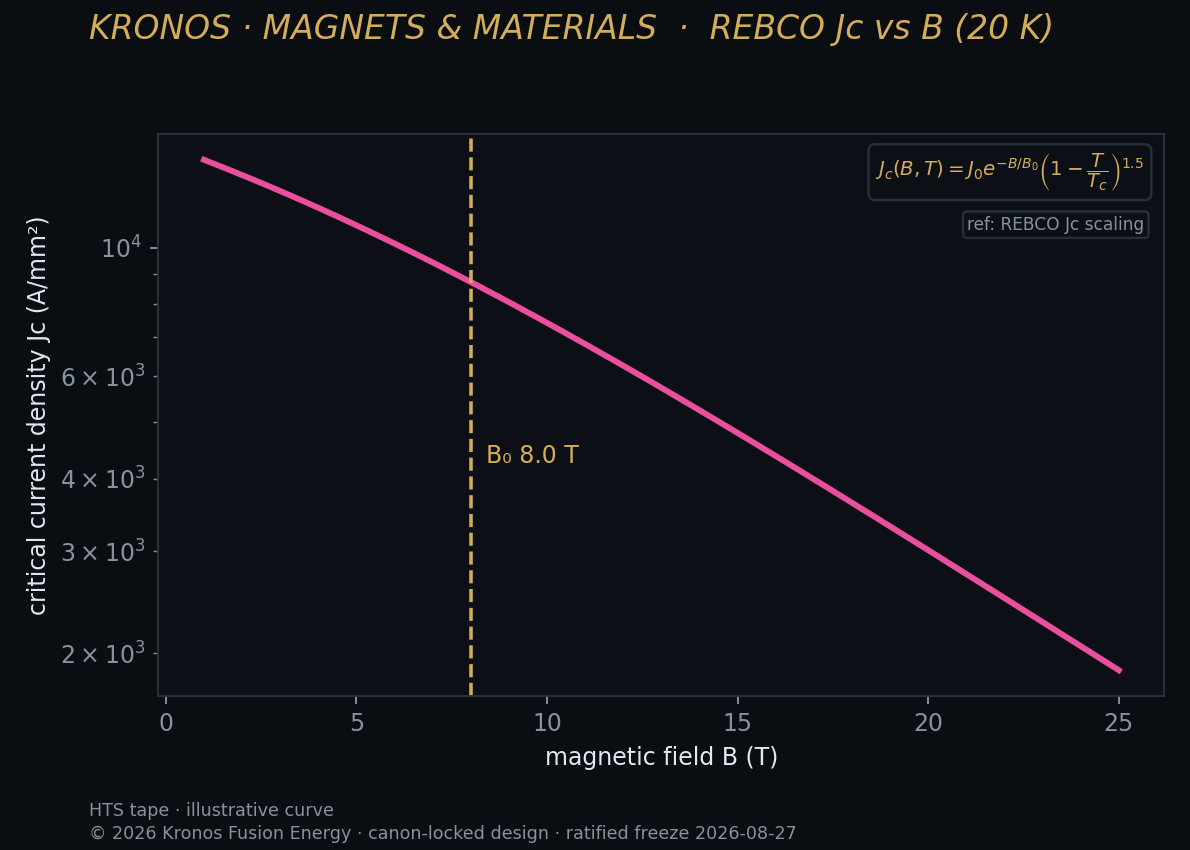
Strain gauges bonded across the high-field REBCO magnets report the mechanical state of the most stressed components in either machine.
Watching the magnets
REBCO high-temperature-superconductor magnets carry the fields that define both machines — 16.84 T peak in the breeder, 26.49 T at the burner's plugs — and with those fields come immense Lorentz loads. Strain gauges bonded across the winding pack and its structure measure the resulting deformation, the raw input to the magnet-strain-delta feature and to structural-health monitoring.
Sensitivity and environment
- Gauges resolve microstrain, so front-end gain and drift correction are critical.
- They operate cold, in high field, under neutron flux, so their sensitivity is drift-tracked continuously.
- Bonded sensors relax mechanically over load cycles, a drift the fabric models explicitly.
- Signals cross the boundary through cryo-rated feedthroughs characterized for parasitics.
Baseline and delta
The gauge's absolute reading includes the static ICE-PISTON preload. The fabric subtracts the preload baseline to yield the operational strain delta, the quantity the twin and failsafe act on. A delta trending toward its structural envelope is a quench-and-mechanical precursor.
Into safety
Because a magnet's mechanical and electromagnetic health is safety-critical, strain telemetry is one of the inputs the L1 autonomous hardware failsafe can act on directly — dumping a quench with zero AI dependency if a hard limit is crossed. The fabric's job is to deliver strain that is clean, calibrated, and timestamped so both the twin and the failsafe see the truth. Envelopes are versioned per machine in the registry.