REBCO Strain-Gauge Anomaly Detection
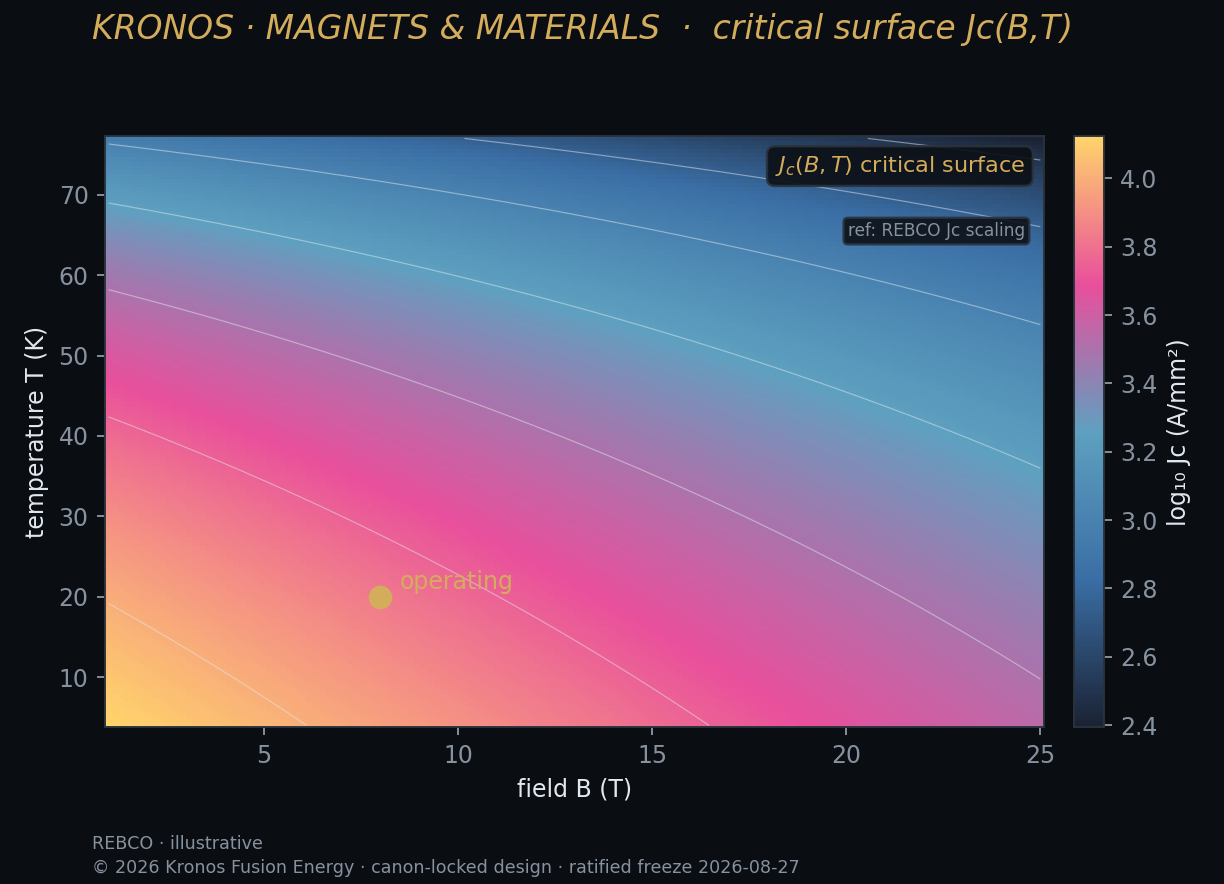
High-field REBCO tape is strain-sensitive; Kronos monitors distributed strain gauges to catch mechanical precursors to conductor degradation and quench.
Strain as a leading indicator
REBCO superconductor is mechanically brittle and its critical current degrades under excessive strain. In the breeder's 16.84 T magnets and the burner's 26.49 T plug, Lorentz forces and the cryogenic ICE-PISTON preload cycle put the conductor under large, structured stress. Distributed REBCO strain gauges, sampled sub-microsecond through cryo-rated feedthroughs, are therefore a leading indicator: a local strain excursion can precede both mechanical damage and the hot spot that seeds a quench.
Spatial pattern, not single channel
A single strain reading is ambiguous; the informative signal is the pattern across neighboring gauges on a magnet section. Kronos uses the sensor-topology GNN to model the mechanical coupling between gauges (they co-move under normal load) and flags the residual: strain that deviates from the coupled pattern indicates a local defect, delamination, or a conductor-motion event.
- Baseline: expected strain field vs field, current, and preload state
- Coupled model: GNN over mechanically linked gauges predicts each from neighbors
- Anomaly: gauge residual outside the coupled-pattern envelope
- Cross-check: correlate strain residual with local voltage and temperature
The ICE-PISTON preload cycle gives a repeatable mechanical reference. Each cycle produces a known strain signature; drift in that signature across cycles indicates accumulating fatigue or a loosening preload, which the Thermomechanics module of the twin tracks as structural health rather than as an immediate alarm.
As with all anomaly outputs, strain-based precursors are advisory. They request a gentle ramp of field or current and feed the structural-health record; the hardware quench failsafe remains independent. Correlating a strain residual with a resistive-voltage rise raises the ensemble's confidence that a mechanical precursor is becoming an electrical one.