REBCO Strain and Quench Sensing
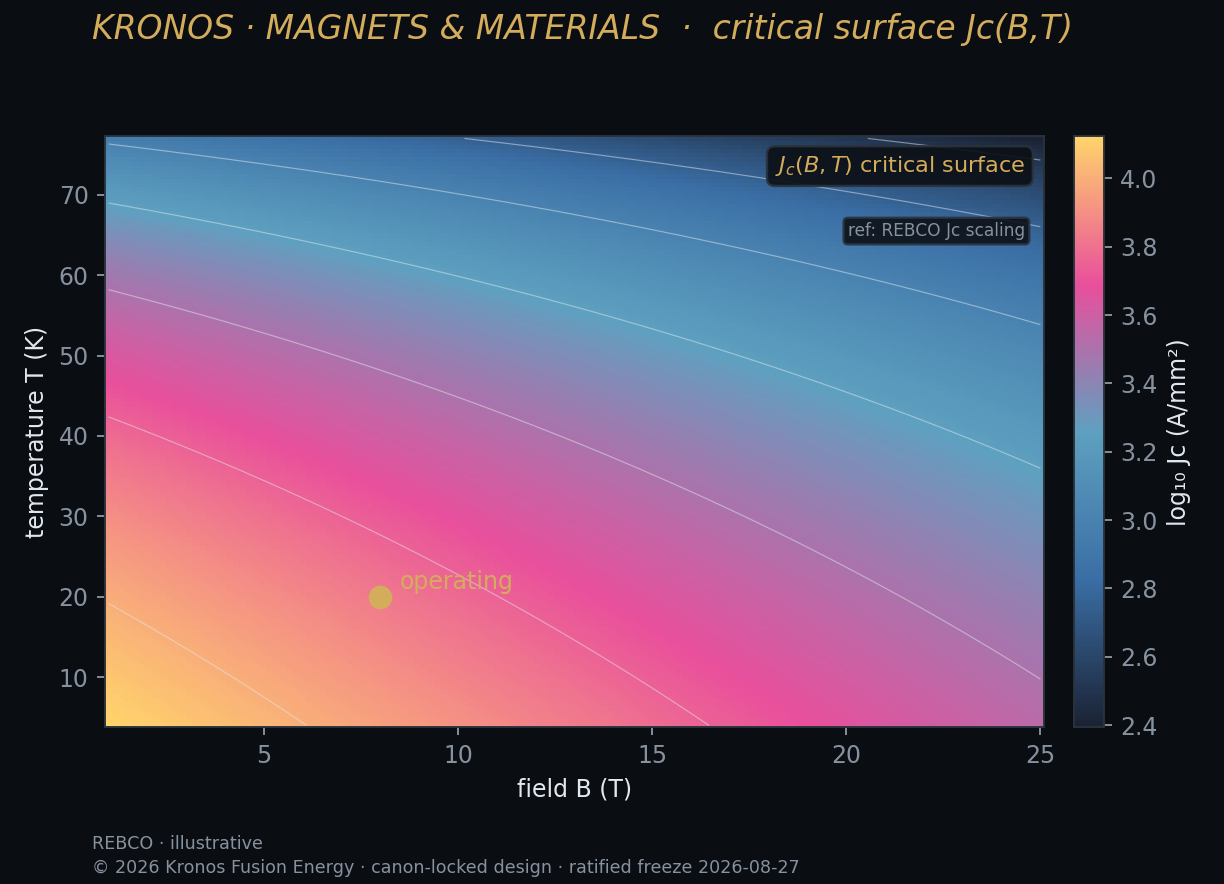
REBCO tape is strain-sensitive; L1 reads distributed strain gauges to catch conductor disturbances that can precede a thermal quench.
Why strain matters for REBCO
REBCO conductor carries current density that degrades if strain exceeds an irreversible limit, and mechanical disturbances — conductor motion, epoxy cracking, differential thermal contraction — can deposit energy that seeds a normal zone. Kronos instruments the high-field windings with strain gauges so that mechanical precursors are visible to L1 alongside thermal and electrical ones.
The ICE-PISTON connection
Kronos's cryogenic ICE-PISTON preload cycle applies controlled mechanical preload to the magnet structure. Strain sensing closes the loop on that preload: L1 confirms the winding is held within its strain envelope through cooldown and energization. A strain excursion outside the envelope is both a structural-health flag and a quench-risk flag.
Sensing and use
- Distributed gauges report local strain ε across the winding pack.
- L1 compares ε against a static irreversible-strain envelope.
- Sudden strain steps (conductor motion) arm the quench detector.
- Slow strain drift feeds L2/L3 structural-health monitoring.
At the breeder peak field of 16.84 T and the burner plug field of 26.49 T, Lorentz loads on the conductor are severe, so the strain margin is a first-class operating constraint, not a diagnostic afterthought. The fast path treats a strain step as a coincidence input to quench detection; the slow path trends strain to predict fatigue.
Determinism at the edge
Strain acquisition sits in the same deterministic front end as the other magnet diagnostics, sampled through cryo-rated feedthroughs and normalized in fabric so its contribution to the trip decision has a fixed, bounded latency. Mechanical, thermal, and electrical cues thus arrive on a common clock, which is what allows the coincidence logic to be tight.