REBCO Quench Detection Timing
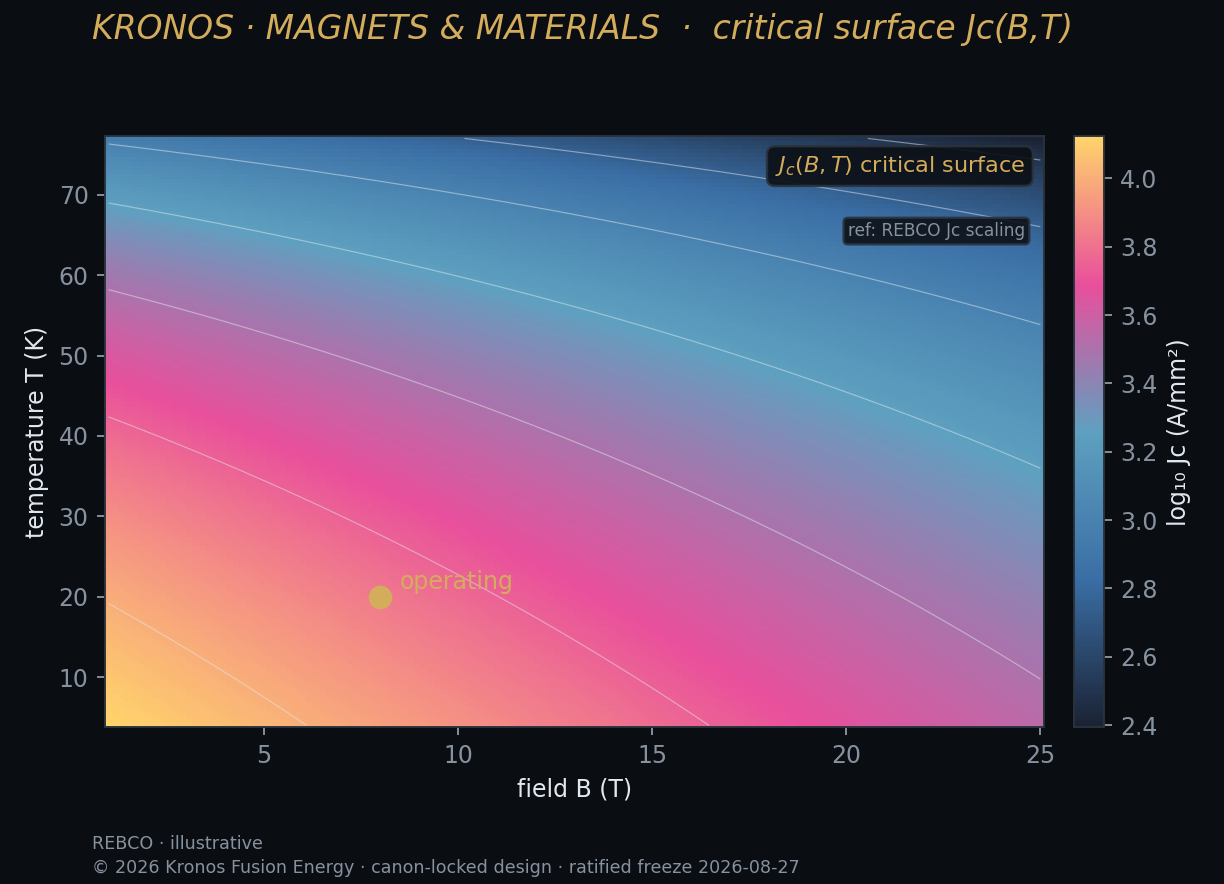
REBCO conductors quench with a slow-propagating normal zone that is hard to see electrically; detection must be sensitive and fast without tripping on noise.
The slow-propagation problem
High-temperature REBCO conductors, used for the high fields on both machines, have a low normal-zone propagation velocity: a quench spreads slowly, so the classic voltage signature is small and localized before it becomes dangerous. Detection must therefore be sensitive enough to catch a small early signal, yet robust enough not to trip on inductive and mechanical noise — a genuine engineering tension the timing design has to resolve.
def covoltage(v_taps, mutual_inductance, di_dt):
    # subtract the inductive component to expose the resistive (quench) part
    v_inductive = mutual_inductance * di_dt
    return v_taps - v_inductive        # co-wound / bridge cancellation

def detect(resistive_V, threshold_V, dwell_us, min_dwell_us):
    # require a small resistive voltage to persist briefly
    return resistive_V > threshold_V and dwell_us >= min_dwell_us
Diversity of indicators
- Co-wound voltage taps / bridges to cancel the inductive term and expose the resistive quench voltage.
- Distributed fiber or acoustic sensing to localize a normal zone the voltage barely shows.
- Temperature and strain trends as slower, corroborating channels.
- Voting across indicator types to cut both missed detections and spurious trips.
The detection dwell — how long a signal must persist before it counts — is the knob that trades sensitivity against false trips. It is set just long enough to reject known noise transients, then handed to the confirmation stage of the quench protection chain. Every microsecond of detection latency is a microsecond less for the dump, so the two budgets are designed together.
The tension between sensitivity and false trips is resolved by diversity rather than by picking a single clever threshold. Voltage bridges, distributed fiber or acoustic sensing, and slower thermal and strain trends are combined so a real quench lights up several indicators while noise lights up only one, letting the detector be sensitive without being twitchy. Kronos treats this as a fundamentally hard, still-open detection problem and validates the scheme against injected quench signatures rather than assuming it solved.
Because REBCO detection is genuinely hard, Kronos treats it as a diversity problem, not a single-sensor problem, and validates the scheme by injecting synthetic and real quench signatures during commissioning. Detected quenches feed the energy extraction path immediately.