REBCO Quench-Detection Interface
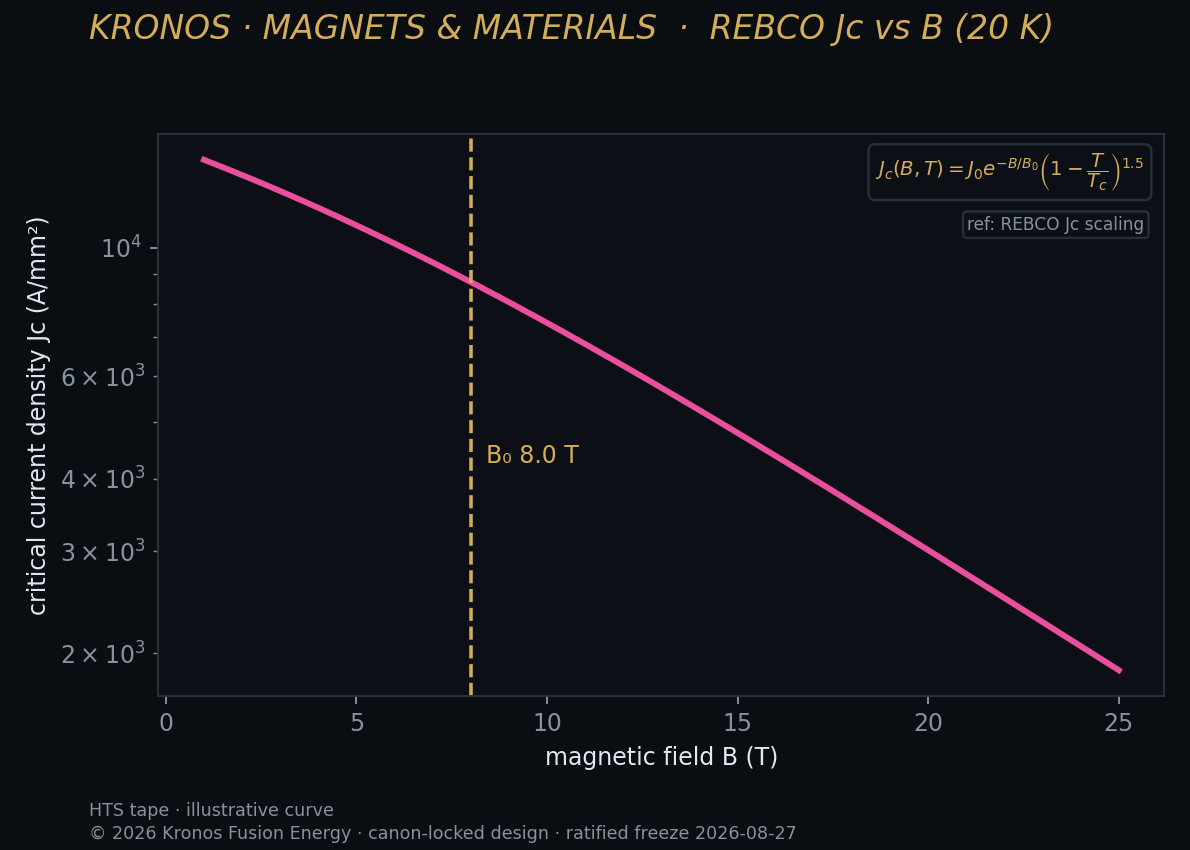
Quench detection is the highest-authority magnet interface: a validated precursor pre-empts every other command and dumps stored energy on a fixed deadline.
Why it has top authority
A quench — loss of superconductivity in a REBCO coil — deposits large stored magnetic energy locally. On the breeder's 16.84 T system and the burner's 26.49 T plug, detection latency directly bounds the peak hot-spot temperature. This interface therefore sits above all shape, fueling, and power commands.
Detection signal set
- Co-wound voltage taps (resistive-voltage rise past the inductive baseline).
- Fiber-optic and RTD temperature along the winding pack.
- Acoustic and quench-antenna precursors for early, sub-threshold indication.
- Cross-check against the strain/thermometry interface.
# quench discriminator (L1 edge, fixed WCET)
v_res = v_tap - inductive_model(dI_dt)      # remove L*dI/dt
if v_res > v_thresh and dwell > t_min:
    trip_dump()                              # open dump switch, fire heaters
    latch_fault('quench', coil_id)           # non-clearable by AI
The discriminator subtracts the inductive voltage L·dI/dt so that a fast, legal current ramp is not mistaken for a resistive quench. A confirmed quench latches a fault that no learning layer can clear; recovery is an operator-and-interlock procedure.
Timing and owner
Owner: L1, on the deterministic protection fabric with a worst-case execution time budgeted in microseconds. The AI stack contributes only upstream: the twin flags rising quench probability so a campaign can be de-rated before the hardware discriminator ever fires. Detection authority itself never leaves hardware. All figures here are design and validation targets validated against the twin.