Plug-Stability Supervision
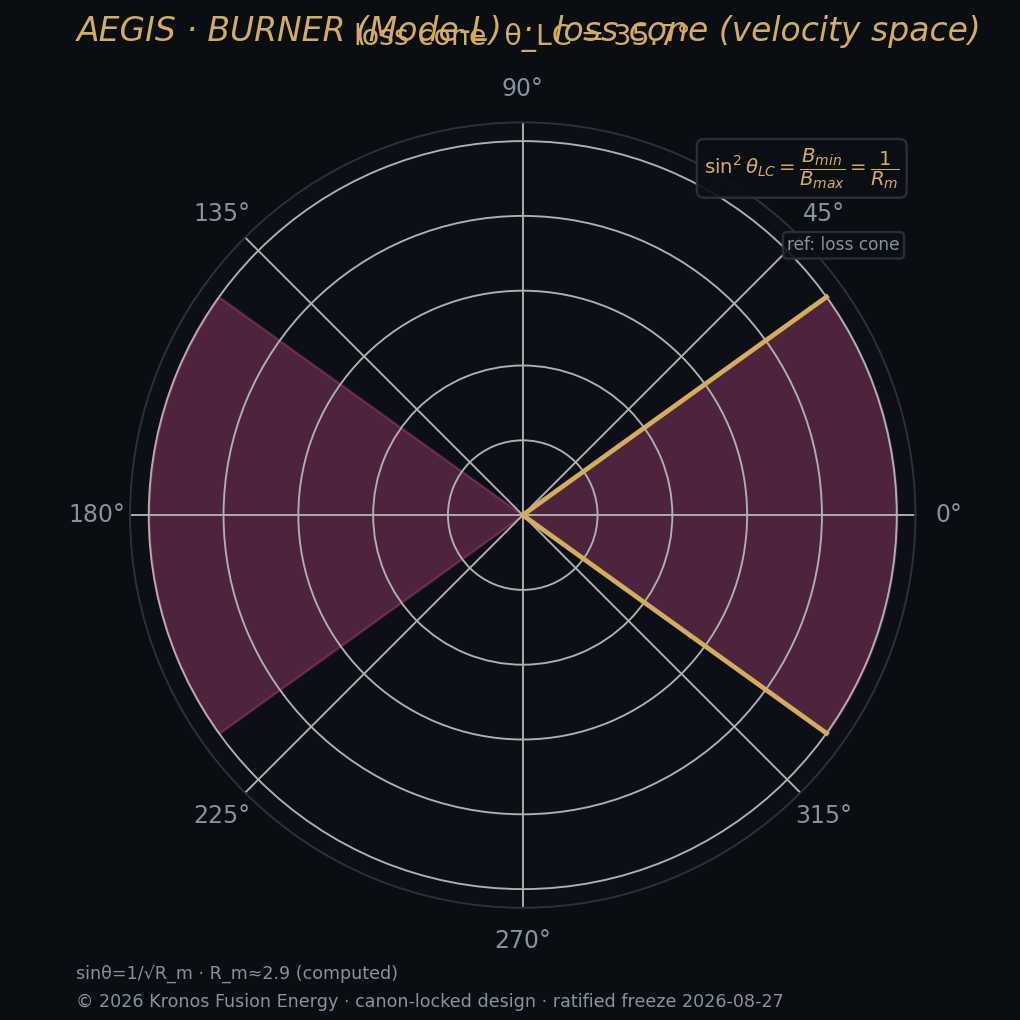
The burner's tandem-mirror end plugs must hold continuously; orchestration supervises plug field and stability and gates every corrective setpoint.
The plug is the burner's crux
The burner (Aegis / MetroVolt) is a D-3He tandem mirror whose end plugs (design field 26.49 T, throat 17 T) confine the central-cell plasma. Losing plug confinement ends the operating point. In steady state, orchestration runs a continuous plug-stability supervisor that watches plug field, mirror ratio, and stability indicators and issues small corrective setpoints through the full gating pipeline.
Supervisory loop
while state == STEADY_STATE:
    s = twin.reconstruct()                     # plug field, mirror ratio, beta
    if s.stability_margin < MARGIN_WARN:
        prop = copilot.correction(s)           # proposed plug/throat setpoint nudge
        cmd  = reconcile(prop, twin.predict(prop))
        gate(cmd)                              # schema+rules+envelope+rate
    if s.stability_margin < MARGIN_CRIT:
        safe_bleed()                           # rate-limited controlled shutdown
Envelope in plug space
The envelope checker for the burner is expressed in plug-relevant coordinates: the joint region of plug field, throat field, mirror ratio, and beta that keeps confinement and stays within magnet ratings. A setpoint that individually looks fine but pushes the mirror ratio combination toward a loss-of-confinement boundary is rejected.
Two failure directions
- Toward instability: escalate corrective setpoints, then controlled safe-bleed if the margin keeps falling.
- Toward magnet limits: rate-limit and clamp per the actuation limiter so no correction exceeds the 26.49 T rating.
- Sensor loss: hold last-known-safe and route to a human gate rather than act on bad state.
Continuous, checkpointed, simulated
Supervision is a long-running procedure that checkpoints continuously so a supervisor restart resumes without dropping the plug. As an engineering program with no built machine and no net-gain claim, plug supervision is validated against long-duration twin runs and fault injection.