Plasma Copilot: Negative-Triangularity Shape Advising
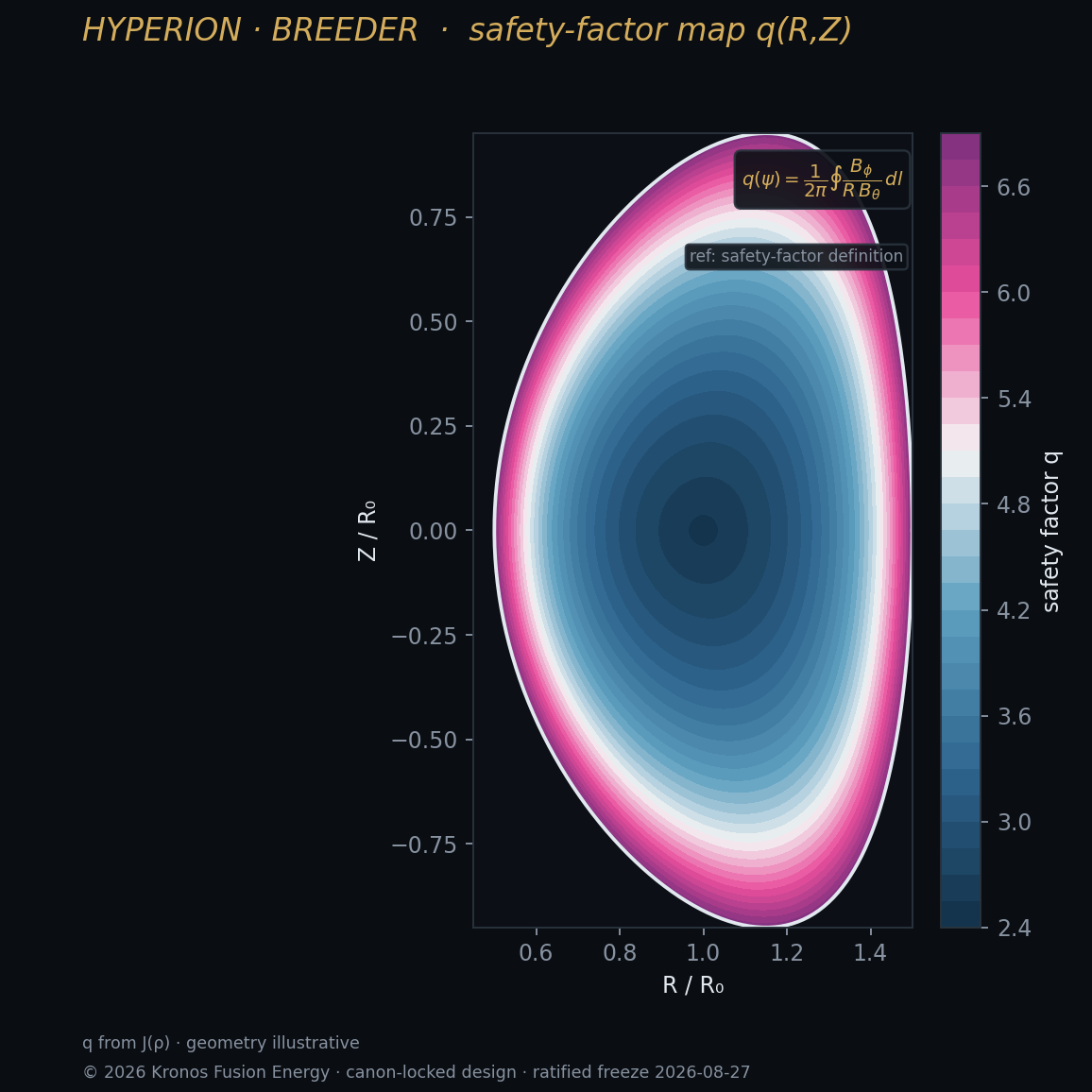
Advising on breeder plasma shape toward the delta -0.30 negative-triangularity target that underpins the ELM-free, disruption-tolerant scenario.
Why shape is a first-class advisory target
The breeder (Hyperion) runs at negative triangularity delta -0.30. That shape choice is central to its scenario: negative triangularity suppresses edge-localized modes without an H-mode pedestal, reducing transient heat loads and easing the disruption problem. The Plasma Copilot advises operators on how to reach and hold that shape given the available poloidal-field coils and the plasma's current and pressure state.
Shape as a control objective
Triangularity is a boundary descriptor extracted from the reconstructed equilibrium. The copilot reasons over the mapping from PF-coil currents to the last-closed-flux-surface shape, using the twin's equilibrium reconstruction, and proposes coil-current setpoints that drive triangularity toward -0.30 while holding elongation, X-point position, and vertical stability.
# triangularity from LCFS geometry (upper/lower averaged)
delta = 0.5*((R_geo - R_upper)/a + (R_geo - R_lower)/a)
target: delta -> -0.30
advise PF setpoints s.t.:
  delta_err small,  kappa (elongation) held,
  vertical growth rate < gamma_max,   coil currents in limits
What the operator receives
- Proposed PF-coil setpoint deltas with twin-predicted shape response
- Vertical-stability margin at the proposed shape
- Interaction with the disruption-avoidance advisor if a move erodes margin
- Uncertainty from equilibrium-reconstruction error propagated to delta
Shape advising is tightly coupled to disruption advising: a shape move that improves confinement but reduces vertical-stability margin is flagged, and the copilot presents the trade rather than choosing silently. The proposed setpoints are candidates for the L1 shape controller (an MPC), not direct commands; execution requires L4 authorization. The copilot's shape reasoning is validated against the twin's ELM-free shape studies and negative-triangularity scans.