Plasma Copilot: Burner Plug and Mirror Operating-Point Advising
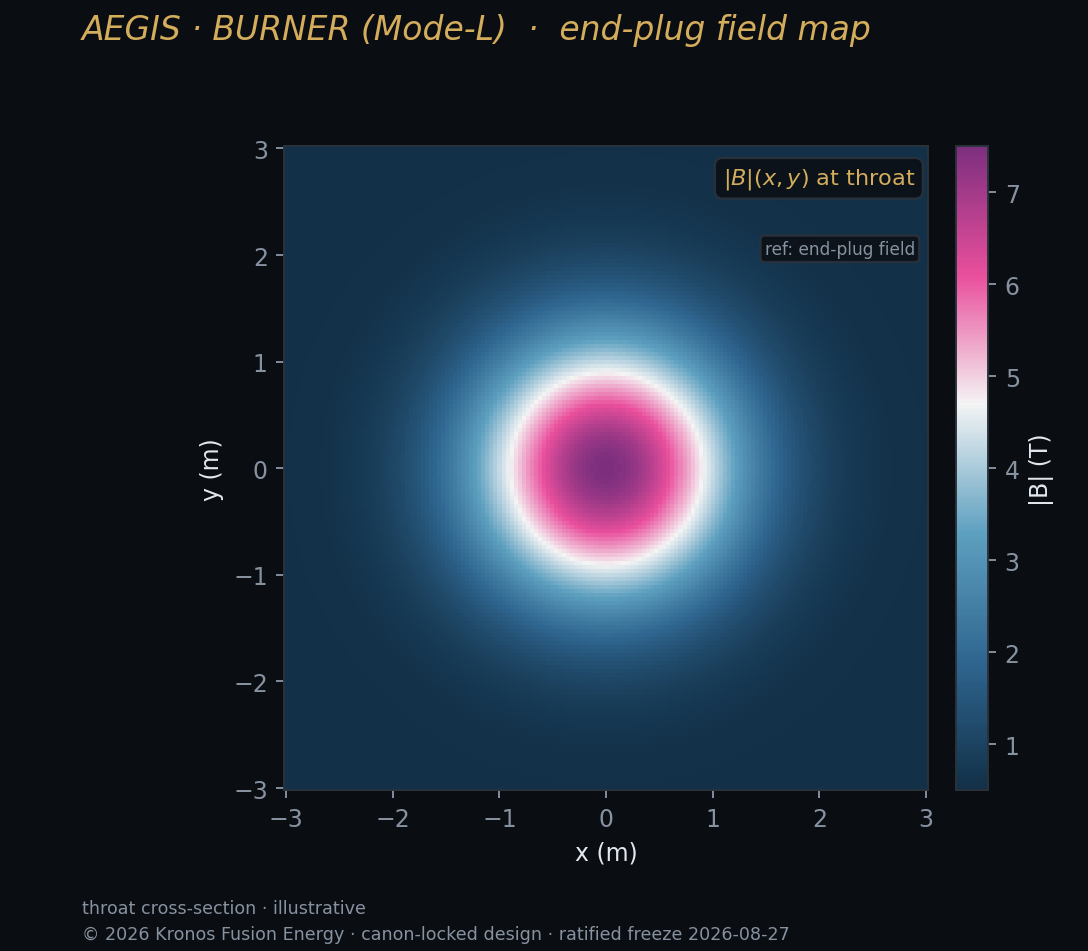
For the D-3He tandem mirror, the copilot advises on end-plug density, ambipolar potential, and the direct-energy-conversion window against the 26.49 T plug line.
The burner's operating-point problem
The burner (Aegis / MetroVolt) is a D-3He tandem-mirror generator. Its confinement rests on an axial electrostatic potential phi(z) established by dense end plugs — 26.49 T plug field, 17 T throat. The controllable operating point is the tuple (end-plug density, ambipolar potential depth, central-cell density and temperature) that keeps the potential well deep enough to confine ions while staying inside the plug-field and heating limits. The Plasma Copilot advises operators on where in that space to sit.
What it advises on
- End-plug density target to maintain the confining ambipolar potential
- Ambipolar potential depth versus central-cell pressure trade-off
- Direct-energy-conversion (DEC) collector operating window
- Thermal-load context from the 5.44% neutron fraction on plug and DEC hardware
The copilot queries the twin's ambipolar potential solver for the confinement response to a proposed plug density, and the DEC-train model for the conversion efficiency at that operating line. It returns a recommended operating point with the confinement and DEC margins and their uncertainty.
advise_operating_point(target):
  n_plug = search over plug density
    s.t. phi_confine(n_plug) >= phi_min   (ambipolar well depth)
         B_plug <= 26.49 T                 (field limit)
         DEC_window(n_plug) open           (conversion feasible)
         q_neutron(5.44%) within thermal limits on plug/collector
  return rank_by(confinement_margin, DEC_efficiency)
Distinct control physics from the breeder
As with the breeder, the copilot only proposes. Any change to plug heating or fueling is routed to L4 and requires operator approval. Because the burner is an engineering program, advising is validated against the twin's tandem-mirror equilibrium and there is no hardware net-gain claim. See burner plug-density control and ambipolar confinement.