One Architecture, Two Machines
The same eight-layer stack runs the breeder tokamak and the burner tandem mirror; only the physics the top layers reason about changes.
Shared stack, different physics
Kronos runs two very different machines on one architecture. The breeder (Hyperion) is a D-T spherical tokamak; the burner (Aegis / MetroVolt) is a D-3He tandem-mirror generator. From L0 to L2, the stack is essentially identical. The differences appear at L3 and above, where the models and copilots reason about each machine's distinct control problem.
What is shared
- L0 compute substrate and MLOps for both machines.
- L1 FPGA determinism and the autonomous failsafe pattern.
- L2 the 60+ port data fabric, validation, feature store, and vector DB.
- The color grammar, line semantics, and safety hierarchy.
What differs
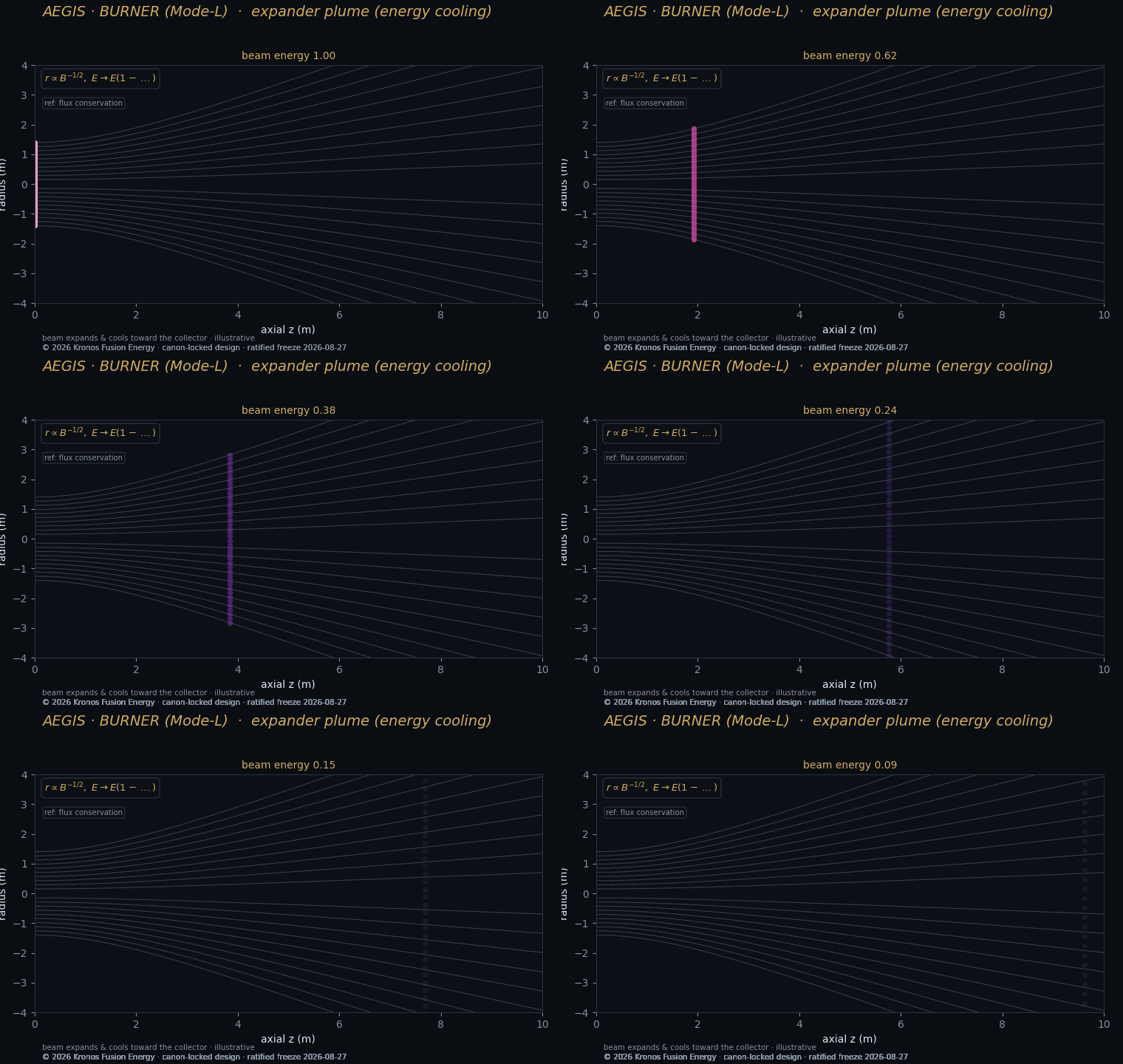
The breeder's control problem is equilibrium and disruption: holding a negative-triangularity (delta -0.30), ELM-free shape at 9.66 MA and 16.84 T peak field, and avoiding disruptions. The burner's control problem is end-plug density and the ambipolar potential: sustaining confinement in an open magnetic bottle with a 26.49 T plug and 17 T throat, and steering charged particles into the direct-energy-conversion train.
Why one architecture is the right choice
A shared stack means a single safety model, one data fabric to certify, and one learning loop to operate across a mixed fleet. The physics-specific intelligence is confined to swappable L3 modules and L5 copilots, so the expensive, safety-critical lower layers are built and validated once. The mappings are detailed in mapping the stack to Hyperion and mapping the stack to the tandem mirror.