Supercomputing for Offline Multi-Physics Monte Carlo
The largest recurring L0 workload: billions of particle histories tracing neutron transport, breeding, and damage through both machines.
Monte Carlo as the L0 workhorse
The single largest recurring workload on L0 is Monte Carlo particle transport. Neutron and photon histories are traced stochastically through detailed 3D models of both machines, scoring the quantities that matter: tritium breeding, energy deposition, activation, and material damage. Because the machines are not built, these campaigns are how their nuclear behavior is currently known.
Why Monte Carlo and not deterministic
Neutron transport in complex, heterogeneous geometry with sharp resonances is where Monte Carlo excels. It handles the breeder's blanket, coolant channels, and structure without the discretization error a deterministic mesh imposes on angle, energy, and space. The cost is statistical noise, which falls only as one over the square root of the history count.
Both machines, different questions
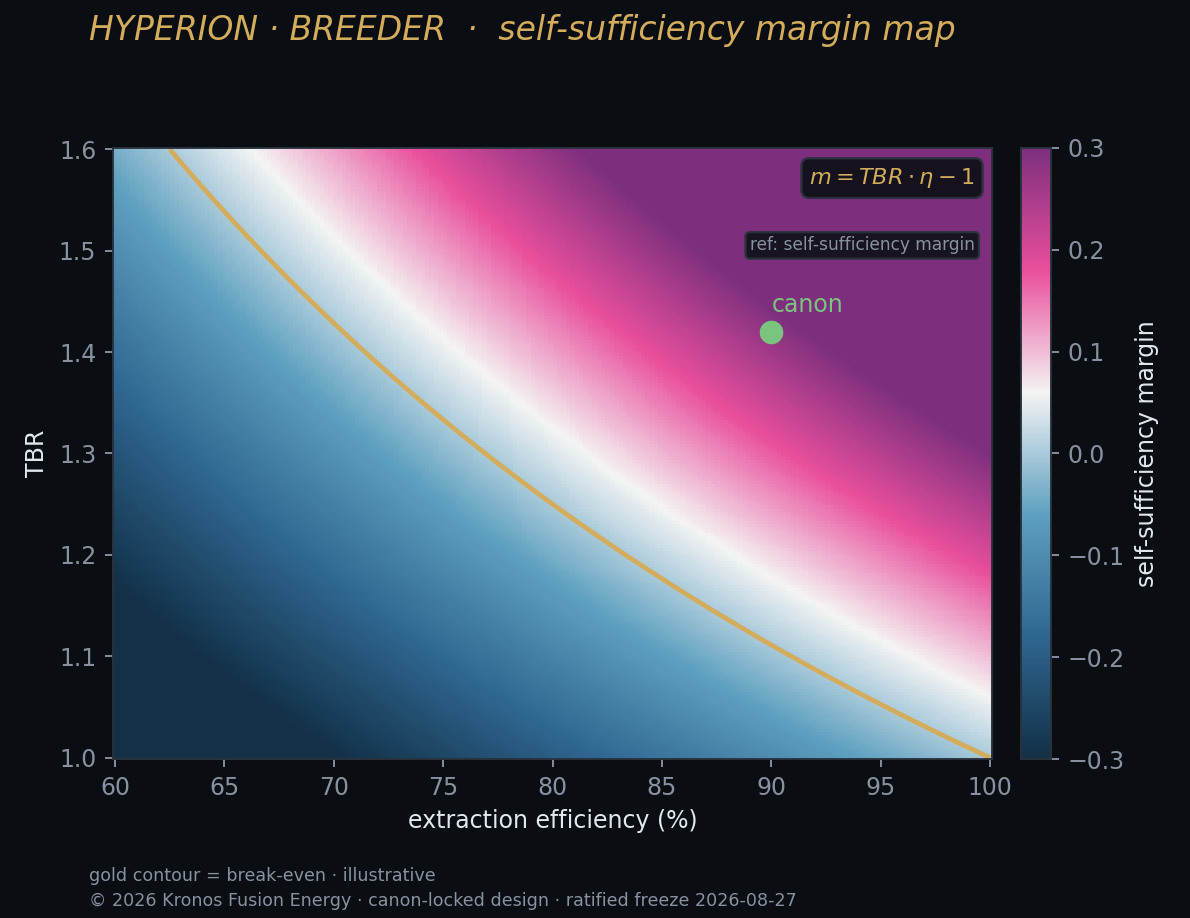
For the breeder (Hyperion), the central question is the tritium breeding ratio, studied as a design lever across 1.1, 1.5, and 1.8, plus 14 MeV neutron flux and blanket heating. For the burner, the question is the 5.44 percent neutron fraction of the D-3He reaction: shielding, activation, and the low but non-zero neutron load on structure and the direct-conversion train.
- Tritium breeding and 14 MeV flux mapping in the breeder blanket
- Nuclear heating for coupling into thermomechanics
- Activation inventories for both machines
- Shielding of the burner direct-conversion train
These runs scale almost perfectly because histories are independent. A campaign fans out across a large node count, each node tracing a batch, with tallies combined at the end. This is the workload that could absorb exascale throughput; the practical limit is the variance target, not coupling.
Every campaign records its cross-section library, geometry hash, and RNG seeds so the result can be replayed. Monte Carlo output does not stay isolated: nuclear heating fields feed the thermomechanics solves, and breeding results feed the fuel-cycle and isotope-balance models, making this the entry point of the multi-physics chain.