14 MeV Neutron Services Scheduling
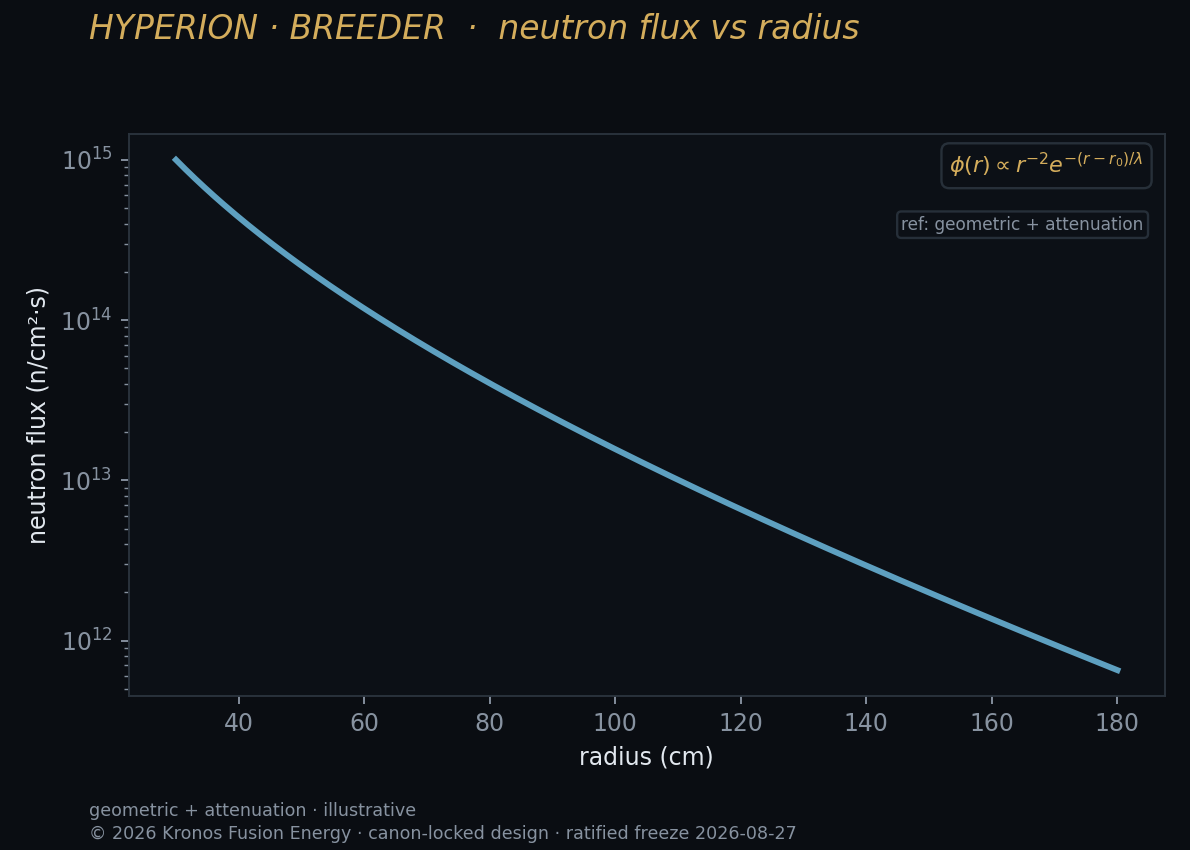
The breeder's 14 MeV neutron flux is a schedulable service for irradiation, testing, and isotope production, arbitrated against tritium breeding.
Neutrons as a service
Beyond isotopes, the breeder (Hyperion) offers its 14 MeV fusion neutrons directly as a service: materials irradiation and qualification, activation-based isotope production, and fusion-relevant testing that no fission or accelerator source reproduces at the same energy and spectrum. L7 exposes irradiation positions as schedulable resources with defined flux, spectrum, and dwell time.
The trade against breeding
Every neutron sent to a service position is a neutron not captured by the lithium blanket for tritium breeding. Neutron services therefore compete directly with the tritium breeding ratio target. L7 makes this trade explicit: a service booking specifies a fluence, and the scheduler checks that fulfilling it keeps the breeding balance at or above the active TBR lever (1.1/1.5/1.8). Bookings that would push TBR below target are deferred or scaled.
# accept a neutron-service booking only if breeding stays on target
def book(service_req):
    fluence = service_req.fluence            # n/cm^2 over window
    diverted = neutrons_for(fluence)
    tbr_after = projected_tbr(diverted)      # twin neutronics
    if tbr_after >= tbr_target():
        return schedule(service_req)
    else:
        return defer(service_req, reason='TBR floor')
Service positions differ in flux and spectrum by location relative to the plasma, so L7 publishes a catalog of positions with their neutronic characteristics from the twin. A customer requests a spectrum and fluence; the scheduler assigns a position and window that meets it without disturbing breeding beyond the allowed lever.
Neutron activation of samples creates radioactive material, so every service creates byproduct-material records for the irradiated articles as they leave the plant, handled through the same compliance data path as isotope shipments.
Neutron services are a design-stage offering: the flux, spectrum, and position catalog are twin-computed. No irradiation is performed before the breeder operates at FOAK ~2030, and the scheduling and TBR-trade machinery is validated now against the neutronics twin.