Mirror Throat Field Supervision
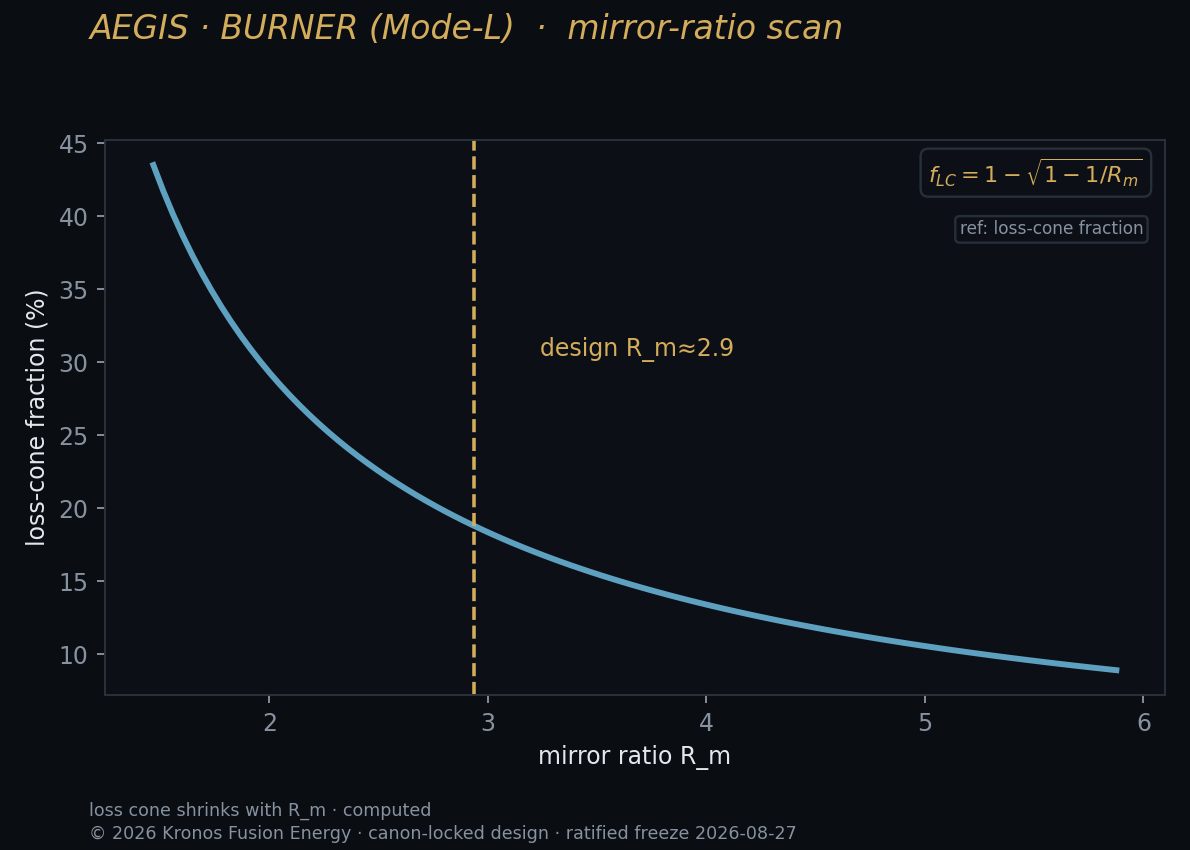
The 17 T throat field sets the mirror ratio that confines the burner plasma; the supervisor guards both the field and the coil producing it.
The throat as a confinement gate
In the tandem mirror, the throat field — 17 T at the burner design point, against the 26.49 T plug — sets the mirror ratio that determines which particles are confined and which escape through the loss cone. The throat supervisor monitors this field and the coil producing it, because a throat that sags changes the confinement physics, and a throat coil that overstresses is a structural hazard like the plug coil.
def mirror_ratio(B_throat_T, B_center_T):
    return B_throat_T / B_center_T

def throat_permit(B_throat_T, target_T, coil_stress_ratio, tol=0.05):
    field_ok  = abs(B_throat_T - target_T) <= tol * target_T
    stress_ok = coil_stress_ratio < 1.0
    return field_ok and stress_ok

# 17 T throat, 3 T center -> mirror ratio ~5.7 (illustrative)
print(round(mirror_ratio(17.0, 3.0), 2))
Coupled to the plug
The throat and plug fields are not independent knobs: the confinement picture depends on their ratio and profile together. The supervisor therefore cross-checks throat and plug states and trips if their relationship leaves the modeled envelope, not just if either exceeds an individual limit. This coupling is why plug and throat supervision are designed as one subsystem.
- Field guard: hold the throat field within tolerance of target.
- Stress guard: keep the throat coil below its material limit, dump on breach.
- Consistency guard: trip if the plug/throat relationship exits the modeled regime.
Because confinement depends on the plug and throat together, the supervisor treats them as a coupled pair and can trip on their relationship even when each is individually inside its own limit. This catches failure modes that per-signal thresholds miss, such as a throat sag that leaves the mirror ratio too low while every scalar reading still looks nominal. The coupled check is set conservatively for the same reason the plug envelope is: the operating regime is far outside anything experiment can yet corroborate.
Like the plug, the throat coil's stress is enforced with the overstress protection discipline and the energy extraction path. Together with the ambipolar potential envelope, throat supervision completes the burner confinement safety set — all designed to respect the burner's open physics gates rather than assume them away.