Magnet Delta-T Quench Precursor
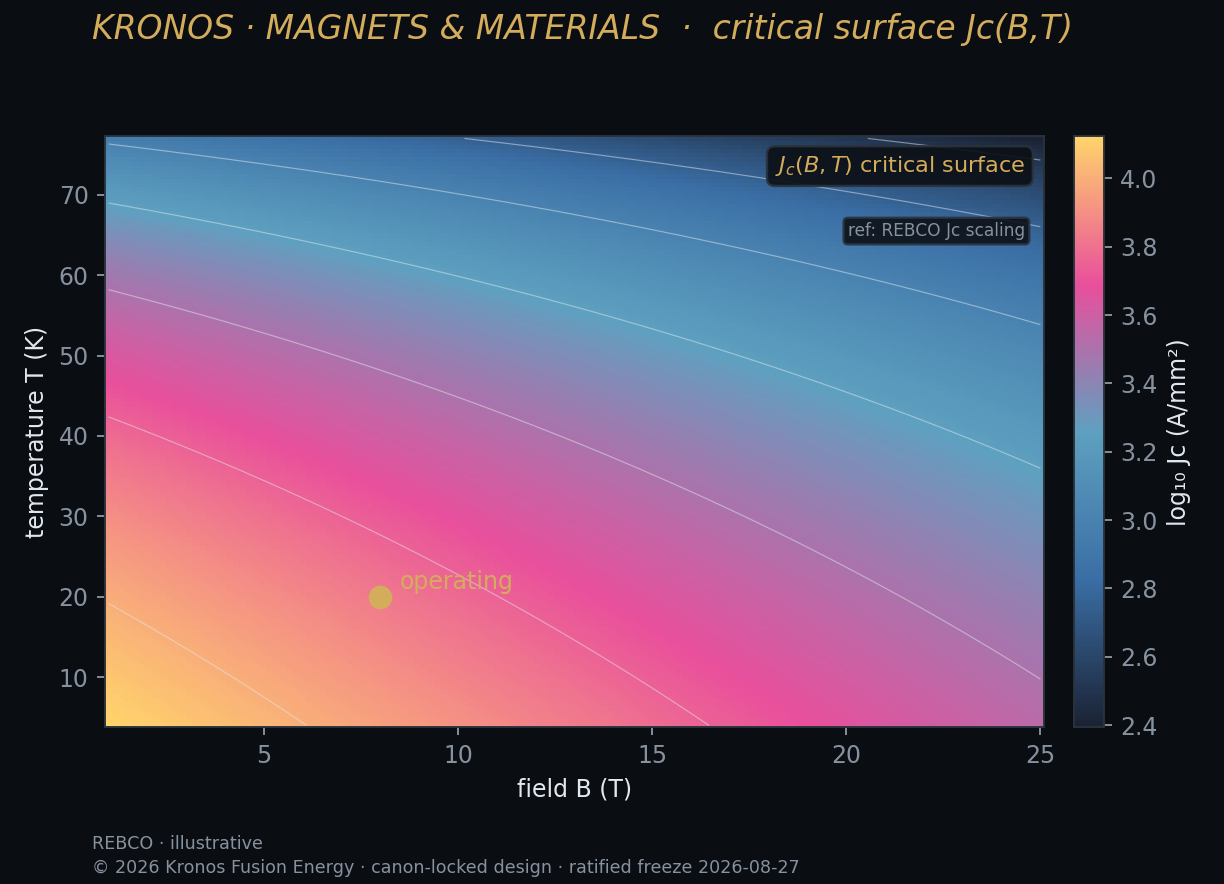
The earliest reliable sign of a quench in a high-field REBCO magnet is a localized temperature rise; L1 senses its rate to trip before a normal zone spreads.
The physics of the precursor
A quench begins when a small region of REBCO conductor exceeds its current-sharing temperature and transitions from superconducting to normal. Ohmic heating in that normal zone raises the local temperature, and the zone can propagate. Because REBCO has a slow normal-zone propagation velocity, detection cannot wait for the zone to grow — the local ΔT and its time derivative are the actionable early signature.
Sensing approach
Kronos co-instruments the winding: distributed fiber thermometry and resistance thermometers report absolute temperature; co-wound voltage taps report the resistive voltage that appears as soon as a segment goes normal. The trip criterion combines a temperature-rate threshold d(ΔT)/dt and a resistive-voltage threshold, so a genuine normal zone is separated from inductive pickup and coolant transients.
Detection math
In the simplest form the balance is C dT/dt = Q_joule − Q_cooling, where a forming normal zone injects Q_joule = I²R_normal locally. The comparator watches for d(ΔT)/dt exceeding a bound that cooling cannot produce, catching the event while R_normal is still small and the current can still be commutated cleanly.
- Temperature-rate threshold catches the thermal runaway onset.
- Resistive-voltage threshold confirms a true normal transition.
- Both are hardwired comparators on the failsafe path — no software.
- The FPGA estimator adds spatial localization for selective response.
Two machines, same hazard
The breeder's toroidal-field and PF coils and the burner's 26.49 T plug / 17 T throat magnets share this hazard and this precursor logic. Thresholds differ with operating field and conductor margin, but the ΔT-rate detection principle is common, feeding the same bypass dump action.