Lithium-Blanket Interface
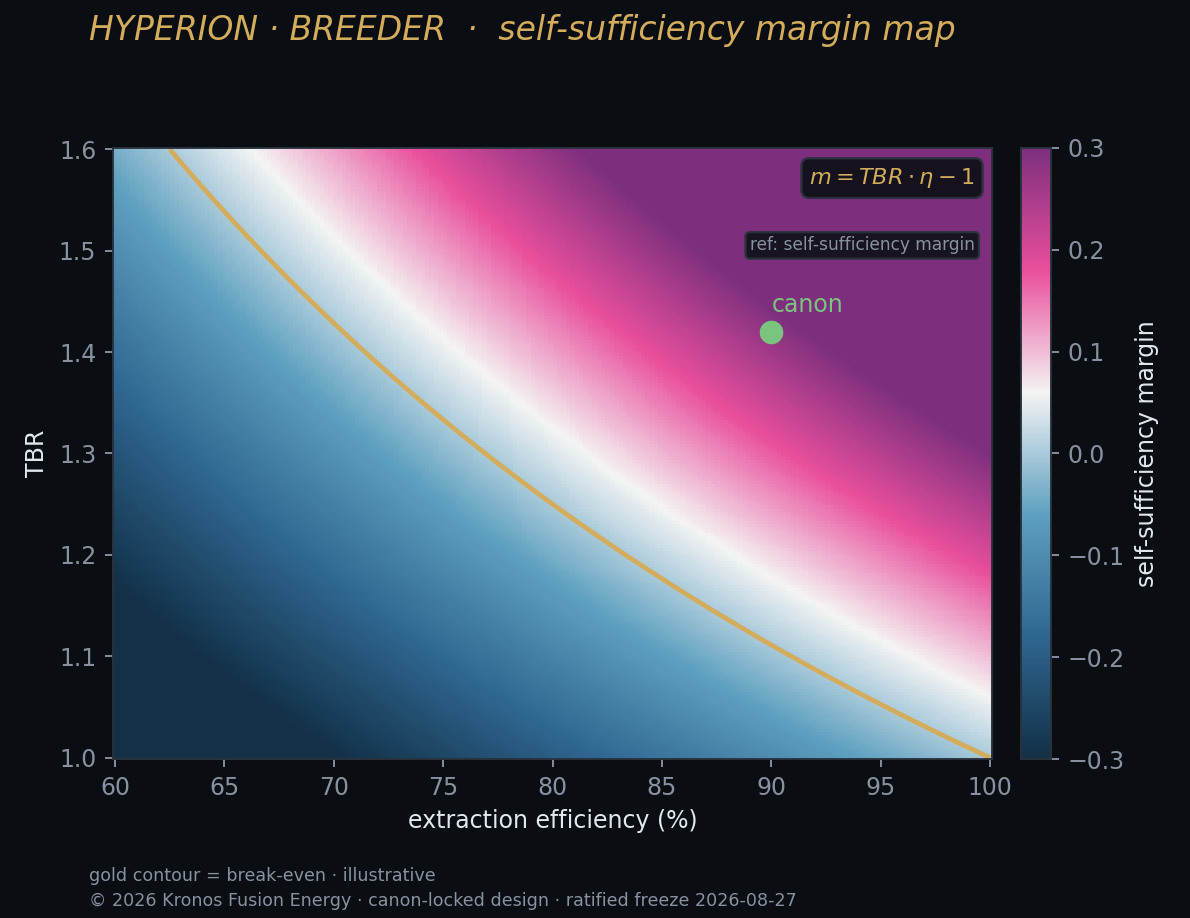
The breeding blanket is a sensed-and-controlled subsystem: coolant, purge, and temperature interfaces set the effective tritium breeding ratio.
Where tritium is bred
The breeder's lithium blanket captures 14 MeV neutrons and breeds tritium via lithium reactions. The design treats the tritium breeding ratio as a lever across 1.1 / 1.5 / 1.8; the blanket interface is where coolant flow, purge-gas cycling, and temperature distribution are sensed and regulated to hold the intended breeding condition.
Interface signal set
- Sense: blanket module temperatures, coolant inlet/outlet, purge tritium partial pressure, neutron fluence.
- Actuate: coolant flow setpoints, purge-gas flow, module isolation valves.
- Cross-link: extraction feeds the tritium plant interface.
# blanket thermal + breeding monitor (L3/L4)
for m in modules:
    if m.T > T_limit: derate_local_power_or_flow(m)
# effective breeding estimate from neutronics + purge assay
TBR_eff = breed_measured / neutron_source_est
reconcile(TBR_eff, TBR_design_lever)
Neutronics coupling
The blanket's breeding performance is inferred by coupling the neutron diagnostics to the twin's neutronics module; purge-gas assay then confirms extracted tritium. The two are reconciled against the design lever. This is where a design assumption (a chosen TBR) meets its measured proxy.
Owner: L4 for the breeding campaign, L3 for thermal regulation, L1 for coolant and isolation trips. Coolant temperature limits protect the structure and the REBCO cold mass behind it. Calibration is accountancy-grade on the tritium side. Design and Validation specification; no bred-tritium claim before FOAK first tritium (~2030).