L3 for the Burner: End-Plug Density
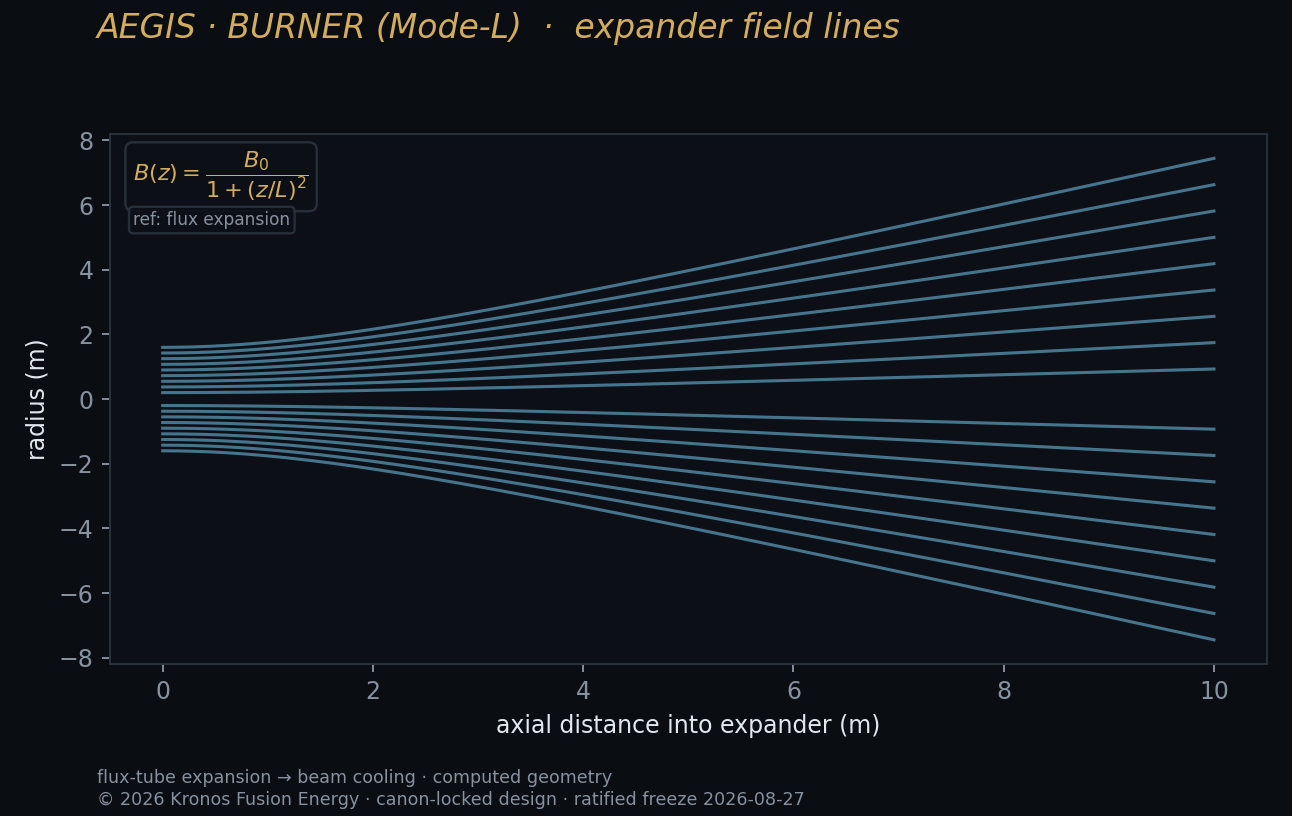
For the tandem-mirror burner, confinement stands or falls on end-plug density, and L3's central task is to hold it against a fast collapse mode.
The burner's defining control problem
The D-3He tandem-mirror burner confines its central cell with an ambipolar potential set by dense end plugs at 26.49 T (17 T throat). Plug density is therefore the master control variable: it sets the confining potential, which sets central-cell confinement, which sets fusion output. Where the breeder's core problem is equilibrium, the burner's is holding plug density in the window that sustains the potential.
How L3 holds it
The ambipolar-potential PINN predicts how plug fueling, heating, and DEC collector potentials move the plug density and the confining potential; plug-density MPC drives those actuators to the target; the stability analysis checks mirror/interchange margins; the shadow projects the potential 50-100 ms ahead. The Power Systems module couples in because the DEC potentials are both an actuator and the confinement boundary.
- Master variable: plug density -> ambipolar potential -> confinement
- Actuators: plug fueling, plug heating (ECH/NBI), DEC collector potentials
- Risk watched: potential erosion that can collapse confinement in tens of ms
- Coupling: shared state with the DEC/Power-Systems controller
The dangerous mode is fast: if plug density falls, the confining potential erodes and central-cell confinement can collapse in tens of milliseconds, faster than a from-scratch MPC replan. Kronos precomputes plug-recovery maneuvers triggered on an anomaly-ensemble precursor (a potential or plug-density signature departing from the shadow), so recovery begins before confinement is lost.
As a design-stage validation pre-FOAK, plug-density control is validated against high-fidelity mirror-confinement models; the burner is a later program element than the breeder, and no net-gain is claimed from this control before hardware. The framework mirrors the breeder's, same PINN/MPC/anomaly machinery, applied to a different confinement physics.