L3 for the Breeder: Disruption Avoidance
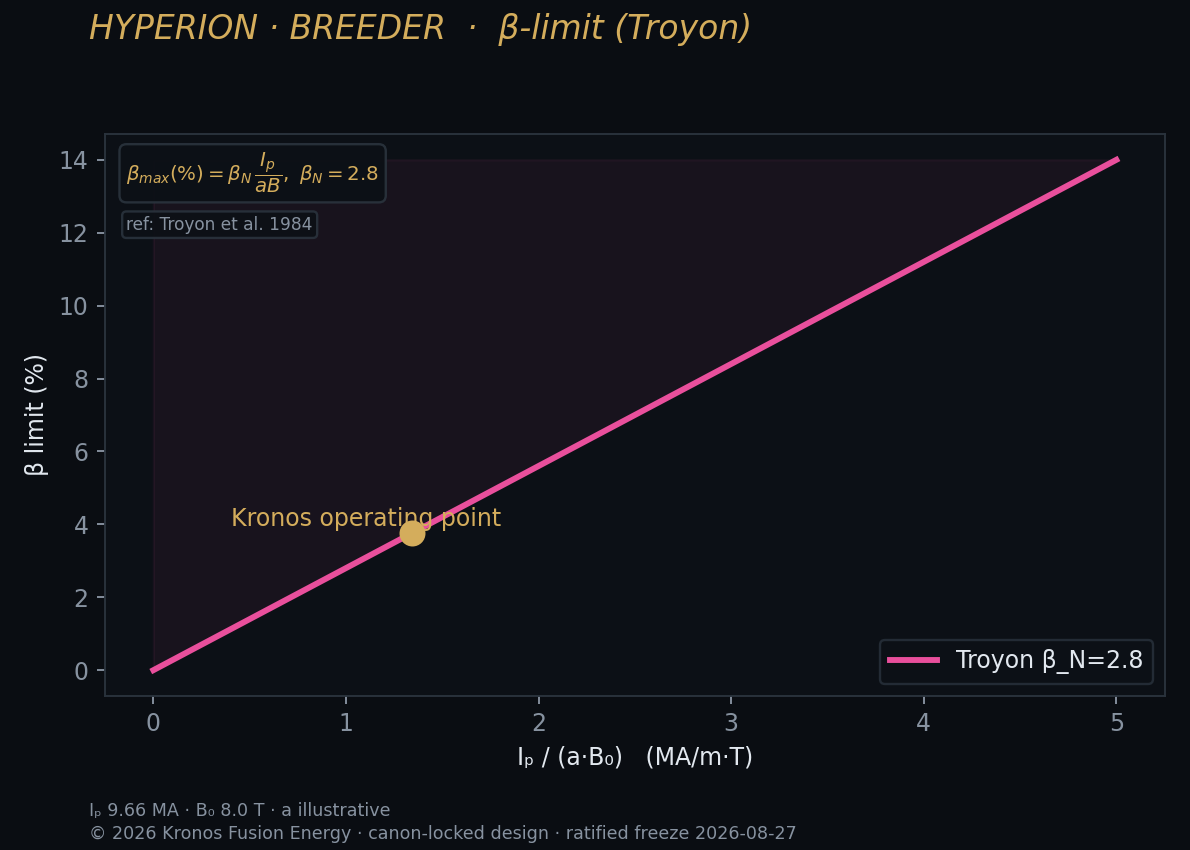
The breeder's highest-consequence event is a disruption; L3 is architected to avoid disruptions early rather than mitigate them late.
Avoidance over mitigation
A disruption suddenly terminates the plasma, dumping thermal and magnetic energy into the structure, the event a 9.66 MA spherical tokamak most needs to avoid. Kronos's L3 strategy is avoidance-first: use the twin's stability margins and the anomaly ensemble's precursors to steer away from disruptive boundaries before they are reached, keeping mitigated shutdown as a fallback rather than a routine tool.
The avoidance chain
- Continuous margins: stability PINN reports distance to MHD and density limits
- Precursor detection: locked-mode, density-limit, vertical-stability signatures
- Labeled mechanism: the ensemble names the dominant approaching limit
- Pre-computed maneuvers: mechanism-specific MPC responses triggered fast
Because disruption precursors give short lead times (milliseconds to hundreds of milliseconds), Kronos pre-computes avoidance maneuvers per mechanism, current/shape adjustment for an approaching locked mode, fueling reduction for a density-limit approach, vertical-position action for an incipient VDE, so the controller triggers a validated response instantly rather than planning under time pressure. The lead-time analysis tells the system which responses are feasible for a given precursor.
Layered fallback
If avoidance cannot succeed in the time available, L3 hands off to a controlled, mitigated shutdown that spreads the energy release as safely as possible; and beneath that, the L1 hardware protection path remains, independent of any model. The layering means the AI buys the lead time to avoid, the mitigation limits damage if avoidance fails, and hardware guarantees the machine is protected regardless.
Pre-FOAK, the avoidance logic is trained and validated on disruption simulations and legacy-device disruption data, then recalibrated on real events after FOAK. The design goal is a machine that spends its operational life avoiding disruptions early, protecting the CrMoNbV vessel and preserving the ELM-free regime.