Instantaneous Q-Value
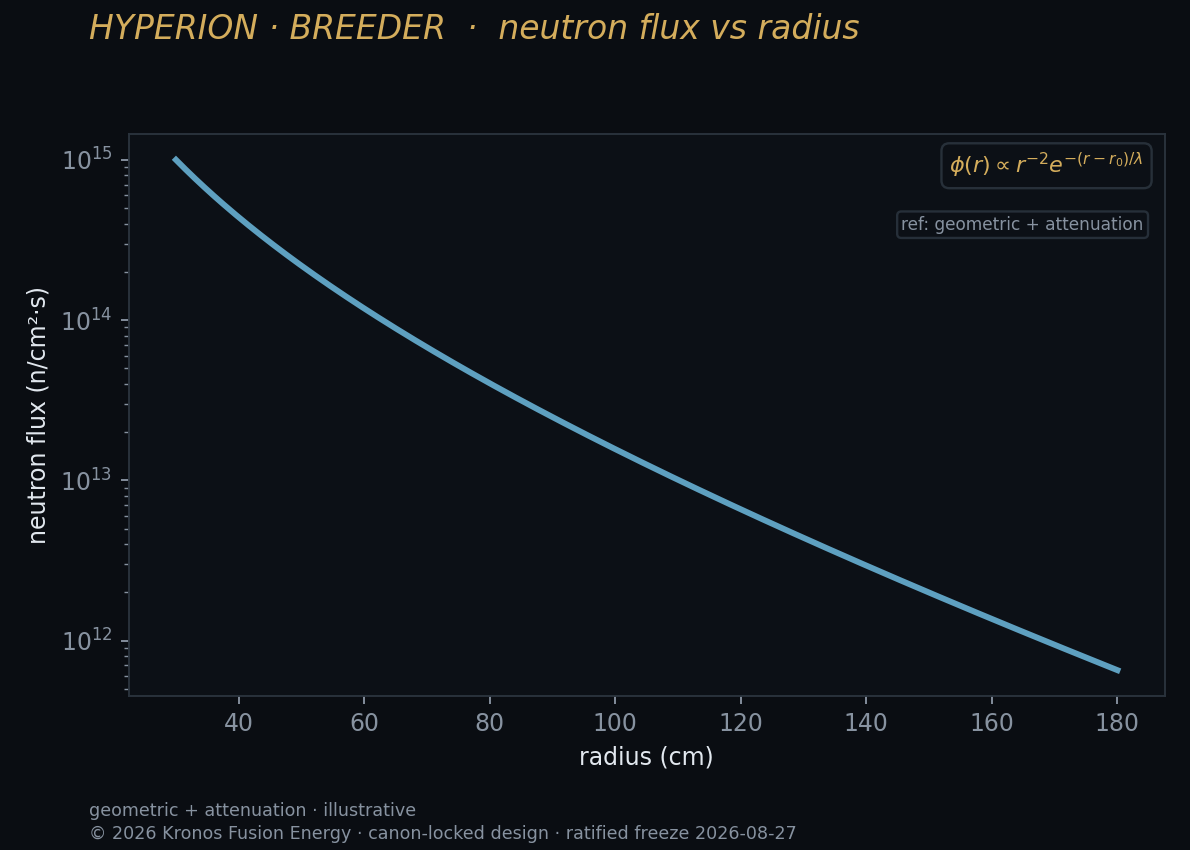
A live estimate of fusion gain fuses neutron flux, input-power, and profile telemetry into the ratio the whole program is judged on.
The definition
The scientific gain Q_sci is fusion power divided by the external heating power coupled to the plasma. The breeder's design point is Q_sci 3.076 at 85.0 MW of fusion power. Computing an instantaneous estimate of this ratio during a shot turns a headline design number into a live control and diagnostic feature.
Fusing the inputs
Fusion power is inferred primarily from calibrated neutron flux (14 MeV for the breeder's D-T reactions), cross-checked against the reconstructed pressure and temperature profiles. Input power is the sum of the coupled heating systems, measured on their own telemetry. The feature fuses these, propagating each input's uncertainty into a confidence band on Q.
def instantaneous_q(p_fusion_w, p_input_w, eps=1.0):
    # p_fusion from calibrated neutron flux + profile cross-check
    # p_input from coupled heating telemetry
    if p_input_w <= eps:
        return None            # undefined during ramp; mask
    return p_fusion_w / p_input_w

# design point sanity check
assert abs(instantaneous_q(85.0e6, 85.0e6/3.076) - 3.076) < 1e-2
Burner form
For the burner, the D-3He tandem-mirror generator, the operationally meaningful gain also accounts for direct energy conversion in the DEC train and the low 5.44% neutron fraction. The feature is defined per machine so 'instantaneous Q' means the physically correct ratio on each, while sharing the same interface to the twin.
Honest by construction
- When input power is near zero during ramp, Q is undefined and the feature is masked, never faked.
- The estimate is a diagnostic feature computed in simulation and, for FOAK, from first tritium near 2030 — not a claim of hardware net gain before then.
- Its confidence band reflects neutron-calibration and profile uncertainty, so downstream models weight it correctly.