GPU Clusters for Millisecond Twin Synchronization
How L0-trained models feed the KRONOS-CTRL twin so its Power, Neutronics, Thermomechanics, and MHD modules run a 50 to 100 ms predictive shadow.
From offline forge to predictive shadow
The KRONOS-CTRL digital twin runs a predictive shadow of the live machine on a 50 to 100 ms horizon, updating its Power, Neutronics, Thermomechanics, and MHD modules continuously. It cannot achieve that horizon by solving the underlying physics from scratch each step. It runs surrogates and PINNs that were trained offline on the L0 GPU clusters and compiled for fast inference.
Why L0 makes millisecond sync possible
A full Grad-Shafranov equilibrium or an implicit MHD stability solve takes far longer than the twin budget allows. L0 pays that cost once, offline, generating training data and fitting surrogates that reproduce the solver output in a single forward pass. The twin then evaluates the surrogate in milliseconds, which is what makes the shadow tractable at 50 to 100 ms.
- Equilibrium surrogates for the breeder negative-triangularity shape
- Fast MHD stability estimators for disruption margin
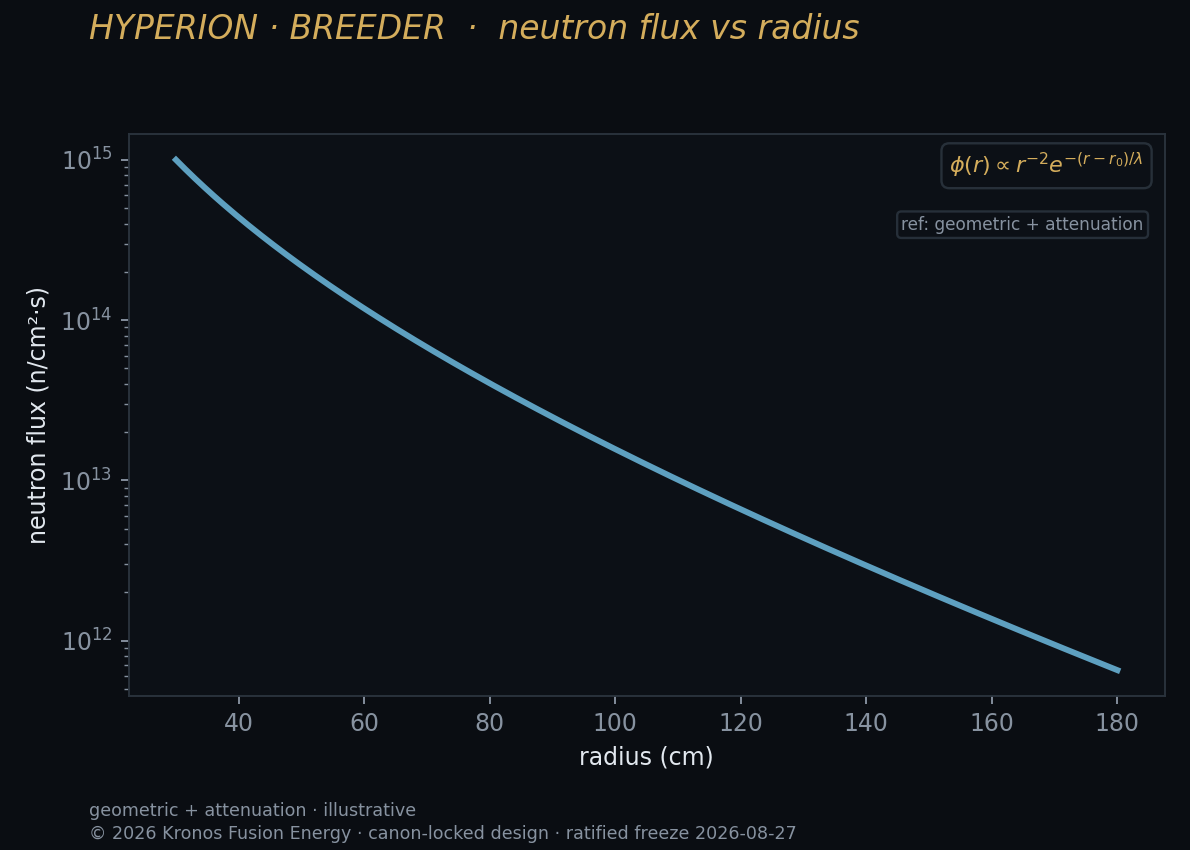
- Neutronics response tables for real-time isotope balancing
- Burner end-plug and ambipolar-potential emulators
Keeping the shadow honest
A surrogate drifts if the machine drifts. The batch retraining pipeline continually re-grounds twin models against fresh pulse histories, closing the loop between the fast twin and the slow foundation. L0 both creates and maintains the twin; synchronization is a standing relationship, not a one-time build.
This applies to both machines. The breeder twin tracks equilibrium, the ELM-free negative-triangularity shape, and disruption margin; the burner twin tracks end-plug density, the ambipolar potential, and the direct-energy-conversion train. Both draw their fast models from the same GPU forge and both are refreshed by the same retraining cadence.
Because the machines are still design and validation until FOAK around 2030, the twin today runs against simulated pulses and archived study campaigns rather than live plasma. The synchronization machinery is being validated now so that it is trustworthy the moment real pulses begin.