Engineering Copilot: Superconducting Magnet Health Reasoning
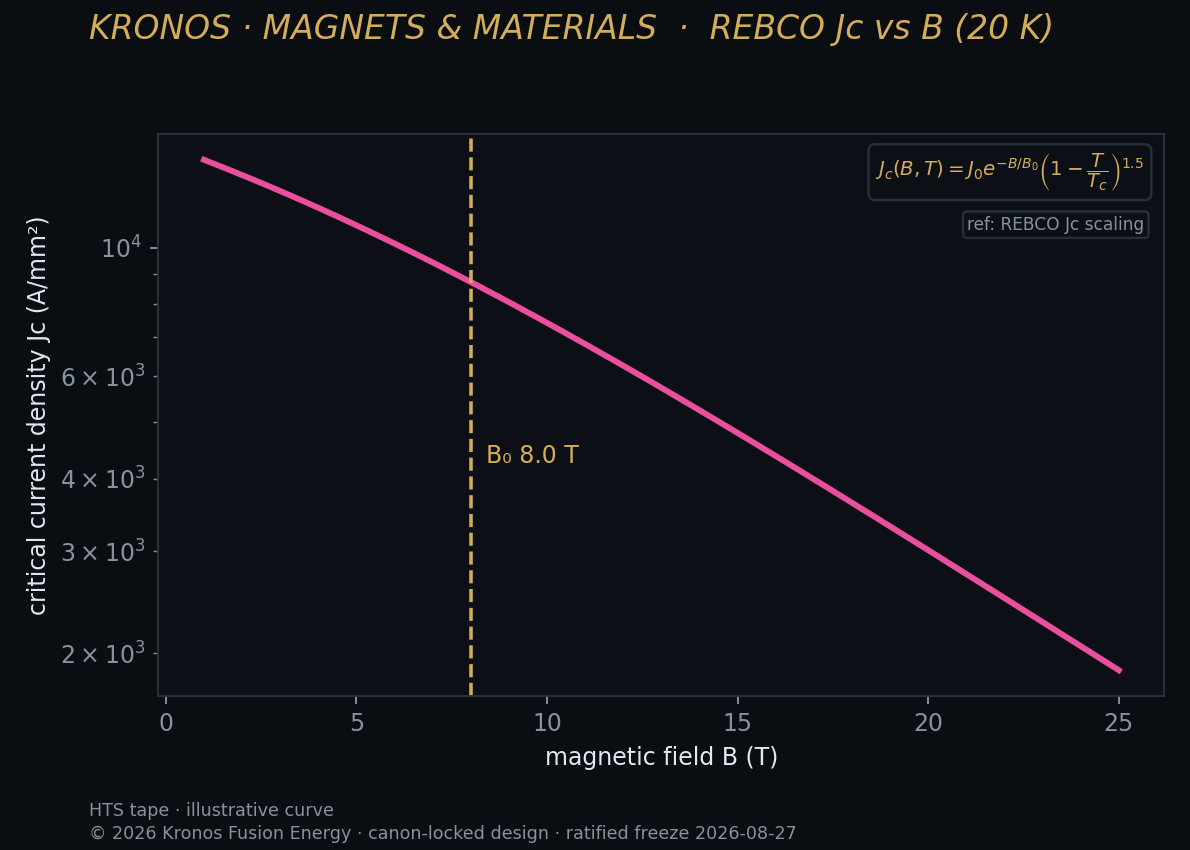
Reasoning over REBCO strain, temperature margin, and quench precursors for the breeder's 16.84 T magnets and the burner's 26.49 T plug coils.
The highest-consequence subsystem
The superconducting magnets are the highest-consequence engineered subsystem on both machines: 16.84 T peak field (8 T on-axis) on the breeder (Hyperion), and 26.49 T plug with 17 T throat on the burner (Aegis / MetroVolt). A quench that is not detected and dumped in time can destroy a coil. The Engineering Copilot provides the slow-timescale reasoning layer above the hardware quench-detection and dump systems.
Division of responsibility
Fast quench detection and the energy dump are hardware functions with microsecond-to-millisecond authority — the copilot never owns them. The copilot reasons on the seconds-to-hours timescale: tracking strain accumulation, temperature-margin erosion, delta-T patterns across pancakes, and joint-resistance trends that predict where a quench becomes more likely, so that operating limits and maintenance can be adjusted before the fast layer must act.
- REBCO strain versus the irreversible-strain limit, with margin and trend
- Temperature margin to the current-sharing temperature Tcs
- Magnet delta-T precursor patterns from distributed sensing
- Joint and lead resistance drift over the campaign
magnet_health(coil):
  T_margin = Tcs(B, I, eps) - T_meas      # current-sharing margin
  strain   = eps_meas vs eps_irrev_limit
  dT_map   = distributed_dT(coil)         # hotspot localization
  risk     = quench_precursor_model(T_margin, dT_map, dR_joint)
  if risk rising: propose lower I_op or inspection (via L4)
  return report(T_margin, strain, dT_map, risk, UQ)
When the copilot's reasoning indicates eroding margin it proposes a reduced operating current or an inspection window — a proposal routed through L4, never an autonomous derating. It grounds every conclusion in the strain and quench sensing telemetry and the magnet thermomechanical model, and it defers to hardware for anything on the fast protection path. See also delta-T precursors and hardware quench detection.