Disruption Prediction and Mitigation
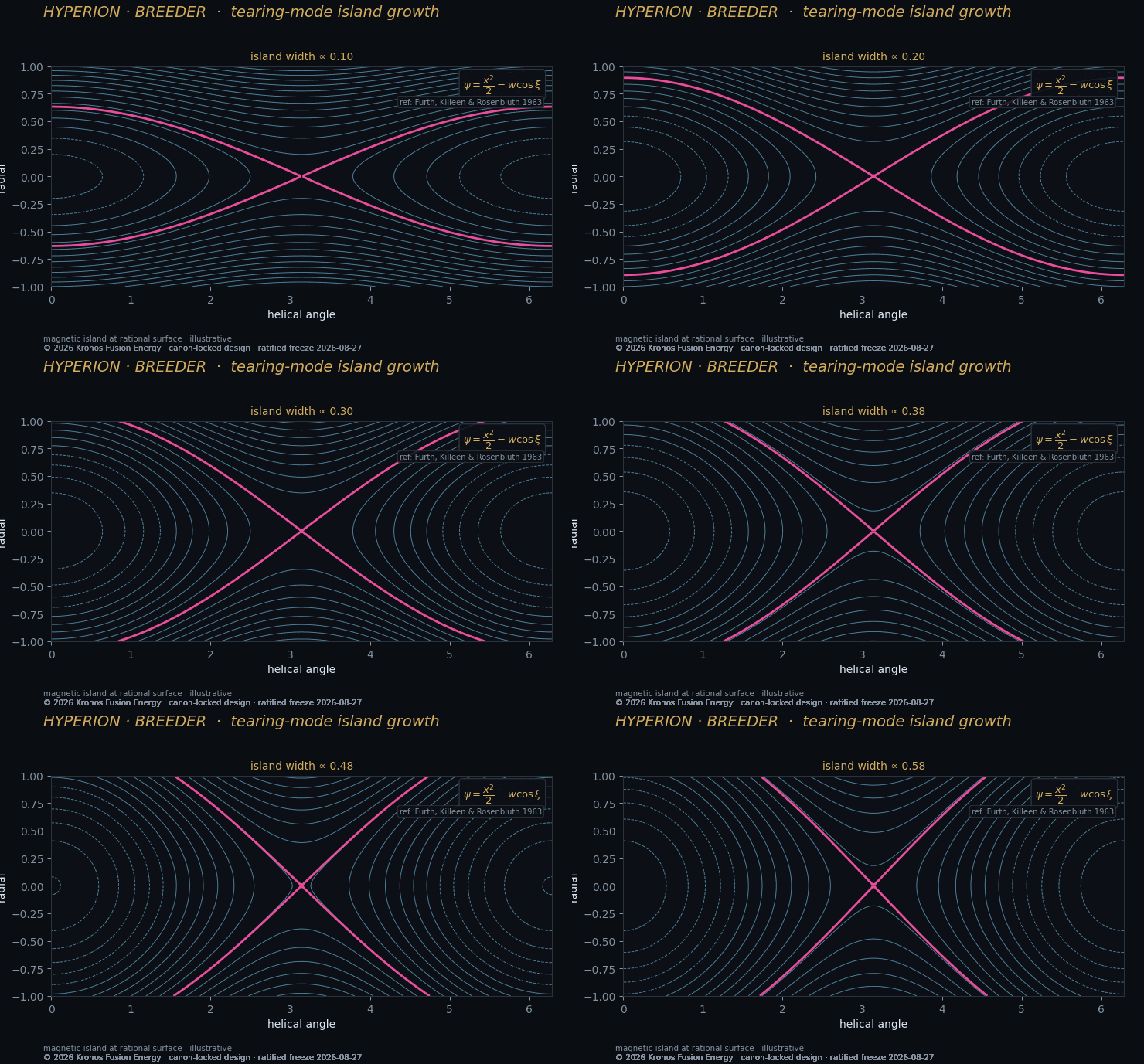
The breeder's fast-loop resiliency problem: predict a tokamak disruption early enough to soften it, at delta -0.30 and 9.66 MA.
The tokamak-specific hazard
A disruption is a sudden loss of plasma confinement that dumps thermal and magnetic energy into the machine on a millisecond scale. For the breeder (Hyperion) at 9.66 MA and negative triangularity delta -0.30, an unmitigated disruption imposes large electromagnetic and thermal loads and can generate runaway electrons. Prediction and mitigation is therefore the breeder's tightest fast-loop resiliency task.
Predict early, act decisively
Prediction uses a model trained on precursor signatures - magnetics, radiated power, mode activity - to estimate disruption probability with enough lead time to act. The value is lead time, not just accuracy: a correct warning 1 ms before is useless, 30 ms before allows mitigation. The model runs inside the fast-loop budget as a bounded-operation evaluation.
def disruption_step(features, model, warn_ms_needed):
    p, ttd_ms = model.predict(features)   # prob, est time-to-disruption
    if p > P_HIGH and ttd_ms < warn_ms_needed:
        return trigger_mitigation()       # massive gas / shattered pellet
    if p > P_WATCH:
        return derate_scenario()          # back off toward safer point
    return 'nominal'
Mitigation choices
- Preemptive soft stop: ramp the scenario down before the disruption develops
- Impurity injection: radiate the thermal energy uniformly to protect the wall
- Runaway avoidance: manage the current quench to suppress runaway electron beams
Honest limits
Pre-FOAK there is no Hyperion disruption dataset, so the predictor is trained on spherical-tokamak physics and simulation and cross-machine data, with calibrated uncertainty. It is explicitly a design and validation capability; its false-alarm and missed-detection rates are reported as modelled, not measured. It feeds the shot lifecycle and defers to safe states when uncertain.