Twin-Governed Fuel Cycle and Isotope Balance
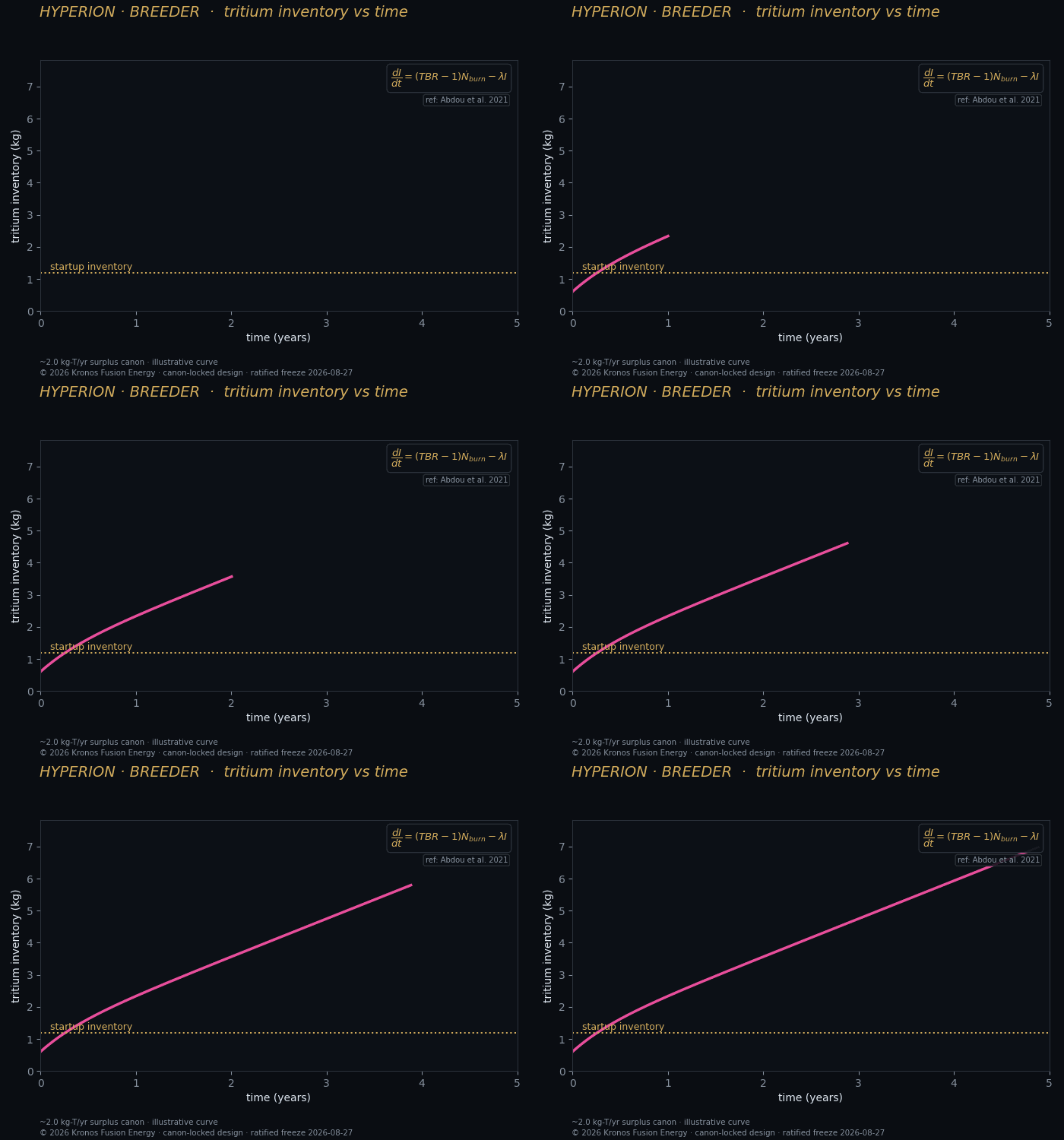
The KRONOS-CTRL twin tracks the tritium and helium-3 balance in real time so the breeder's fuel cycle stays closed and its isotope products are accounted.
The fuel cycle as a controlled loop
The breeder is a D-T machine that must supply its own tritium and produce a surplus, roughly a 4 kg/yr tritium class plus about 1.97 kg/yr helium-3, alongside 14 MeV neutrons. That requires closing the fuel cycle: tritium bred in the blanket must at least replace tritium burned, with the tritium breeding ratio treated as a design lever across 1.1 / 1.5 / 1.8. The twin governs this as a real-time isotope balance.
What the twin tracks
- Burn: tritium consumed, inferred from neutron output and plasma state
- Breeding: tritium produced in the blanket, from the Neutronics module and TBR
- Inventory: running tritium and helium-3 inventory across the fuel loop
- Products: helium-3 accumulation and 14 MeV neutron output accounting
The Neutronics module supplies the source and breeding terms, and the fuel-cycle controller balances fueling, processing, and inventory so the loop stays closed with the chosen TBR margin. Helium-3, a decay product of tritium, is tracked as an accumulating product; the neutron output is accounted for both as a product and as the driver of blanket breeding and material activation.
Isotope-balance drift is watched by the anomaly ensemble: a breeding-to-burn ratio departing from the expected TBR, or an inventory trend that does not close, indicates a fuel-cycle problem (a processing issue, a blanket anomaly) that the twin flags before inventory is compromised. Because a D-T machine must not lose control of its tritium inventory, this accounting is safety- and mission-critical, not just bookkeeping.
All of this is described in physical terms, kilograms of isotope, breeding ratios, neutron flux, with no economic content whatsoever; the fuel-cycle copilot's role is operational balance and accounting, never commercial value. Pre-FOAK the balance model is validated against neutronics simulation, to be synchronized with real inventory measurement once FOAK operates ~2030.