Burner Diagnostic Port Map
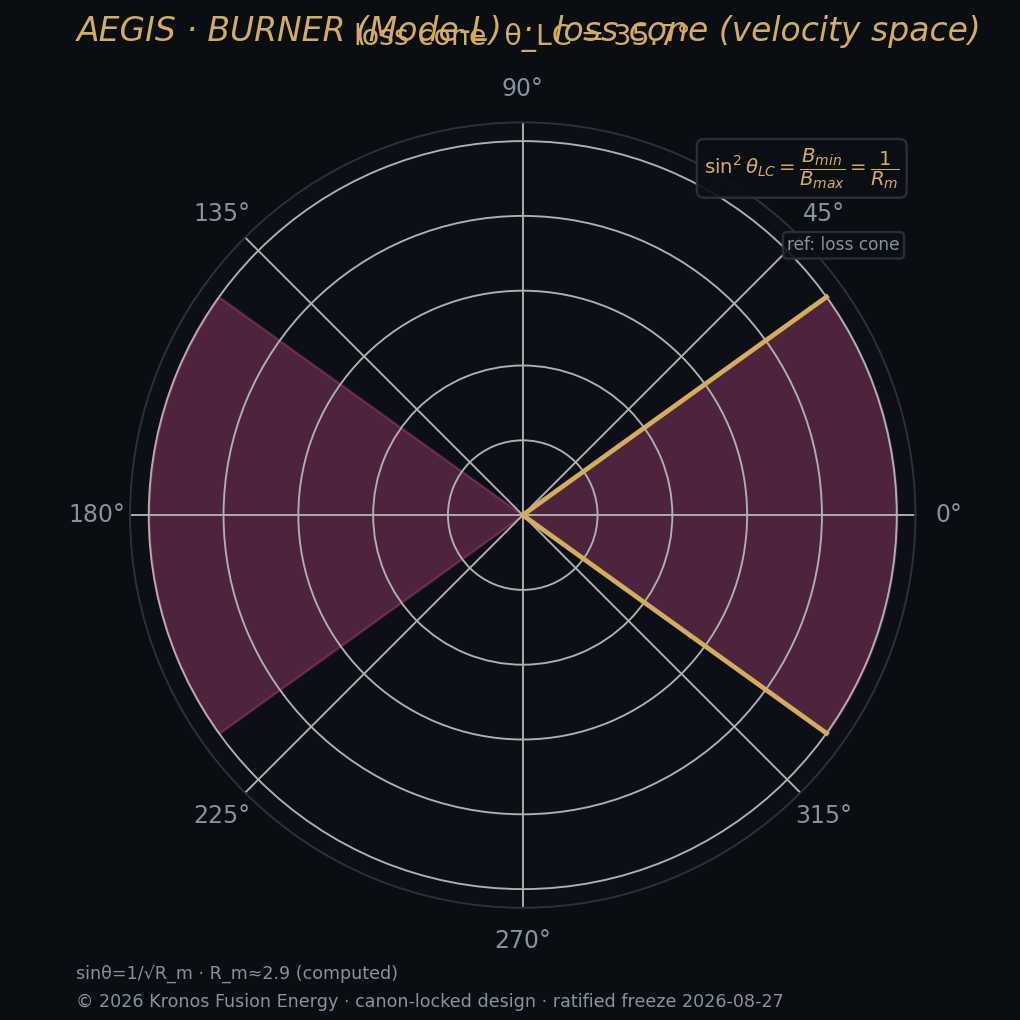
The burner's ports are organized along the machine axis - central cell, throat, plug, expander - because confinement is axial, not toroidal.
An axial machine
The burner (Aegis / MetroVolt) is linear: plasma sits in a central cell between two end plugs. Its diagnostic ports are therefore mapped along the axial coordinate z rather than to flux surfaces. Density, potential, and field are functions of position along the axis, and the port map reflects that geometry.
Port classes by region
| Region | Key diagnostics | Controls served |
|---|---|---|
| central cell | interferometry, neutron | fueling, power |
| throat | field probes, thermography | plug field |
| plug | density, emissive probe | plug density/potential |
| expander | end-loss analyzer, IR | DEC feed, heat load |
The plug and expander regions are the most heavily instrumented because they hold the two hardest-to-observe quantities: the plug density/potential that confines the machine, and the ion energy spectrum arriving at the direct-energy-conversion collectors.
# axial channel registration
for ch in ports:
    z   = geometry[ch].axial_position
    reg = region_of(z)                 # central/throat/plug/expander
    channel_map[ch] = (z, reg)
Observability under the regime gate
A blunt honesty note: the plug regime is 166–830× beyond any operated device, so several plug diagnostics have no calibration precedent at these conditions. The port map records this by tagging plug-region channels with elevated uncertainty, so the twin never treats an un-precedented reading as ground truth.
Owner: L2 for registration and timestamping; L3 for axial-profile assembly. Design and Validation specification; the burner is not built.