Burner Plug & Potential Telemetry
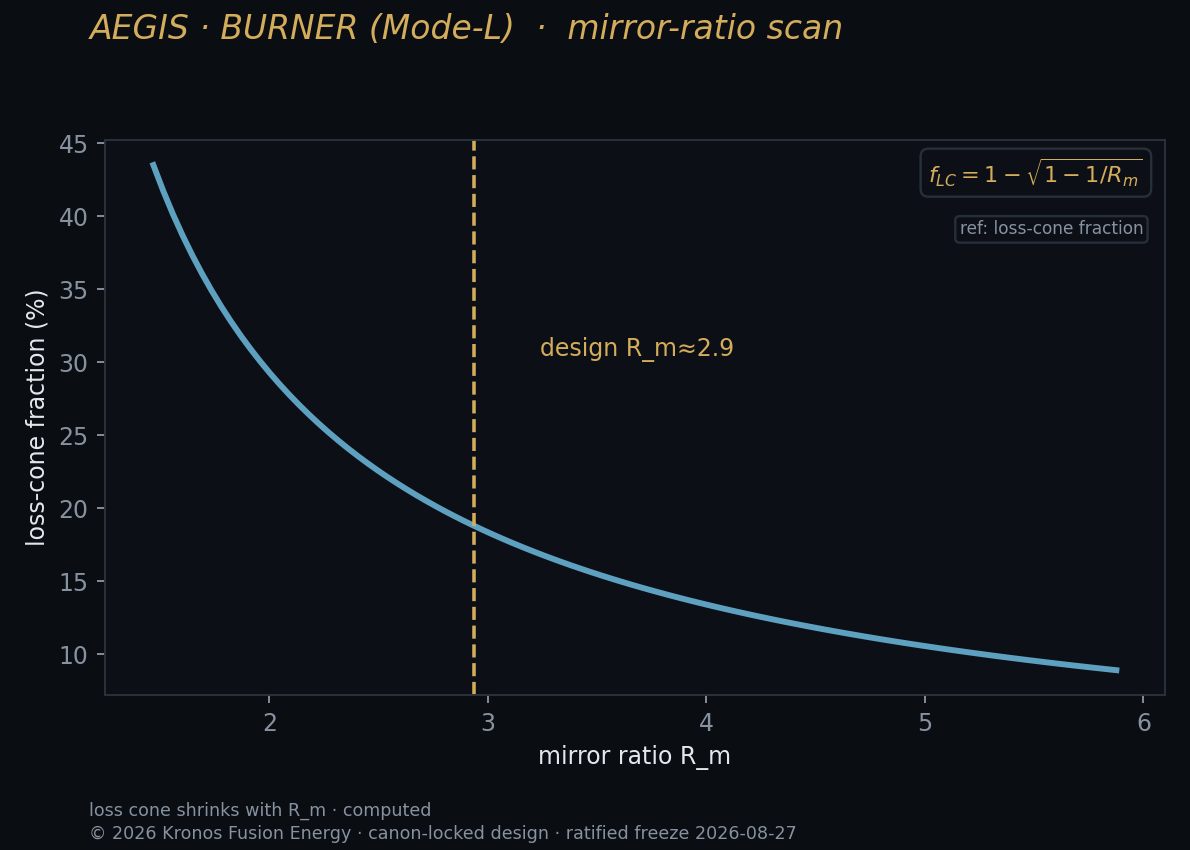
The burner's control problems live in the end plugs — density and ambipolar potential — and this telemetry set is where the fabric watches them.
The tandem mirror's crux
The burner is a D-3He tandem-mirror generator. It confines plasma in a central cell between two high-field end plugs (26.49 T plug field, 17 T throat) that create an electrostatic ambipolar potential to plug particle loss along the field. Its control problems are the end-plug density and that ambipolar potential — if either weakens, confinement degrades. This telemetry set watches both.
End-plug density
- Interferometry chords and localized density diagnostics at each plug track the plug density directly.
- A plug density falling toward threshold is a primary precursor feature.
- The two plugs are monitored symmetrically so an asymmetry is caught early.
- Density telemetry couples to the fueling and heating actuation on L1.
Ambipolar potential
The ambipolar potential is the electrostatic barrier that plugs the mirror. Potential telemetry — from probes and inferred from the plasma state — is engineered into a feature the twin and copilots track. A dropping potential warns of confinement collapse and is one of the burner's key precursor signatures.
Into the DEC train
What escapes the mirror along the field flows into the direct energy conversion train, so the plug and potential telemetry directly inform the DEC feed (see DEC train telemetry). The fabric treats plug density, ambipolar potential, and DEC input as a coupled set. These are design and validation specifications; the machines are not yet built.