Burner Control Problems
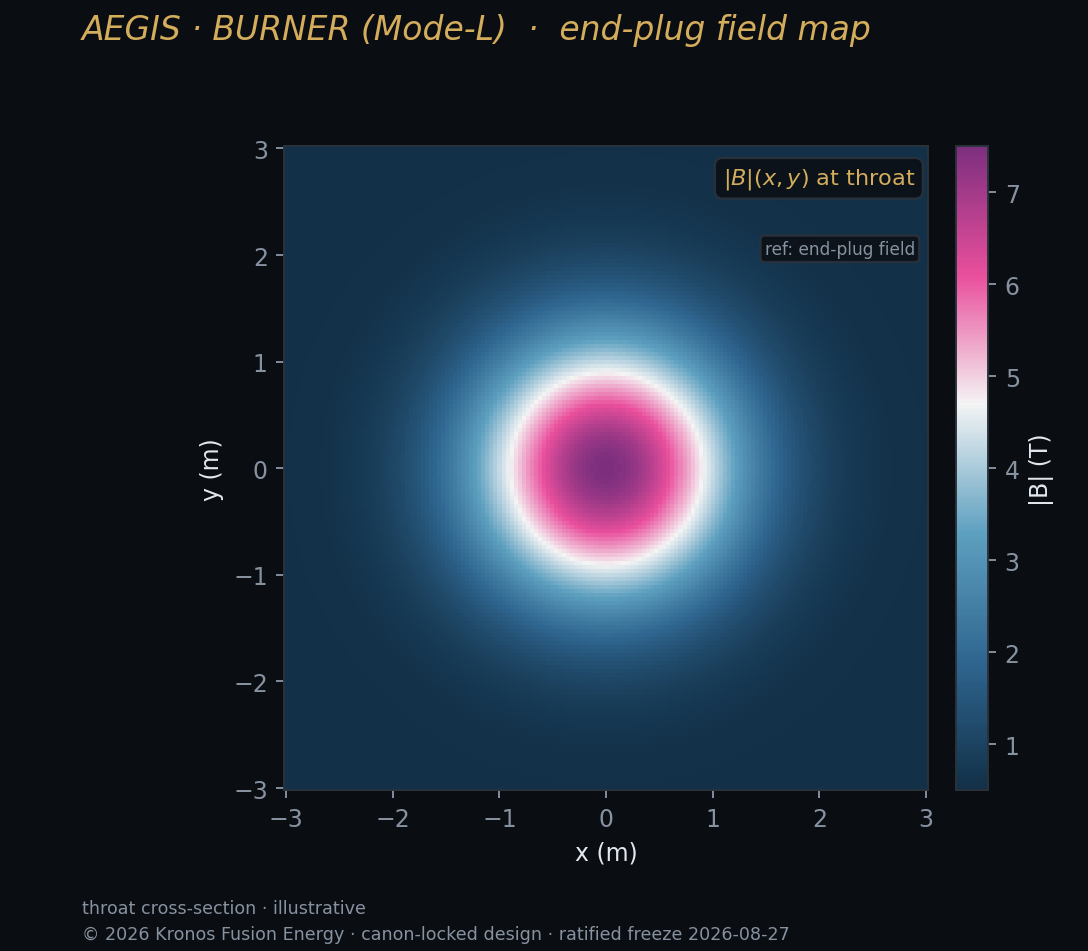
For the tandem mirror, the challenges are end-plug density, the ambipolar potential, and steering charged particles into the direct-energy-conversion train.
What the burner must control
The burner (Aegis / MetroVolt) is a D-3He tandem-mirror generator with a 26.49 T end-plug field, a 17 T throat, and a low neutron fraction of 5.44%. Its control problems are those of an open magnetic system, quite different from a tokamak's, and they center on holding the ends and converting the output.
The three core problems
- End-plug density — sustaining the high-density plugs that confine the central-cell plasma.
- The ambipolar potential — maintaining the electrostatic potential profile that plugs ion loss.
- Direct energy conversion — steering the escaping charged-particle flux into the multi-modal DEC train.
The ambipolar potential
Confinement in a tandem mirror is electrostatic as much as magnetic. The end plugs raise a potential that reflects central-cell ions; the balance between electron and ion losses sets the profile, and the control loop must hold it:
# Ambipolar (Boltzmann) relation for the confining potential
# n_plug / n_center = exp( e * phi_c / T_e )
# phi_c : central-cell confining potential   T_e : electron temperature
# The plug density sets phi_c; the loop holds phi_c against fluctuations.
Low-neutron, not aneutronic
D-3He is a low-neutron fuel — 5.44% of the power appears as neutrons — not an aneutronic one. That residual neutron flux is a diagnostic and a materials input, tracked by the twin's Neutronics module. p-11B remains a gated research endpoint; there is no p-6Li main burn. The DEC train's job is to convert the dominant charged-particle output directly.
These problems map onto the shared stack in mapping to the tandem mirror, and the conversion side in the DEC train.